

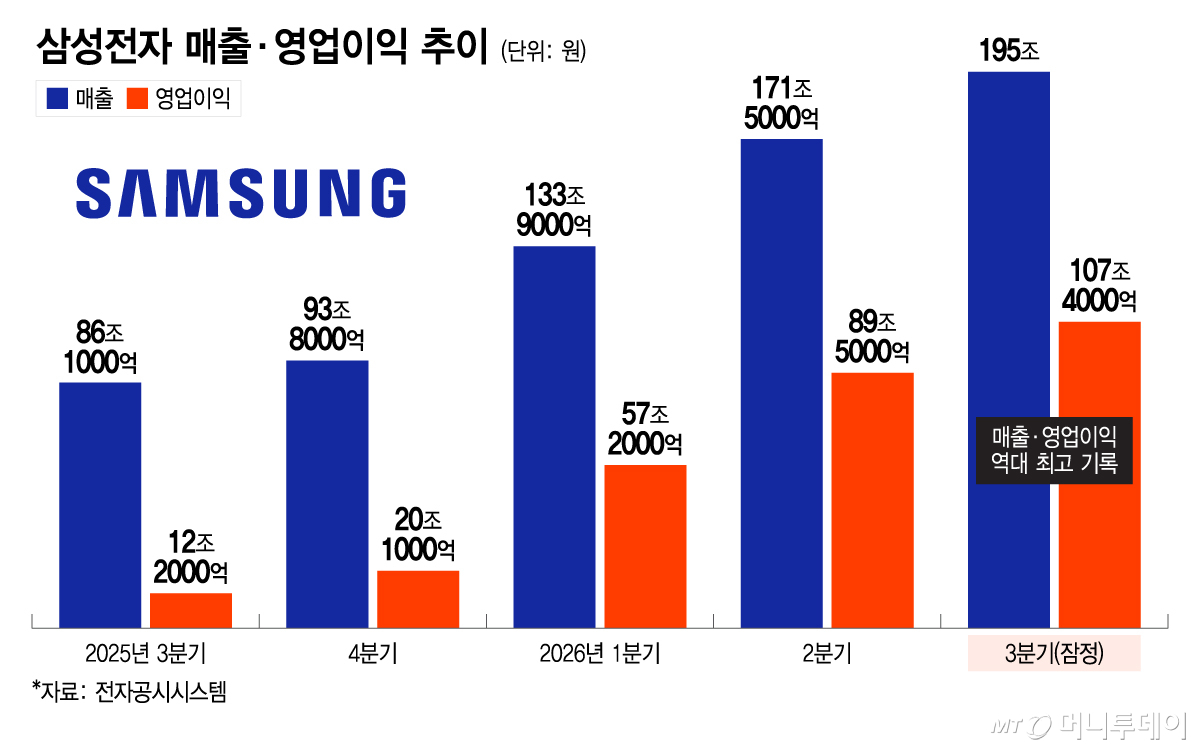
Although Samsung Electronics has opened the era of 100 trillion won quarterly operating profit for the first time in its history, expectations are growing that the peak in earnings has yet to be reached. An expansion in High Bandwidth Memory (HBM) supply and price increases are expected to occur simultaneously next year. The ongoing competition among global big tech companies for AI (artificial intelligence) infrastructure investment is also a factor boosting earnings expectations.
Samsung Electronics announced on the 8th that its cumulative operating profit for the first three quarters of this year was provisionally tallied at 254 trillion 130 billion won. This represents a 10.8-fold increase compared to the same period last year. Cumulative revenue for the same period rose by more than double to 500 trillion 370 billion won. The majority of the profit was generated from the memory business.
In the third quarter alone, it recorded an operating profit of 107 trillion 400 billion won, becoming the first global tech company to enter the era of 100 trillion won quarterly operating profit. By simple calculation, this equates to an average daily operating profit of approximately 1 trillion 170 billion won. This significantly exceeds Nvidia's record-high quarterly operating profit of $63.734 billion (approximately 85 trillion 470 billion won) recorded in the previous quarter.
The market is already looking ahead to next year. Expectations for next year's earnings are higher than those for this year, which posted record-high results. According to financial information provider FnGuide, domestic securities firms estimate Samsung Electronics' annual operating profit for next year to reach 554 trillion won. This amounts to an average of 138 trillion 500 billion won per quarter. It is a scale 50% larger than this year's estimated annual operating profit (370 trillion won).
This is because demand for HBM and server DRAM is growing rapidly due to expanded AI infrastructure investment, but production capacity expansion is failing to keep pace with the rate of demand growth. Micron predicted in its earnings announcement at the end of last month that "memory and storage supply and demand will become much tighter next year and in 2028 than this year."
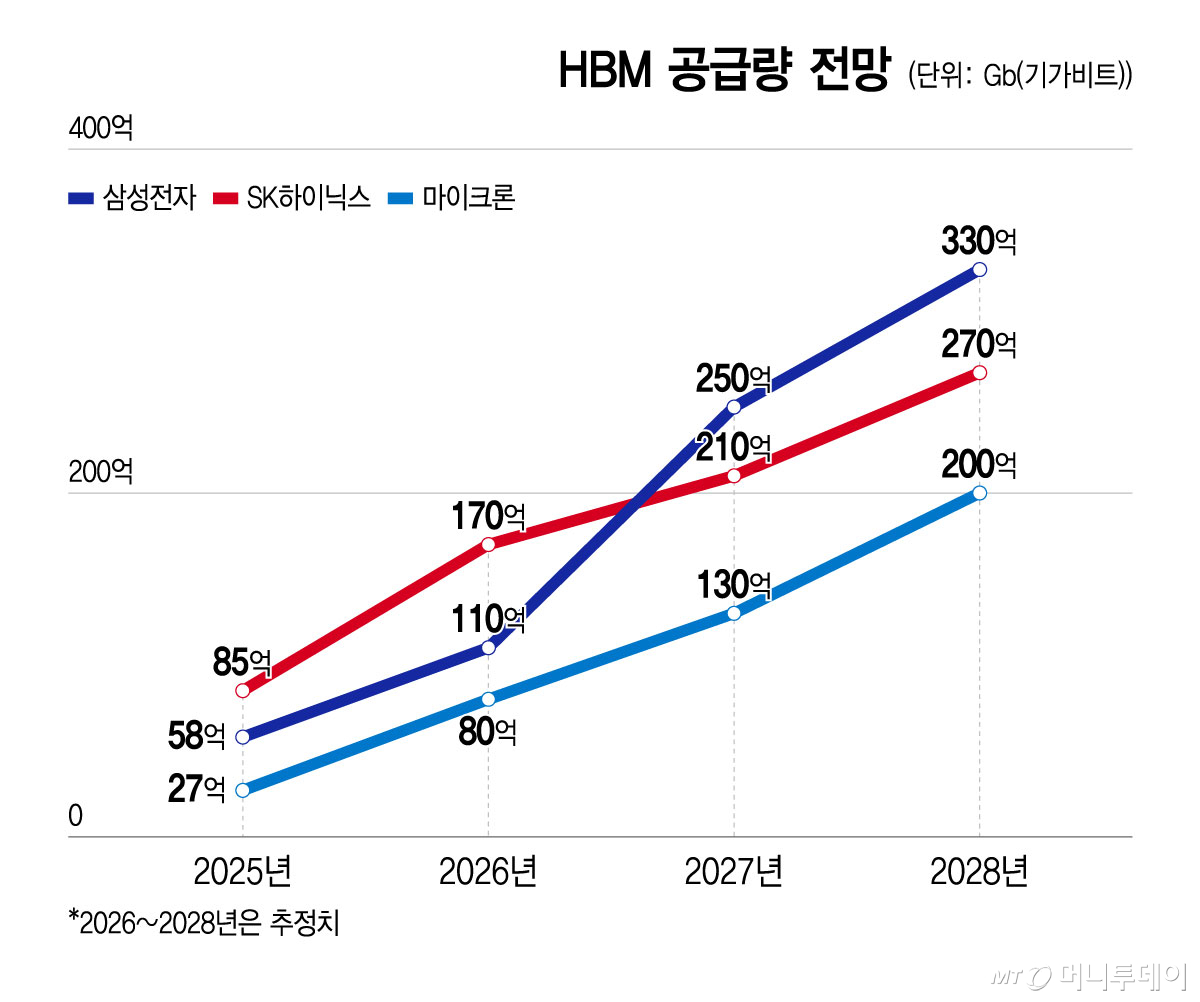
The expansion of Samsung Electronics' HBM supply is also expected to be fully reflected in earnings starting next year. Global investment bank Citi predicted that Samsung Electronics' HBM supply volume will increase by approximately 2.3 times this year to 25 billion Gb (gigabits) next year, allowing it to take the top spot in market share. Forecasts also indicate that the shipment ratio of high-value-added products in the HBM4 (6th-generation HBM) series will rise from approximately 40% this year to around 80% next year.
Price increases are expected to be added to volume expansion. Market research firm TrendForce forecasted that the blended average selling price (ASP) of HBM will rise by 121% next year compared to this year. This is due to the continued supply shortage, the expanding share of relatively higher-priced HBM4, and the full-scale supply of HBM4E (7th-generation HBM) in the second half of next year.
Memory manufacturers such as Samsung Electronics are also holding the upper hand at the price negotiation table. Customers, for whom securing stable volumes has become important, are paying advance deposits to enter into Long-Term Agreements (LTAs). Samsung Electronics is also pursuing a strategy to secure stable sales channels through long-term contracts of 3 to 5 years while maintaining high profitability.
The expansion of HBM production is also increasing pressure on general-purpose DRAM prices. This is because HBM and standard DRAM compete for limited wafer production capacity. HBM also consumes more wafers than standard DRAM. As the proportion of HBM production increases, the production capacity that can be allocated to general-purpose DRAM, such as server DDR5 (Double Data Rate 5), decreases relatively. The structure is such that increased HBM demand leads to a shortage of general-purpose DRAM supply and price hikes, thereby boosting overall memory profitability.
AI infrastructure investment is also expected to expand for the time being. PwC believes that global data center investment will exceed $1 trillion (approximately 1340 trillion won) next year. It is projected that cumulative investment over the five years until 2030 will reach $5.15 trillion (approximately 6900 trillion won). In particular, since equipment such as GPUs (Graphics Processing Units) and servers requires replacement every 4 to 6 years, there is a high possibility that AI infrastructure investment will not be a one-time event but will generate continuous memory demand.
It will also be difficult to resolve the supply shortage in the short term. Although major memory companies such as Samsung Electronics and SK Hynix are moving to expand production capacity, it takes considerable time for new fabs (factories) to translate into actual supply increases. Even if new fabs begin operating sequentially from the second half of 2027, additional time is needed for yield stabilization and expansion in Yangsan.
Ultimately, a structure has been formed where expanded AI infrastructure investment drives up demand for HBM and server DRAM, while increased HBM production restricts general-purpose DRAM supply, thereby supporting memory prices. If Samsung Electronics' high-value-added memory sales increase substantially centered on HBM4, profitability could rise to another level. The foundry business has also recently raised its utilization rate to narrow its losses.
A semiconductor industry official said, "Memory manufacturers are using a strategy of adjusting LTA volumes and selling the remaining volume at high prices to maximize profitability," adding, "An atmosphere has formed where AI infrastructure investment companies are accepting high memory prices."

 in INDUSTRY


