

"Recently, there is talk that Chinese consumers place great importance on the 'Hamhwa-ryang (Huawei content)'—a term referring to the extent to which Huawei technology is applied—when purchasing vehicles."
This is a change in the Chinese automotive market introduced in an internal report by HMG Management Research Institute, the think tank of Hyundai Motor Group. As Huawei, a telecommunications equipment and smartphone company, has expanded its influence on car purchases, the institute proposed considering the adoption of partner brands to directly learn customer-centric development and commercialization methods.
According to industry sources on the 12th, HMG Management Research Institute emphasized in its report titled "How Did Huawei Take Over China's Automotive Industry?—Sources of Competitiveness and Our Response" that there is a need to actively consider strategic cooperation with Huawei, including the "adoption of the first joint venture Jing () brand."
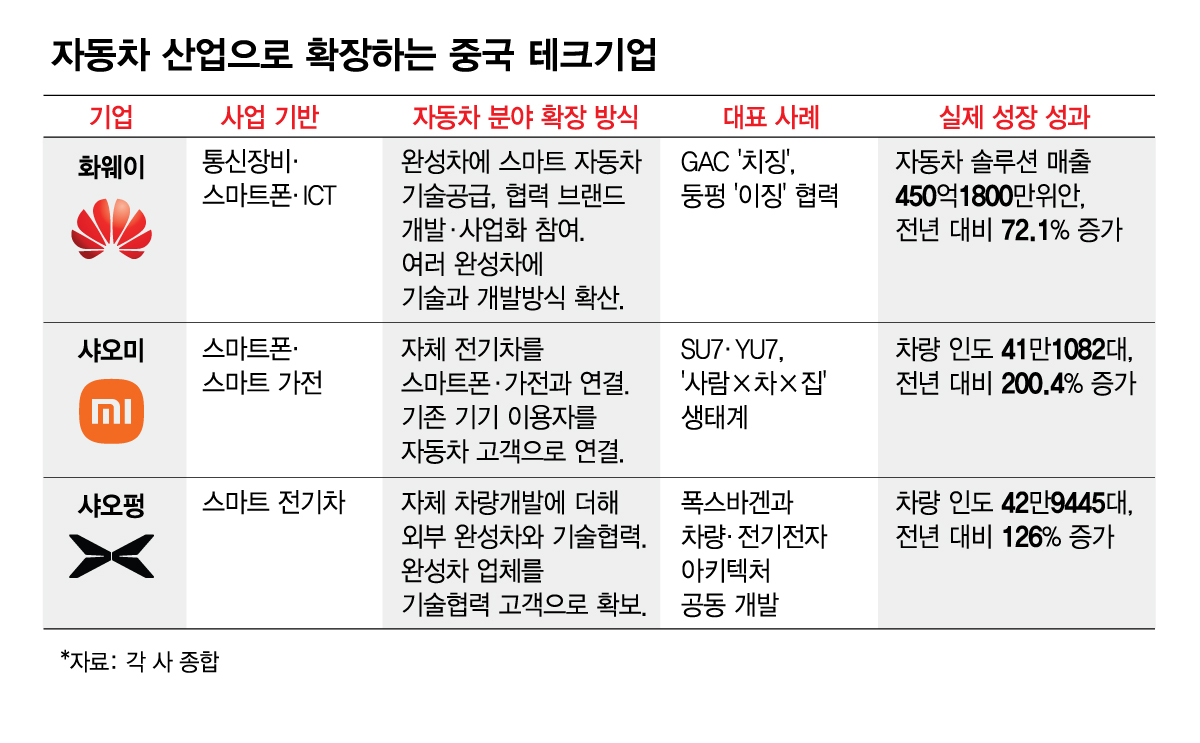
The character 'Jing' is used in the names of Huawei partner brands such as Chijing () by Guangzhou Automobile Group (GAC) and Yijing () by Dongfeng Motor. Chijing adopted Huawei's smart car technology along with the "Integrated Product Development (IPD)" and "Integrated Product Marketing & Service (IPMS)" systems. It has accepted not only the technology but also the methods of planning and selling products.
IPD is a method where R&D, product planning, and marketing personnel identify customer requirements from the early stages of development and reflect them in the product. IPMS is a system that connects everything from launch to marketing, sales, and service. The focus is on turning developed technology into products customers want and managing the experience after purchase.
Through this report, HMG Management Research Institute analyzed that, unlike the existing automotive industry which emphasizes departmental regulations and practices, Huawei identifies customer requirements from the outset and ensures that development, sales, and evaluation proceed under the same goal. It cited examples such as headrest-integrated speakers and unmanned valet parking technology. The diagnosis is that realizing these requires talent to coordinate work across departments and a long-term organizational culture, necessitating direct cooperation to learn.
HMG Research Institute also proposed forming a small-scale "One Team R&D CFT" combining China-region research and development (R&D) and commercialization functions. A CFT is a collaborative organization where personnel from different departments work toward a common goal. The aim is to create a structure that constantly reflects customer requirements during the development, launch, and operation processes. However, the adoption of partner brands and organizational restructuring are suggestions from the research institute, and their promotion at the group level has not been confirmed.
The background includes changes where Chinese companies leveraging ICT (Information and Communication Technology) capabilities have emerged as competitors to automakers. Huawei is expanding cooperation with automakers based on vehicle software and smartphone connectivity technology. Xiaomi is extending customer touchpoints secured in smartphones and home appliances to automobiles. Smart electric vehicle maker XPeng is pursuing a business that supplies technology to external automakers in addition to vehicle sales.
Their competitiveness lies not only in the performance of individual vehicles but also in connecting smartphones, apps, and vehicles, providing updates and services after purchase, and maintaining relationships with customers. It is pointed out that during the transition to SDV (Software-Defined Vehicles), where software determines vehicle functions and user experience, such ecosystems can threaten existing automakers.
A domestic automotive industry official said, "We are paying attention to the strength of being able to approach customers through everyday touchpoints such as smartphones and apps, and are considering response strategies for that ecosystem."

 in INDUSTRY
