

The semiconductor stock market fluctuated following the announcement of next-generation DRAM technology by Chinese memory semiconductor firm CXMT (Changxin Memory Technologies), but DRAM spot prices rose further. Assessments suggest it is still too early to compare CXMT's technological catch-up with the product competitiveness of Samsung Electronics and SK Hynix. Meanwhile, demand for memory is expanding, centered on AI (artificial intelligence) servers.
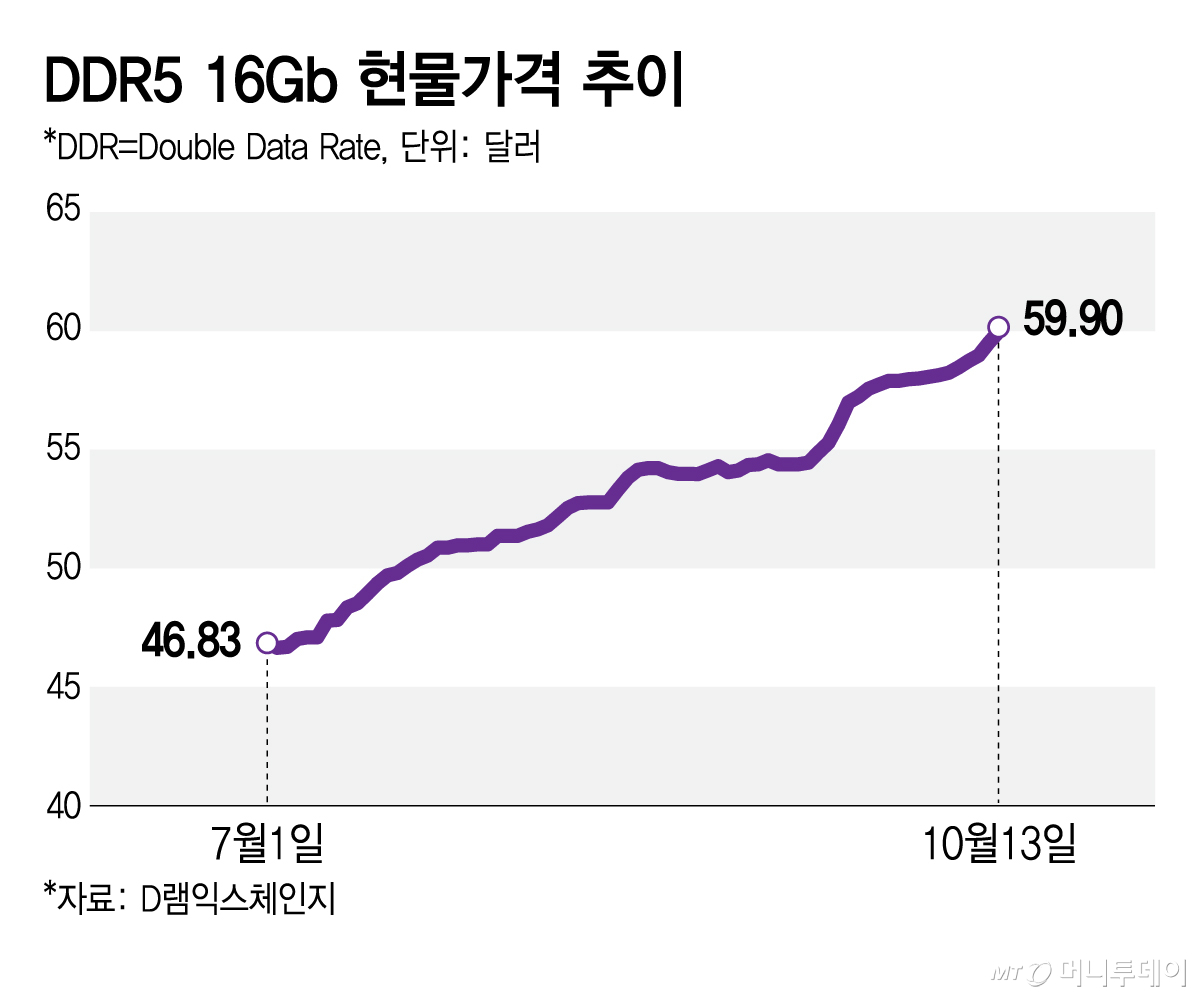
According to market research firm DRAMeXchange, the spot trading price for general-purpose DDR5 (Double Data Rate) 16Gb (gigabit) products was $59.9 on the 13th, up 0.8% from the previous day. This represents a 10.2% increase compared to one month ago. DDR5 spot prices saw a slight pause in their upward trend in March of this year but have since continued to rise, recording all-time high levels.
Although China's CXMT announced on the 10th that it would release next-generation server DDR5 RDIMMs (memory modules) utilizing the 4F² DRAM structure by the end of the year, spot prices were not significantly affected. The spot price for server DDR5 RDIMM 32GB (gigabyte) products was $2,185 on the 12th, a 1% increase from the end of last month. Prices for this product have more than doubled over the past six months.
4F² is a technology that can reduce the area of memory cells, the minimum unit for storing data, by approximately 33% compared to the existing 6F² structure. Samsung Electronics and SK Hynix are also developing related technologies. Samsung Electronics unveiled a prototype in early this year, and SK Hynix has published research papers on the subject. The industry expects full commercialization to occur after 2028.
If CXMT releases related products by the end of the year as announced, it would showcase 4F²-applied products approximately two years earlier than Samsung Electronics and SK Hynix. Concerns have been raised regarding intensified competition and expanded supply volumes due to CXMT's technological catch-up, leading to a decline in the stock prices of Samsung Electronics and SK Hynix by 7.39% and 10.09%, respectively, on the 13th.
However, spot prices, which react sensitively to supply and demand conditions in the semiconductor market, are maintaining their upward trend. DRAM spot prices refer to prices in the distribution market where small-scale transactions occur among mid-sized finished product manufacturers or memory module vendors. Although the total trading volume is small, these prices have the characteristic of quickly reflecting supply and demand situations and market sentiment.
Responses from the semiconductor industry indicate that it is premature to discuss a technological reversal by CXMT. This is because launching new products and mass-producing them with high yields for stable supply are separate issues. It has not yet been clearly confirmed whether the 4F² structure announced by CXMT is applied to the entire DRAM cell or only to specific areas.
There is also analysis suggesting that CXMT, which faces difficulties in securing advanced EUV (Extreme Ultraviolet) lithography equipment from ASML due to U.S. semiconductor regulations against China, is focusing on developing the 4F² structure to find a technical workaround. Given constraints on transitioning to fine processes using EUV equipment, this interpretation suggests an effort to increase integration by changing the memory cell structure, separate from refining circuit line widths.
Technical challenges remain with the 4F² structure. Reducing cell area can lead to issues such as increased leakage current and degraded data retention characteristics. While CXMT claims to have improved these problems, verification is needed to determine whether performance and yield can be stably secured in the actual mass production process. CXMT's stock price has also shown a downward trend since the 9th.
Separate from concerns over CXMT's technological catch-up, new demand is being created in the memory market for AI servers. AMD Chief Executive Officer (CEO) Lisa Su revealed plans on the 12th (local time) at the keynote speech of 'OCP Global Summit 2026' held in the U.S. to introduce SOCAMM2 (So-Cam 2) memory based on LPDDR5X (7th generation low-power DRAM) in the next-generation server CPU, 6th Gen EPYC Verano.
Verano is AMD's first server CPU to adopt LPDDR. With AMD following NVIDIA in adopting SOCAMM2, the possibility of expansion in the server low-power DRAM market has increased. NVIDIA applied SOCAMM2 to the CPU of its next-generation AI platform, Vera Rubin, to increase memory capacity and bandwidth.
An industry official stated, "It is difficult to attribute recent stock price declines solely to CXMT's technological catch-up," adding, "Given that the competitiveness and profitability of domestic memory manufacturers are being maintained, it appears that stock market supply and demand or sentiment have had an impact."
Meanwhile, according to market research firm Counterpoint Research, Chinese NAND flash manufacturer YMTC (Yangtze Memory Technologies) ranked third in the global NAND market by shipment volume in the second quarter of this year, with a 17% share. It surpassed Japan's Kioxia and U.S.-based Micron. Samsung Electronics and SK Hynix maintained first and second place, respectively. However, if shipments from SK Hynix subsidiary Solidigm are tallied separately, YMTC's ranking rises to second place.

 in INDUSTRY
