

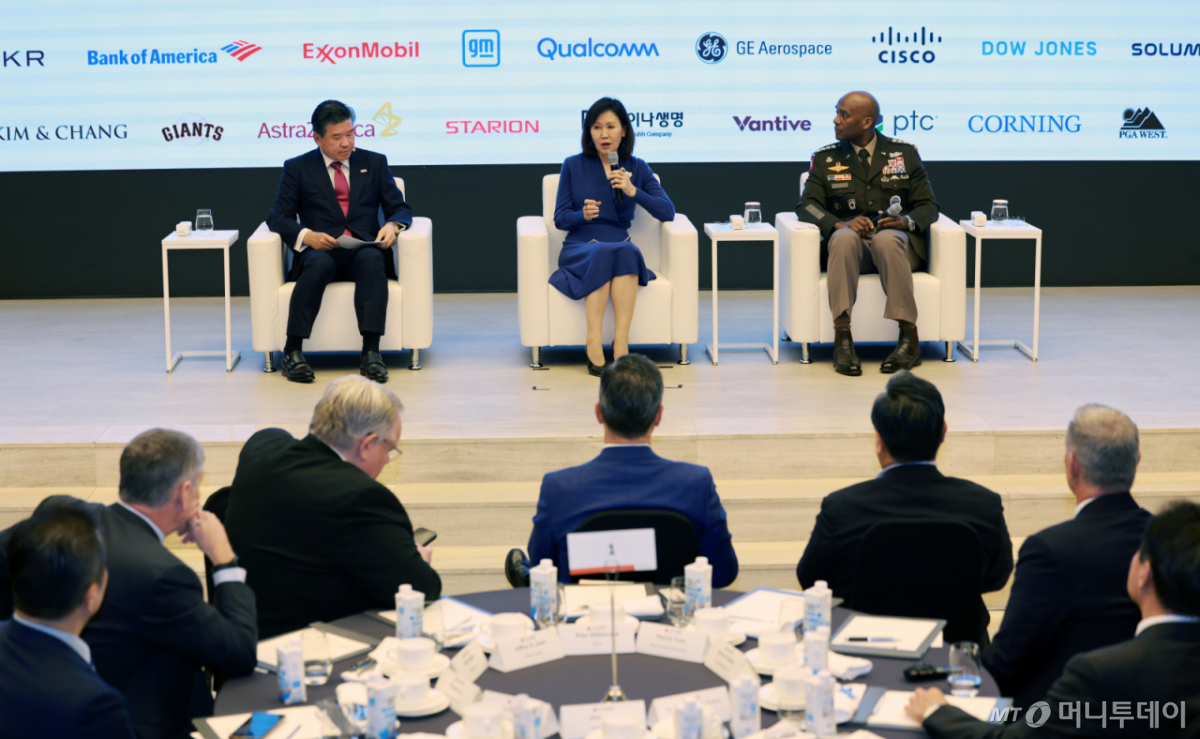
"It seems that South Korea and the U.S. are currently going through a kind of turbulent period."
U.S. Ambassador to South Korea Michelle Park Sinstad offered this assessment of the inter-Korean relationship during a lunch briefing hosted by the American Chamber of Commerce in Korea (AmCham) at the Mondrian Seoul Itaewon in Yongsan-gu, Seoul, on the 21st. The remarks are interpreted as a reconfirmation of the U.S. stance that South Korea should take on a larger role, delivered before domestic and international business leaders, while emphasizing the implementation of investment agreements with the United States.
Ambassador Sinstad stated, "South Korea is no longer a country that needs to be protected by the United States. Its economy has grown to that extent," adding, "Now is the time for South Korea to stand up and lead the Indo-Pacific region alongside the United States."
Regarding investment projects in the U.S., she noted, "Just three weeks ago, President Donald Trump announced investments including power supply for U.S. data centers, a revival of civilian nuclear power generation in both countries, and stable access to U.S.-produced gas." She sequentially mentioned the three pillars of the $200 billion (approximately 265 trillion won) energy investment package announced by President Trump on the 30th of last month: the construction of the EnCinal gas combined-cycle power plant in Texas, eight nuclear reactors, and the Alaska liquefied natural gas (LNG) project. The South Korean government views only the EnCinal power plant ($22.3 billion) as a confirmed project. It maintains that additional review is needed for the nuclear reactor construction and the Alaska LNG project.
When asked about energy cooperation, Ambassador Sinstad appeared mindful of the differences of opinion between the two countries regarding investment in the U.S., responding, "I am thinking about how much I can say and how much I cannot." After a brief pause, she revealed that discussions are underway to implement details for both the nuclear power plant and the EnCinal power plant projects, and that the embassy is also engaged in related work. Ambassador Sinstad stated, "Energy security is national security," adding, "I will say only this much here," thus exercising restraint in her remarks.
She also pointed out that South Korea's digital regulations are becoming obstacles to U.S. companies' business operations. Previously, the U.S. government expressed concern in June when a fine of 624.6 billion won was imposed on Coupang, arguing that South Korean regulations discriminate against U.S. companies. Ambassador Sinstad stated, "There are barriers in the digital sector of the South Korean market," noting, "There have been measures such as searches and seizures, inspections, and the imposition of fines." She continued, "The Joint Fact Sheet explicitly states that treatment will be fair and non-discriminatory," emphasizing, "U.S. companies should be treated just like South Korean companies."

 in INDUSTRY
