

As TSMC, the world’s largest foundry (semiconductor contract manufacturing) company, considers building a new production base in Texas, U.S., competition with Samsung Electronics in the region is expected to intensify. Samsung Electronics plans to strengthen the production competitiveness of its Taylor fab by leveraging expanded orders for advanced processes and increased utilization rates. Stabilizing yields and securing major customers are seen as key to restoring competitiveness.
According to industry sources on Tuesday, TSMC is scouting new semiconductor production sites in Texas. The company has reportedly begun negotiations with the city of Sherman to select a site for constructing a production facility. If the investment is finalized, Texas will become TSMC’s second major U.S. production base after Arizona. TSMC CEO C.C. Wei stated during a recent Q3 earnings announcement conference call, “We have dispatched an inspection team to Texas to conduct all necessary evaluations.”
If TSMC enters Texas, competition with Samsung Electronics over semiconductor production and securing local specialized talent is expected to heat up further. Texas is a key hub for Samsung Electronics’ U.S. semiconductor business, where the company has built its production base over approximately 30 years. Since announcing plans to build an Austin plant in 1996, Samsung Electronics has expanded its local presence. The company also plans to develop the Taylor fab as a production base for advanced processes of 2 nanometers (nm, one-billionth of a meter) and below.
Samsung Electronics’ foundry business, which had been posting large losses, recently narrowed its deficit, laying the groundwork for a rebound. Expanded production of base dies (the bottommost layer) for HBM (High Bandwidth Memory) contributed to improved utilization rates. Samsung Electronics’ HBM4 (6th generation) will feature base dies based on its 4-nanometer process.
As HBM4 production increases, foundry utilization rates also rise accordingly. Vice President Kang Suk-chae, head of the Foundry Strategy Marketing Division at Samsung Electronics, explained during a Q3 earnings announcement conference call on Oct. 30, “Sales increased compared to the previous quarter, and performance improved significantly, driven by the growth in 4-nanometer HBM base dies and expanded sales of advanced processes to global customers.”
In Q3 this year, Samsung Electronics secured a share in the HBM market comparable to its overall DRAM market share. The company plans to expand the proportion of server DRAM sales, including HBM, in Q4. Base dies based on Samsung’s 4-nanometer process are also scheduled to be applied to HBM4E (7th generation), which is expected to contribute to expanded foundry production. The “Groq 3” LPU (Language Processing Unit) installed in NVIDIA’s “Vera Rubin” platform will also be manufactured using Samsung Electronics’ 4-nanometer process.
The company has sufficient “workload” to support plant operations. In July last year, Samsung Electronics secured orders for AI (Artificial Intelligence) chips worth 23 trillion won from Tesla. This year, the number of 2-nanometer order projects for Samsung Electronics’ foundry more than doubled compared to the previous year.
Kang said that “expansion is continuing, centered on 2-nanometer HPC (High-Performance Computing) customers, including major hyperscalers.”
Samsung Electronics has already begun operating cleanrooms and bringing in equipment at its Taylor Plant No. 1. It has also dispatched a large workforce for plant operations. Reports indicate that the company is considering additional fab construction amid rising demand for advanced processes.
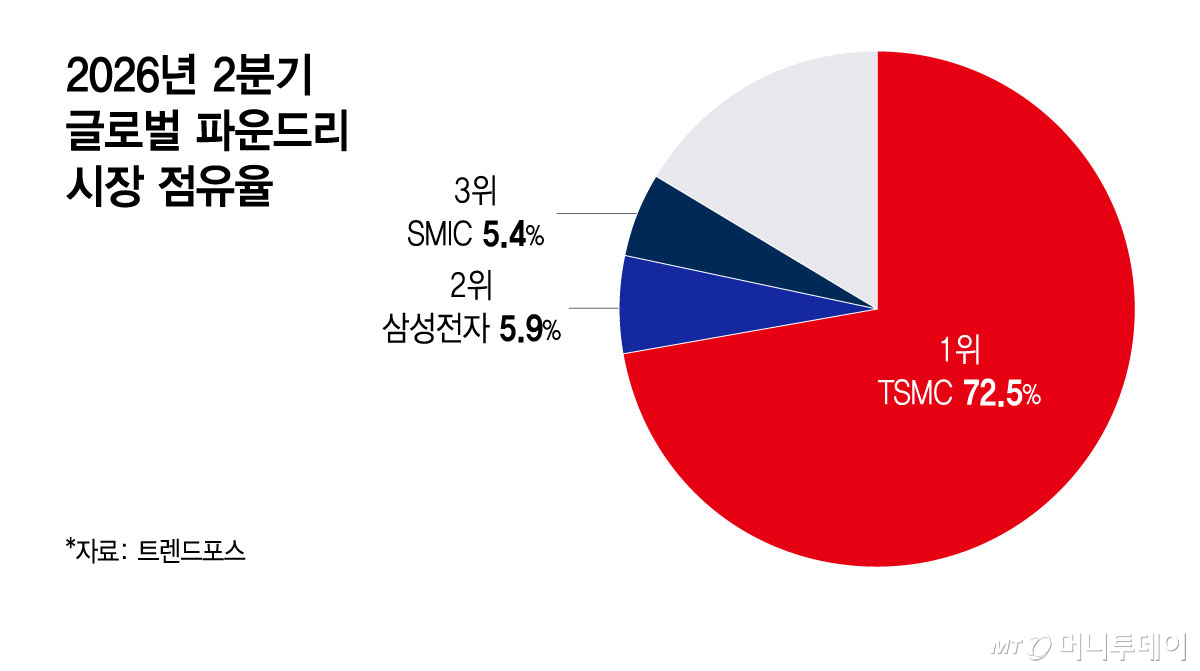
However, stabilizing yields and securing additional major customers remain challenges. The market share gap with TSMC also persists. According to TrendForce, in the global foundry market in Q2 this year, TSMC recorded a 72.5% share, while Samsung Electronics recorded 5.9%. Considering the burden of depreciation costs, securing stable production volumes and improving profitability are crucial.
Professor Lee Jong-hwan of the Department of System Semiconductor Engineering at Myongji University said, “Samsung Electronics needs to leverage its strength of having both memory and foundry capabilities to target major U.S. tech customers. Securing yields and mass production capabilities for advanced processes is key.”

 in INDUSTRY
