

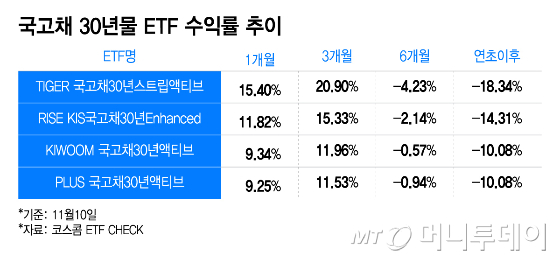
Government bond yields fell sharply last month, driving strong performance in long-term bond exchange-traded funds (ETFs). In particular, the 30th-year ETF recorded double-digit returns over the past month, overtaking the 3rd-year ETF, which saw returns in the single digits. However, opinions are emerging that caution is needed for chasing purchases, as year-to-date returns remain negative.
According to the Bond Information Center of the Korea Financial Investment Association on the 10th, the yield on 30-year government bonds closed at 3.959%, down 1.8 basis points from the previous trading day. The yield on 3-year government bonds closed at 3.633%, down 0.6 basis points. Yields on 3-year and 30-year government bonds have fallen by 48.6 basis points and 79.2 basis points, respectively, from their year-to-date highs. The peaks occurred on September 28 and August 18, respectively.
Government bond yields had been on a steady upward trajectory since the beginning of the year but plunged last month. Falling international oil prices and strengthened risk-averse sentiment contributed to the decline.
As concerns over profitability spread, driven by big tech companies issuing high-yield corporate bonds to invest in artificial intelligence (AI) infrastructure, movements to avoid risky assets intensified. According to SK Securities, four out of the top five days with the largest declines in government bond yields in October were days when the KOSPI index fell.
From a supply and demand perspective, net purchases of treasury futures by foreign investors and the government's reduction in government bond issuance supported the yield decline. The government cut its planned government bond issuance last month by 5 trillion won compared to the initial plan.
In its "October 2026 Over-the-Counter Bond Market Trends" report released on the same day, the Korea Financial Investment Association stated, "Government bond yields generally declined at the beginning of the month, driven by falling international oil prices and foreign buying of treasury futures."
It added, "By the end of the month, with both the Bank of Korea Monetary Policy Board and the Federal Reserve System (Fed) Federal Open Market Committee holding policy rates steady, and continued preference for safe assets due to weakness in global tech stocks, October government bond yields closed lower across all maturities."
As long-term yields fell relatively more sharply, returns on long-term bond ETFs were also high. According to KOSCOM ETF CHECK on the same day, the one-month return of "TIGER Government Bond 30-Year Strip Active" reached 15.40%. Other funds such as "RISE KIS Government Bond 30-Year Enhanced" (11.82%), "KIWOOM Government Bond 30-Year Active" (9.34%), and "PLUS Government Bond 30-Year Active" (9.25%) also showed high returns.
However, when the period is extended to year-to-date, returns remain negative. "TIGER Government Bond 30-Year Strip Active" (-18.34%) and "RISE KIS Government Bond 30-Year Enhanced" (-14.31%), among others, posted double-digit negative returns.
This is because although government bond yields have plunged recently, they have not fully reversed the gains seen since the beginning of the year. The yield on 30-year government bonds was 3.255% on January 2, which was 70.4 basis points lower than on the 10th.
Pointers are emerging that caution is needed for chasing purchases given the sharp short-term decline in yields. Won Yu-seung, a researcher at SK Securities, analyzed, "This plunge, triggered by concerns over AI-driven growth slowdown and risk-averse sentiment, has been reflected to an excessive degree, which conversely could be a factor causing a rebound upward."
There is also a view that long-term bond ETFs offer greater investment appeal than short-term bonds when considering base rate outlooks.
Jeong Sang-woo, head of the ETF Management Division at KB Asset Management, said, "Current forecasts for the base rate are reflected in market rates, and we expect domestic base rate hikes to conclude with the first quarter of next year." He added, "A period will follow during which the effects of interest rate hikes are assessed to some extent, making an interest rate cut difficult in the short term, which will limit downside risk."
Division head Jeong further added, "While long-term bond ETFs are expected to be relatively strong at the final stage of interest rate hikes, long-term bonds have higher volatility compared to short-term bond ETFs and greater uncertainty due to external interest rates such as those in the United States. Therefore, it is appropriate to diversify by including a certain portion of both long-term and short-term bonds."

 in STOCK
