

Hyundai Motor's Chinese factories have struggled to boost their utilization rates. As domestic sales plummeted due to aggressive competition from local companies, the company has been running its factories primarily for exports. Hyundai Motor plans to deploy a series of locally strategic new models in succession to aim for a turnaround.
According to industry sources on the 12th, the utilization rate of Hyundai Motor's Chinese factories is at approximately 15%. Domestic sales in China by Beijing Hyundai, Hyundai Motor's joint venture in China, decreased every quarter from 27,000 units in the first quarter of this year to 19,062 units in the second quarter and 9,303 units in the third quarter. Domestic sales dropped to as low as 2,518 units in July last month. This contrasts with the peak reached in 2016, when annual sales hit 1.14 million units.
The industry views it as difficult to recover utilization rates due to fierce local competition. As Chinese electric vehicle companies rapidly capture the market by leveraging price competitiveness, the foothold of foreign joint ventures is narrowing. In September last month, Hyundai Motor and Kia's combined sales in China were approximately 9,000 units, a 39% decrease compared to the same month last year. The combined market share of the two companies also fell to 0.6% in September, having exceeded 1% at the beginning of this year.
Exports are filling the gap. Beijing Hyundai's exports increased from 16,202 units in the first quarter to 18,794 units in the third quarter. Exports accounted for 67% of third-quarter sales. Cumulatively from January to September this year, exports also surpassed domestic sales, reaching 59,079 units compared to 55,365 units domestically. The Avante (known locally as the Elantra) accounted for 43% of third-quarter export volumes. The Sonata, produced in China and imported into Korea, reached 14,296 units from January to September. Hyundai Motor is pursuing a strategy of utilizing its cost-competitive Chinese factories as export bases for emerging markets such as Southeast Asia and the Middle East and Central/South America.
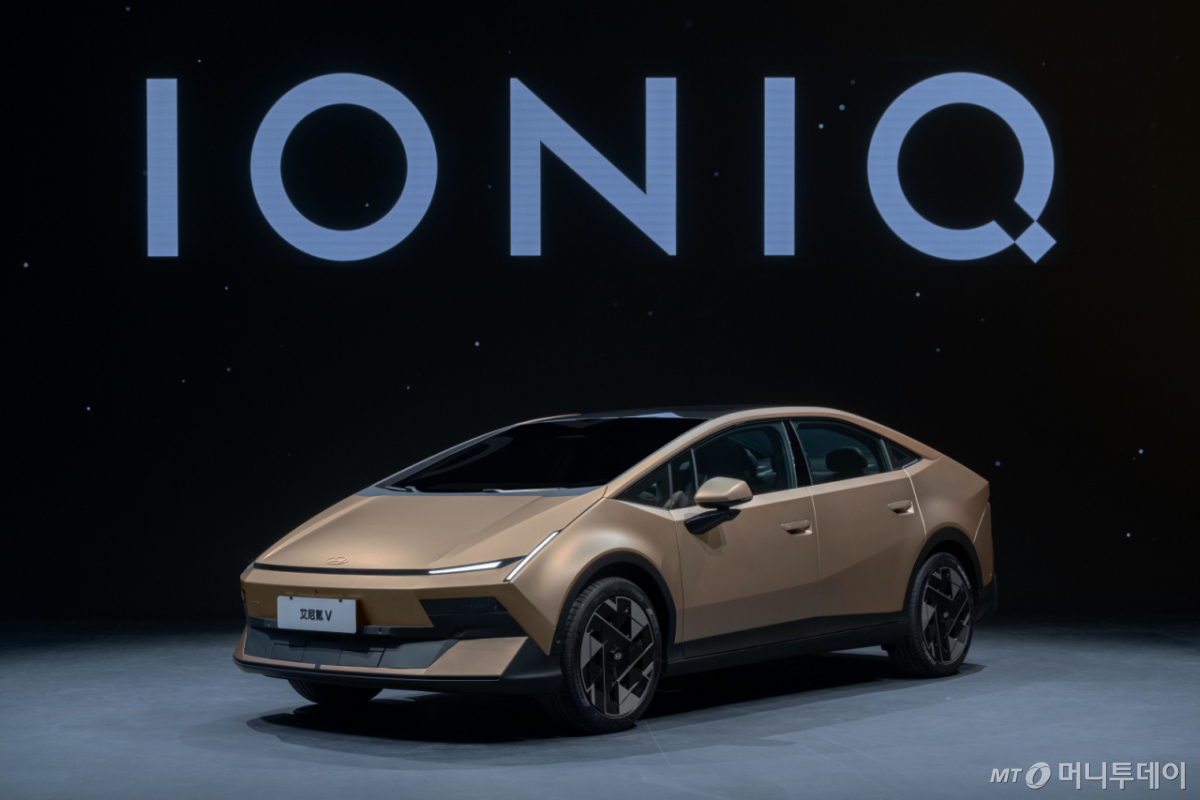
New models are the key to reversing domestic sales. Hyundai Motor plans to launch the China-strategic electric vehicle IONIQ 5 in the second half of this year, followed by four consecutive releases in the first half of next year: an extended-range electric vehicle (EREV) based on the IONIQ 5, an electric version of the Avante and a small SUV (Sport Utility Vehicle), and a facelifted G90. An EREV is a vehicle that generates electricity with an engine to drive a motor, reducing charging burden while increasing driving range. In September last month, new energy vehicles accounted for 67% of China's passenger car retail sales, recording the highest share ever.
Hyundai Motor has decided to transform Beijing Hyundai into a brand centered on new energy vehicles. Jose Munoz, President and CEO of Hyundai Motor, positioned the IONIQ 5 at the Beijing Motor Show in April last month as a symbol of a China localization strategy different from before. The IONIQ 5 actively utilized local technology from the development stage, featuring batteries from Chinese battery maker CATL and a driver assistance system from autonomous driving company Momenta. It can travel more than 600 km on a single charge under Chinese standards.
Hyundai Motor has set a goal to release 20 new models in China by 2030 and sell 500,000 units annually. However, the performance of previously launched locally strategic electric vehicles has been sluggish. The China-strategic electric vehicle Elcseo, released in the third quarter last year, recorded only 251 domestic sales in China from January to September this year.
An industry official said, "Consumers who prioritize infotainment and interior livability over driving performance when choosing an electric vehicle are increasing, and this trend is more pronounced among Chinese consumers," adding, "The sales performance of the IONIQ 5, which fills these gaps with local technology, will determine whether Hyundai's business in China recovers."

 in INDUSTRY
