

A forecast has emerged that domestic carmakers, which ceded their home market to Tesla and Chinese brands this year, will stage a comeback next year, while the growth momentum of imported vehicles is expected to stall. Analysts said this is possible if oil prices stabilize and new domestic models are released on schedule.
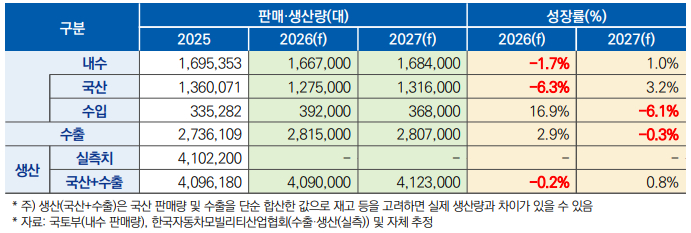
According to a report titled "2027 Global Automotive Market Outlook" released by the Korea Automotive Research Institute (hereafter KARI) on the 18th, domestic car sales in the Korean market are projected to reach 1.316 million units next year, an increase of 3.2% from this year's forecast. Imported vehicle sales are expected to decline by 6.1% to 368,000 units. This marks a reversal within a year of the trend predicted for this year, in which domestic car sales were forecast to drop by 6.3% to 1.275 million units while imported vehicle sales were projected to surge by 16.9% to 392,000 units. The total domestic market is estimated to grow by 1% to 1.684 million units. In this scenario, the share of imported vehicles in the domestic market will fall from 23.5% this year to 21.9% next year.
The concentration on imported cars was distinct this year. Domestic car sales from January to September totaled 946,017 units, a decrease of 8.6% compared to the same period last year, while imported vehicle sales rose by 21.1% to 298,534 units. KARI explained that domestic cars showed weakness due to demand contraction caused by rising oil prices and inflation resulting from the war between the United States and Iran, as well as the popularity of the Tesla Model Y and the penetration of Chinese brands. According to the Korea Import Auto Association, Tesla's new domestic registrations from January to October reached 98,313 units, more than double the figure for the same period last year.
The basis for the forecasted rebound of domestic cars next year lies in oil prices and new models. KARI predicted that if the U.S.-Iran war ends, oil prices stabilize, and new launches of key domestic models proceed as planned, growth centered on domestic cars will emerge in conjunction with economic improvement driven by strong semiconductor exports. The institute attributed the slowdown in imported car sales in the second half of this year to factors such as the expiration of eco-friendly vehicle purchase subsidies in certain regions.
The industry is preparing a counterattack with new models. Hyundai Motor plans to launch the fully redesigned Kona and the Genesis GV70 HYBE RWD model domestically in the first half of next year, followed by the facelifted Sonata and the electric Kona and Avante N in the second half. Kia will release its purpose-built vehicle (PBV) PV7 and facelifted K5 and Morning models in the first half. The sixth-generation Sportage is scheduled for deployment in the second half.
Exports are expected to remain at a level similar to this year. Exports from January to September increased by 0.9%, thanks to a 7.3% rise in North America-bound shipments of 1.3167 million units, but performance was sluggish in the Middle East (-24.8%) and other European markets (-13.5%). Next year's exports are projected to decrease by 0.3% to 2.807 million units. The largest market, the United States, is expected to see a slight recovery, but demand for eco-friendly vehicles, in which domestic companies hold a competitive edge, could slow down as high oil prices subside. Europe's market is expected to stagnate due to strengthened regulations on Chinese-made vehicles, but if the regulations do not significantly impact Korea, the intensity of competition may ease. Production, calculated by simply adding domestic sales and export volumes, is projected to increase by 0.8% to 4.123 million units.
The global market is expected to see a slight recovery after contracting this year. KARI forecast that finished vehicle sales in 55 countries will decrease by 2.5% to 82.476 million units this year and increase by 0.8% to 83.169 million units next year. The Chinese passenger car market, which contracted by nearly 20% this year, is expected to rebound by 2.1%, while the U.S. market is projected to grow by 0.5%.

 in INDUSTRY
