

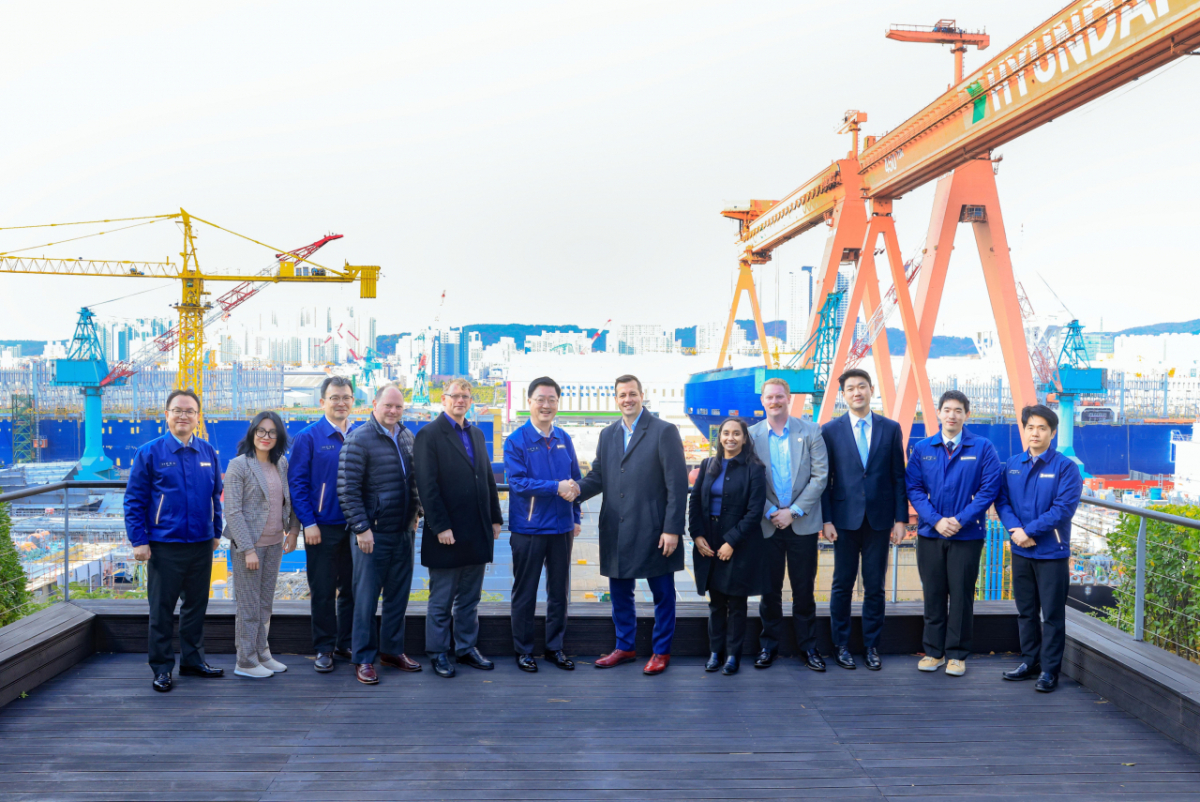
HD Hyundai Heavy Industries said Friday that a delegation from the U.S. Maritime Administration visited its Ulsan shipyard.
The U.S. Maritime Administration is an institutional investor under the U.S. Department of Transportation responsible for transporting military supplies during national emergencies and supporting port infrastructure improvements. Deputy Administrator Mark D. Johnson, among others, attended this visit.
This visit was arranged to explore ways to expand cooperation between South Korea and the United States amid the U.S. government's push of a "Bridge Strategy" that leverages allied nations' shipbuilding technology and production capacity while expanding domestic construction capabilities to rebuild its own shipbuilding industry.
On this day, management including Joo Won-ho, President of HD Hyundai Heavy Industries and head of the Vessel and Mid-size Ship Business Division, received the U.S. Maritime Administration delegation and introduced the company's world-class shipbuilding technology. The two sides also discussed participation in the military vessel procurement projects being pursued by the Maritime Administration and cooperation plans related to port infrastructure.
The delegation then inspected a car carrier (PCTC) under construction, examining HD Hyundai Heavy Industries' shipbuilding technical capabilities. A PCTC is a type of roll-on/roll-off (Ro-Ro) vessel capable of rapidly loading and unloading wheeled cargo such as automobiles. The military support Ro-Ro vessels operated by the U.S. Maritime Administration are also designed in a similar manner to PCTCs to transport tanks, military trucks, and other equipment.
In particular, phased cooperation is expected in connection with the construction of a new shipyard that HD Hyundai is pursuing with the goal of commencing operations locally in the United States by 2029. Previously, HD Hyundai signed a contract last month to establish "HD Kiewit Shipbuilding," a local joint venture for shipbuilding, with U.S. engineering, procurement and construction (EPC) firm Kiewit. The new shipyard is scheduled to break ground next year. Based on this, the company plans to pursue military support vessel construction projects, including Ro-Ro vessels and Consolidated Afloat Logistics Support (CONVEX/CONSOL) tankers, and expand cooperation into the production of ship blocks and modules as well as port infrastructure.
Joo Won-ho, President of HD Hyundai Heavy Industries, emphasized, "Based on more than 50 years of shipbuilding experience and a new local shipyard, we plan to cooperate mutually with the U.S. Maritime Administration to produce vessels and port equipment needed by the United States," adding, "We will continue consultations with the Maritime Administration to contribute to the rebuilding of the U.S. shipbuilding industry and port modernization."
Meanwhile, the "Bridge Strategy" is a strategy presented by the U.S. government through a presidential memorandum last August. It allows foreign shipbuilders investing in domestic shipyards to build up to two vessels overseas initially if they meet certain conditions, such as owning a shipyard within the United States.

 in INDUSTRY
