

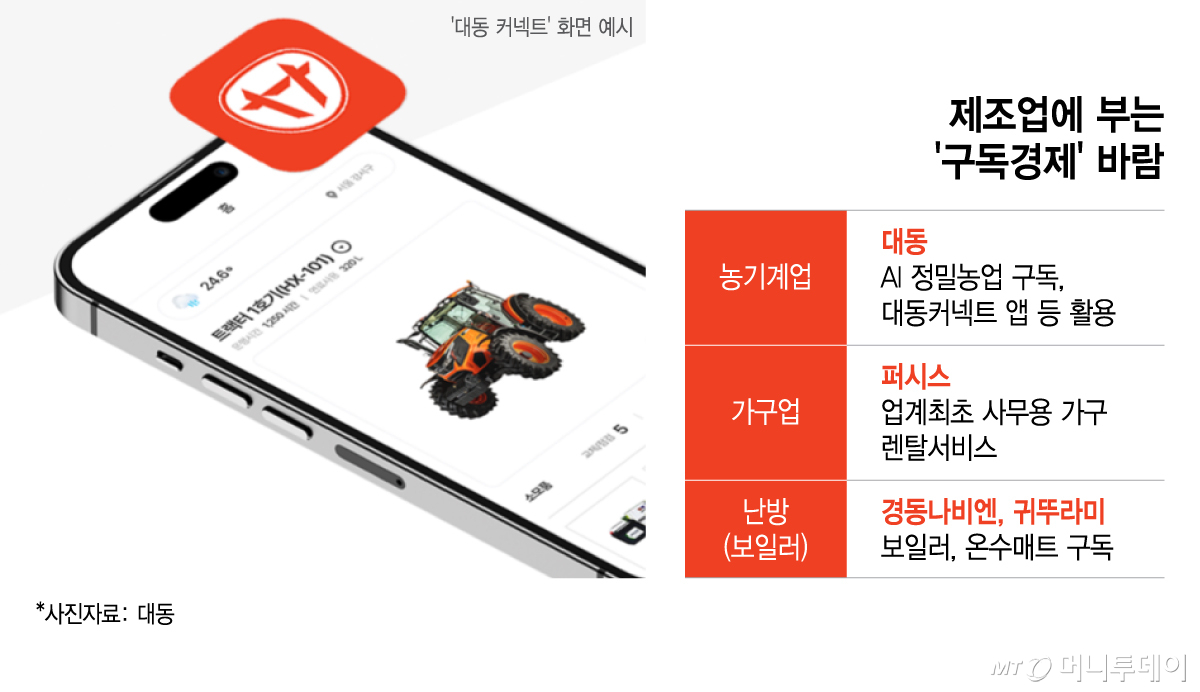
The 'subscription economy' business model, once exclusive to the rental industry, is rapidly spreading into manufacturing. As subscription-type models gain traction in sectors such as agricultural machinery, office furniture, and boilers, companies are shifting their competitive focus toward securing "lifelong customers."
According to industry sources on the 28th, the number of subscribers to Daedong's AI (artificial intelligence) agricultural platform, 'Daedong Connect,' exceeded 50,000 last month. Daedong is further refining its subscription-based business model that automatically updates agricultural machinery and provides precision agriculture services based on data accumulated through remote control systems and other tools. The company aims to achieve an ARR (annual recurring revenue) of 103.2 billion won by 2030.
Subscription-type business models are rapidly spreading to other manufacturing sectors. Pasis introduced office furniture rental services earlier this month, marking the first such move in the furniture industry. The strategy aims to create a new revenue model in the saturated office furniture market by targeting startups and shared offices that face high initial cost burdens. Boiler manufacturers including Kyungdong Navien and Gwitulmi are also expanding boiler and hot water mat subscription services that combine regular inspections, filter replacements, and after-sales service (AS).
These changes reflect an evolution in manufacturing business models toward "manufacturing as a service" (XaaS). This approach combines product sales with maintenance, software updates, and data to provide continuous management and support even after the sale.
Companies are focusing on subscriptions because growth through product sales alone has become increasingly limited. Technological advancements have extended product lifespans and lengthened replacement cycles, while recessions and market saturation have further underscored the importance of stable cash flow. Another advantage is the ability to utilize accumulated customer data for improving product performance and developing new services.
The investment industry also views recurring revenue businesses positively. They offer high predictability in earnings even amid economic fluctuations, and maintaining existing customers costs less than acquiring new ones, making them favorable for profitability improvements. According to KT Economic Management Research Institute, the domestic subscription economy market size was approximately 25 trillion won in 2016 and has recently surpassed 100 trillion won.
As manufacturing companies continue to enter the subscription market, competition in the existing rental industry has intensified. The focus is shifting toward acquiring new accounts and improving subscription retention rates. Coway and SK Intellics are expanding products targeting single-person households, such as food waste disposers and pet appliances, while also establishing rental models overseas to increase their user base.
Coway's total rental accounts increased by approximately 39%, from 8.45 million in 2021 to 11.73 million in the first quarter of this year. During the same period, overseas accounts grew by about 74%, rising from 2.44 million to 4.25 million. SK Intellics also expanded its total account count from 2.05 million to 2.35 million over the past five years. Recently, it strengthened its service competitiveness by equipping its wellness AI robot 'Namu X' with security software.
However, critics point out that subscription models face limitations: initial lump-sum sales decline in the early stages of the business, slowing cash recovery, while maintenance and customer management costs continue to accumulate steadily. There are also numerous cases where consumers express "subscription fatigue." In fact, Hanssem entered the home furniture rental market in 2019 but failed to establish a foothold and terminated the business in 2022.
An industry official stated, "Competition in manufacturing is shifting from how many products can be sold to how long customers can be retained." The official added, "Companies that provide both products and services while managing customer experience will determine their competitiveness."

 in LIVING
