

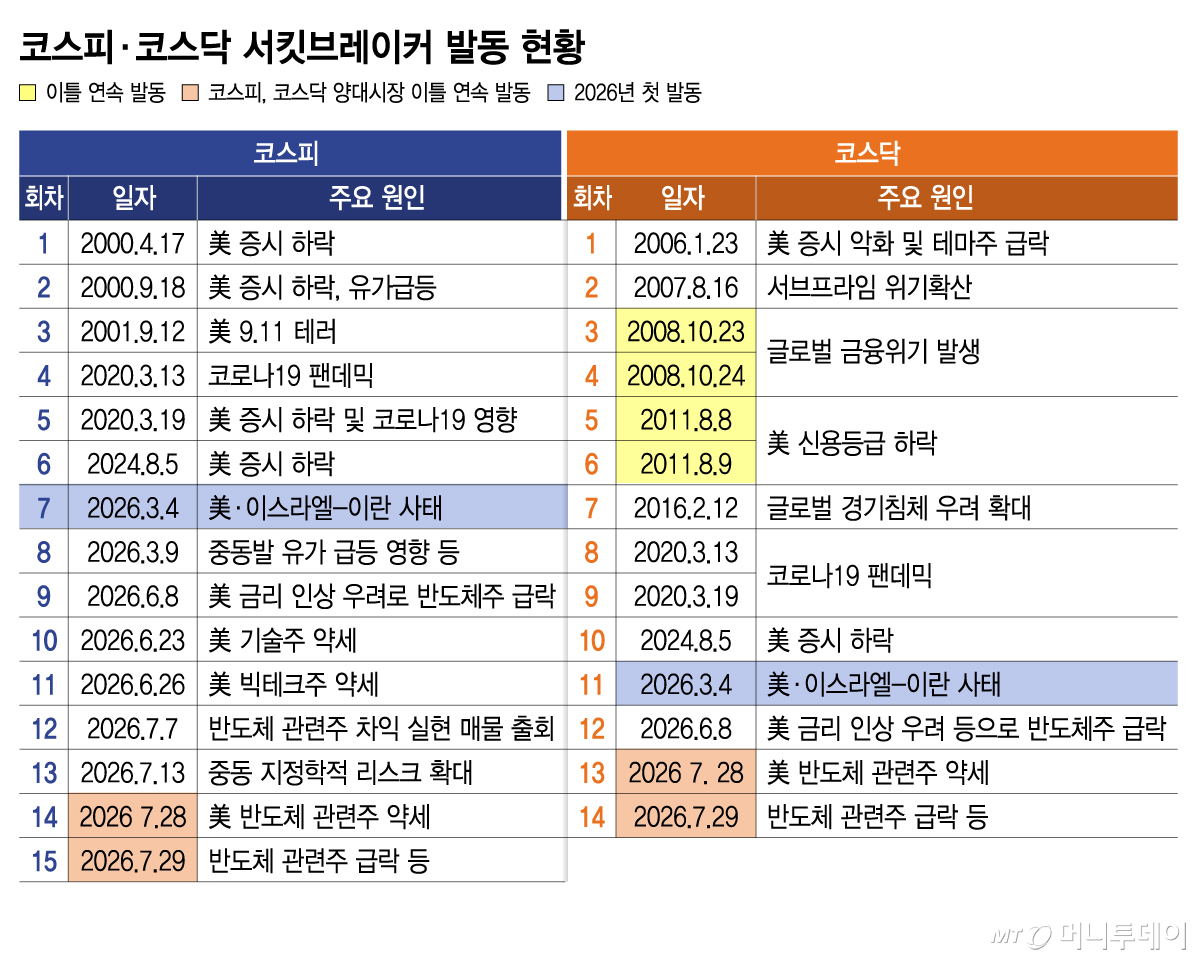
As stock market volatility has become extreme, 70 sidecar (futures market circuit breaker) triggers and 13 circuit breaker (CB) activations have occurred in just seven months this year. This already surpasses half of the nearly 30 years' total number of activations since the system was introduced in 1996 through last year. It indicates that stock market volatility this year has been unprecedentedly high.
The Korea Exchange triggered circuit breaker Level 1 at 12:32 p.m. on the 29th, temporarily halting trading in the KOSPI market. This followed an earlier move at 10:55 a.m. to suspend the effect of program sell orders for five minutes by activating a sidecar (futures market circuit breaker). Market measures have been implemented daily since July. Of the 21st trading days in July, market measures were activated on 16 days in both the KOSPI and KOSDAQ markets — more days than not.
In particular, the number of market measure activations has surged this year. The sidecar (futures market circuit breaker) was triggered 43 times in the KOSPI market and 27 times in the KOSDAQ market so far this year. This is nearly half the total number of sidecar (futures market circuit breaker) activations recorded over the past 25 years from its first activation in 2000 through last year: 60 times for KOSPI and 84 times for KOSDAQ. Circuit breaker activations have become more frequent compared to the past. While there were only 16 circuit breaker activations through last year, 13 have already occurred this year, indicating significantly wider price swings.
The sidecar (futures market circuit breaker), or the temporary suspension of program trading orders, is a system designed to mitigate the impact of program trading on the stock market by limiting program trading orders when market volatility increases. It is triggered when futures prices rise or fall by 5% or more and remain at that level for one minute.
Circuit breaker Level 1 is a measure that halts all trading if the KOSPI and KOSDAQ indices fall by 8% or more and remain at that level for one minute. It is a strong measure intended to provide investors with time to make investment decisions and ease overheated market sentiment. If the stock index falls by 15% or more and an additional 1% or more below the Level 1 trigger point, circuit breaker Level 2 is activated, halting trading in cash, futures, and options markets for 20 minutes. If the index then falls by 20% or more, a measure to terminate all trading is triggered. There have been no cases of Level 2 or higher activations so far.
As market measures continue daily, debates are emerging regarding the effectiveness of sidecar (futures market circuit breaker) and circuit breaker systems. Since the second half of last year, despite increased daily price swings, the criteria for sidecar (futures market circuit breaker) and circuit breakers have remained unchanged, leading to frequent activations becoming routine. The average daily volatility was only 1% last year but rose to 2.88% this year. In particular, the average daily volatility since July has reached 4.43%, following a 3.57% record in June.
Concerns over excessive market measures and volatility continue within the securities industry. Yang Ji-hwan, head of the Research Center at Daishin Securities, stated, "The frequent activation of volatility mitigation mechanisms itself is evidence of an abnormal phase." He added, "To mitigate volatility, institutional reforms are needed in the medium to long term, such as strengthening requirements for diversifying underlying assets and investor qualifications for leveraged products. Fundamentally, stabilizing investment sentiment through earnings verification is necessary."

 in STOCK
