

As financial authorities push for a deposit insurance premium hike, they have proposed raising the rate for the insurance sector more sharply than for other financial sectors, sparking expected industry backlash. The revised premium rates will be finalized after gathering opinions from relevant sectors and further consultations, with implementation set to begin in 2028.
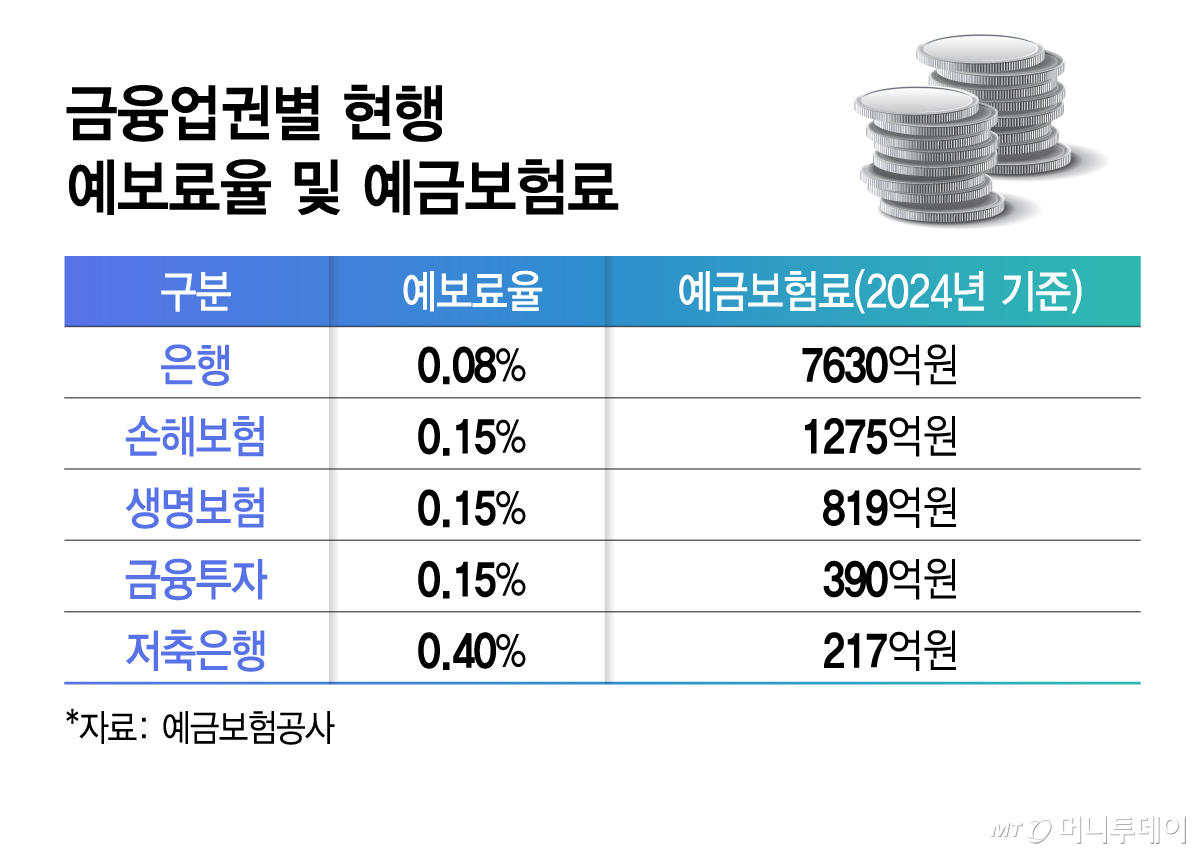
According to the insurance industry on the 29th, financial authorities promoting the premium hike recently met with various financial sectors and proposed significantly higher premium rates specifically for the insurance sector. While current deposit insurance rates are uniformly 0.15% across property and casualty insurance, life insurance, and securities firms, it is reported that authorities have considered a substantial increase in premiums for the insurance sector, particularly for property and casualty insurers.
The push to raise deposit insurance premiums aims to bolster the Deposit Insurance Corporation's fund reserves following the 2023 upward revision of deposit protection limits from 50 million won to 10 billion won last September. The differentiation in premium rate hikes across sectors reflects changes in market conditions since the last adjustment in 2009, it is understood.
Especially for the insurance sector, proposals have been raised to increase premiums by 2–3 times the current level. Under the Deposit Insurance Act, the maximum deposit insurance rate is capped at 0.5%, meaning a 2–3 fold increase would bring rates close to or above those of savings banks (0.4%). Currently, the insurance industry pays 209.4 billion won in premiums (combined life and property/casualty as of 2024), second only to banks which paid 763 billion won in 2024. This burden is expected to grow significantly in the future.
It is reported that higher premium rates were proposed specifically for property and casualty insurers compared to life insurers, leading to heightened sensitivity within the property and casualty sector. This move is interpreted as an effort to have property and casualty insurers share the financial burden arising from the Deposit Insurance Corporation's sale of Yebal Property and Casualty Insurance, which it established through capital contributions.
Under the Deposit Insurance Act, buyers seeking to acquire or merge distressed financial institutions, take over operations, or assume contracts may apply for funding support from the Deposit Insurance Corporation. Property and casualty insurers that pursued the acquisition of Yebal Insurance launched bids on the premise of receiving such capital contributions from the Deposit Insurance Corporation. The Deposit Insurance Corporation also evaluated the scale of capital contribution requested by buyers as a key criterion during the final selection process. With OK Financial Group selected as the priority negotiation partner for acquiring Yebal Insurance, the Deposit Insurance Corporation is expected to provide over 1 trillion won in capital contributions from its deposit insurance fund to OK Financial Group moving forward. Given this large-scale fund expenditure, there is a view that the need for greater industry-wide sharing was reflected in the proposed premium rate hike.
There are 22 property and casualty insurers covered under deposit protection, each paying an average annual premium of approximately 5.8 billion won. The Deposit Insurance Corporation applies different rates based on financial and operational conditions, resulting in significant variation in actual premiums paid among protected companies. However, individual companies could face premium burdens exceeding 10 billion won annually.
While the insurance industry does not oppose the premium hike itself, it is shocked by the unexpectedly large burden. It is reported that premium rate calculations have historically reflected defaults or default risks within each sector. However, with the introduction of new accounting standards (IFRS 17) and increasingly stringent regulations such as solvency ratios (K-ICS), insurance companies face additional costs that could further strain their management.
An industry representative stated, "There are discussions suggesting that the insurance sector is effectively shouldering the costs associated with Yebal Insurance's sale," adding, "Although nothing has been finalized yet, we expect adjustments to be made at a reasonable level."

 in FINANCE
