

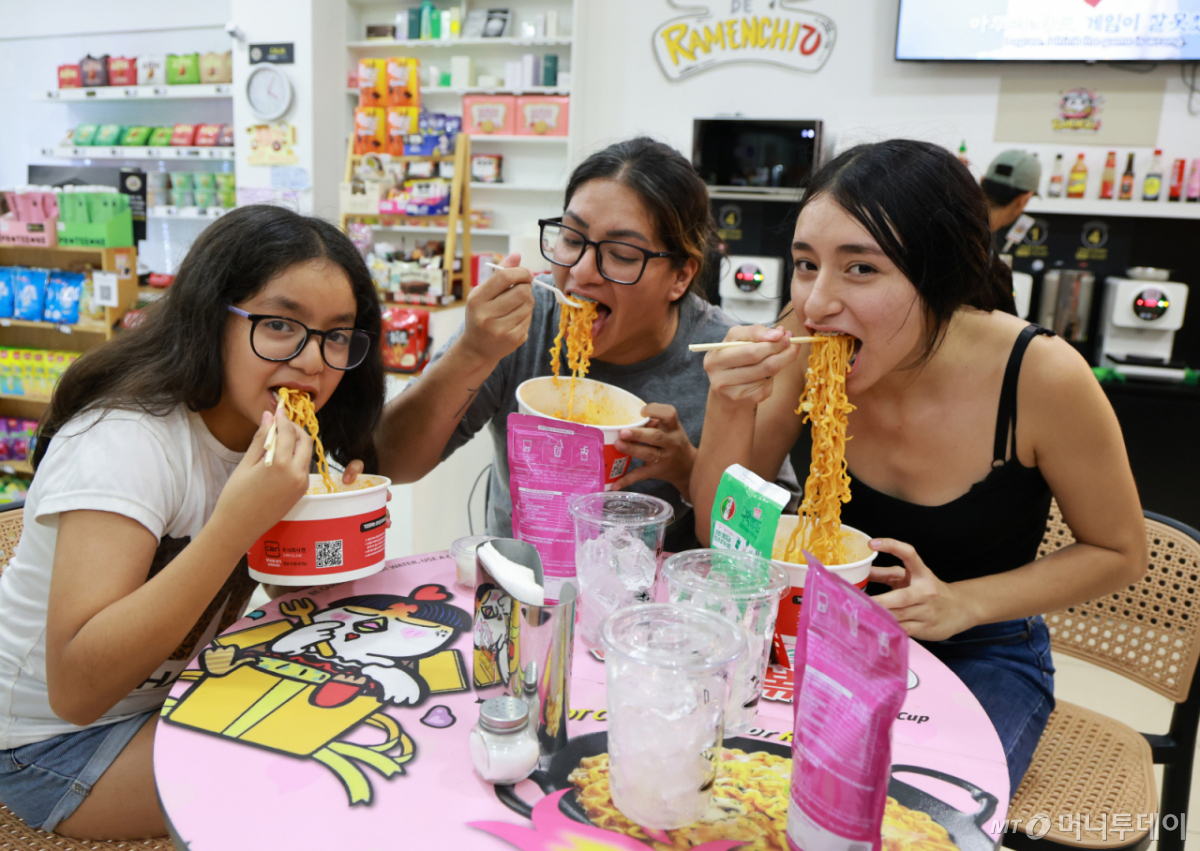
K-ramen is entering its golden age overseas. With major ramen companies such as Nongshim, Samyang Foods, and Ottogi expanding their scale one after another in the first half of this year, analysis suggests that the growth plate of the overseas market has fully opened as K-ramen's sales territory has expanded beyond the United States and China to Europe.
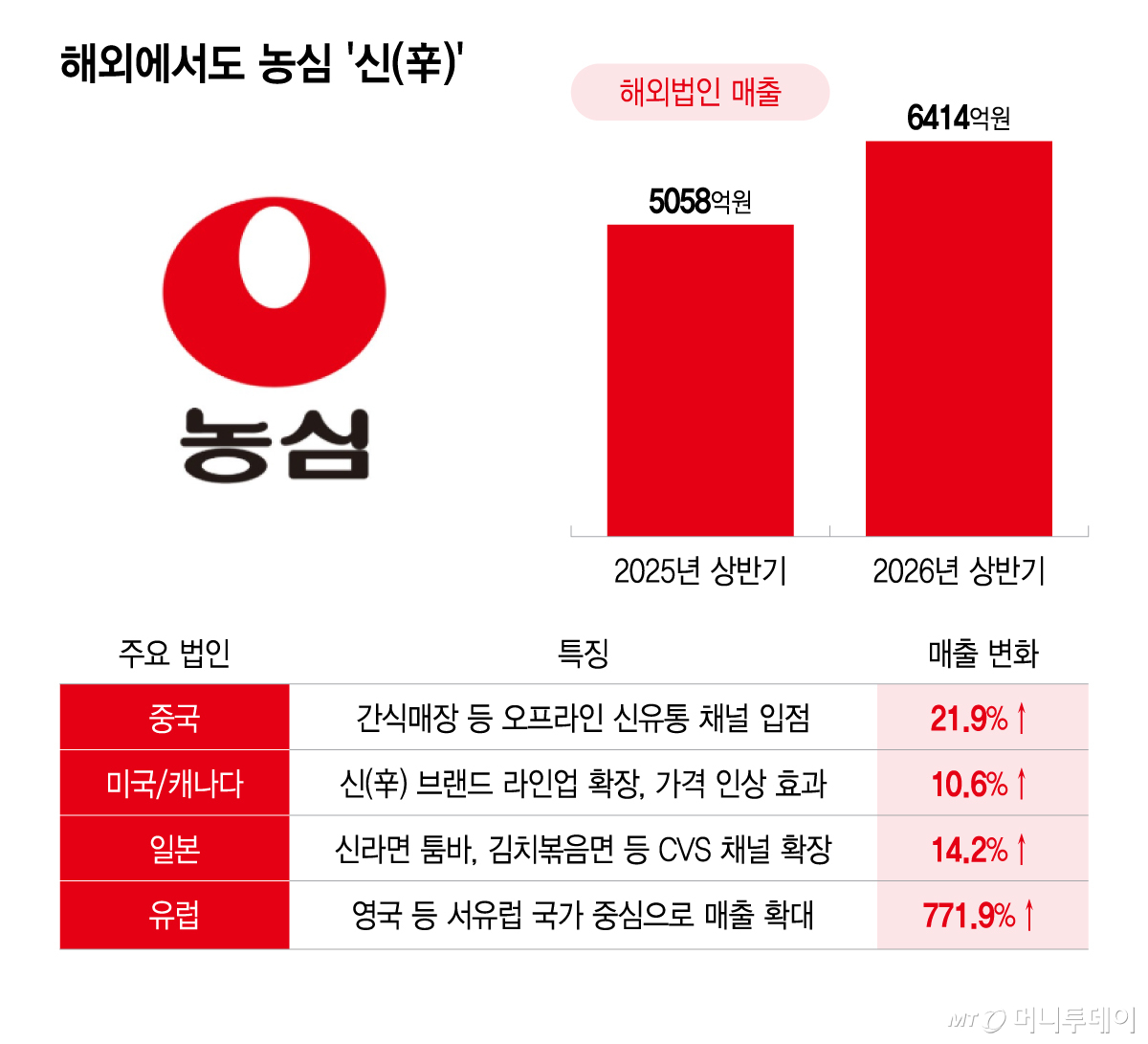
According to industry sources on the 16th, Nongshim recorded consolidated sales of 1.8901 trillion won and an operating profit of 126.7 billion won in the first half of this year, up 7.3% and 31.7%, respectively, from the same period last year. In particular, profits grew faster than sales, showing that expanding overseas operations is leading to improved profitability.
While Nongshim's domestic subsidiary sales decreased by 0.5% compared to the first half of last year, its overseas subsidiaries posted a 26.8% increase to 641.4 billion won. The operating profit margin also rose from 5.5% to 6.7%, an increase of 1.2 percentage points (P) during the same period. This means that domestic weakness was offset by overseas performance while profitability was also boosted.
Sales regions are also expanding beyond reliance on specific countries. Major overseas subsidiaries in China, the United States, and Japan mostly showed double-digit growth rates (%) in the first half of this year, and European sales surged more than eightfold to 80.3 billion won. This is the result of Nongshim expanding its Shin brand product line and distribution channels in the U.S., increasing convenience store (CVS) presence in Japan, and adding sales touchpoints centered on Western Europe, including the UK, in Europe.
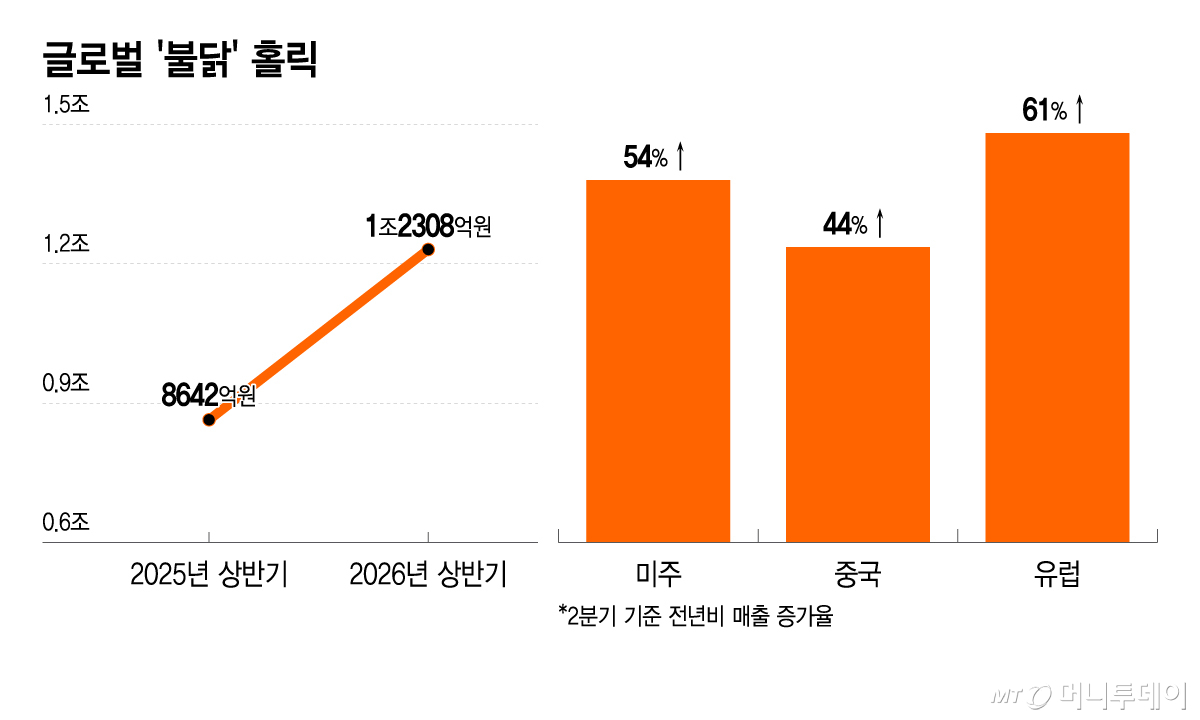
Samyang Foods continued its steep ascent overseas with its 'Buldak' (Spicy Chicken) brand leading the way. First-half sales reached 1.4847 trillion won, and operating profit hit 353.3 billion won, up 37.2% and 39.0%, respectively, from the same period last year. Of this, overseas sales alone amounted to 1.2308 trillion won, accounting for about 83% of total sales.
The popularity of Buldak is spreading beyond its traditional core markets to various regions. In the second quarter, U.S. sales reached 203.6 billion won, a 54% increase from the same period last year, while China saw a 44% rise to 181.0 billion won. Europe, which showed strong sales in Germany and France, recorded an 61% increase to 80.6 billion won.
The high overseas share translated into profitability. Samyang Foods achieved an operating profit margin of about 23% in the second quarter, marking six consecutive quarters above 20%. This was bolstered by improvements in the sales channel mix following the restructuring of its overseas distribution network and increased production efficiency.
Ottogi, which has a relatively lower overseas share, is also gradually expanding its reach. Overseas sales in the first half reached 220.5 billion won, up 12.3% from the same period last year. Although its share of total sales remains at just 11.6%, it rose by 0.8 percentage points compared to a year ago. Second-quarter overseas sales were 110.6 billion won, a 15.1% increase, indicating an even steeper growth trend than in the first half.
Overseas expansion for ramen companies is directly tied to survival. With domestic consumption slowing, it is difficult to significantly increase sales volumes, and raising prices under the government's price stability policy also carries a heavy burden. In contrast, as K-food awareness rises overseas and more products enter major local distribution channels, there is ample room to secure new consumers.
The pace of K-ramen's overseas expansion is accelerating. Export value for ramen in the first half of this year reached $935.4 million, a 27.9% increase from the same period last year, setting a record high. With Europe joining the markets led by China and the U.S., which surpassed $1.5 billion for the first time last year, annual export value is expected to break through $2 billion this year.
Investments in production facilities to meet global orders are also active. Nongshim is set to complete its Busan Noksan export-only factory in November, while Samyang Foods is building a local plant in China with operations scheduled to begin in 2027. Ottogi also plans to invest 200 billion won by 2029 to construct an export factory at the Gumi National Industrial Complex.
A food industry official said, "As interest in K-ramen grows, consumers who try one company's product are seeking out other Korean ramen brands as well, creating a virtuous cycle where the entire industry is expanding the market together."

 in LIVING


