

![[Seoul=NEWSIS] Reporter Kim Jin-a = President Lee Jae-myung spoke at a departmental work report session held on the 4th at the Cheong Wa Dae Guest House, attended by the Ministry of Employment and Labor, the Ministry of SMEs and Startups, and the Korea Fair Trade Commission. (Photo: Cheong Wa Dae Press Corps) August 4, 2026. bluesoda@newsis.com /Photo=](https://thumb.mt.co.kr/cdn-cgi/image/f=avif/21/2026/09/2026091614095848245_1.jpg)
# In 2020, Democratic Party of Korea lawmaker Hwang Hee proposed legislation to reform the current two-tier trial system for fair trade administrative cases into a three-tier system. The existing law stipulates that appeals against Fair Trade Commission decisions must be filed with the Seoul High Court (second instance), effectively treating the Korea Fair Trade Commission's decision as a first-instance judgment. However, the proposal seeks to shift jurisdiction to the Seoul Administrative Court or Daejeon District Court (first-instance courts) to fairly guarantee the constitutionally protected right to a three-tier trial for those subject to Korea Fair Trade Commission decisions.
From the 17th National Assembly through the 20th National Assembly, related bills were continuously proposed but were all dropped due to opposition from the Korea Fair Trade Commission and political considerations. At the time, Hwang (Rep.) stated, "The Korea Fair Trade Commission has a problematic structure where it performs both investigative and adjudicative roles. In the case of the Supreme Court, which handles only legal issues, fact-finding occurs only once at the Seoul High Court, thereby restricting companies' right to a fair trial." He emphasized that "the accused's right to a fair trial must be guaranteed equitably."
When the Seoul Administrative Court was established in 1998, most administrative cases were transitioned from a two-tier to a three-tier system. This change aimed to strengthen judicial review of administrative agency decisions and enhance the courts' expertise. However, fair trade cases remain an exception under the two-tier system. While some argue this is due to the Korea Fair Trade Commission's expertise and the need for swift case resolution, the prevailing view holds that the current system, where the same body acts as both prosecutor and judge, raises significant issues when compared to judicial procedures in courts.
Furthermore, there are concerns that the Korea Fair Trade Commission, often referred to as the 'economic prosecution service,' wields immense power that serves as the root of 'strict administrative enforcement.' A law firm executive (a fair trade law expert) who requested anonymity stated, "It is difficult for companies and their lawyers to effectively voice their opinions against the Korea Fair Trade Commission, which essentially acts as a first-instance court." He added, "The Korea Fair Trade Commission issues administrative penalties while also overseeing the review process for appeals, which is equivalent to a prosecutor and judge serving in both roles simultaneously."
Some argue that because the Korea Fair Trade Commission investigates alleged corporate violations, deliberates on cases, decides on sanctions and their levels, and even handles criminal referrals to the prosecution service in certain instances, the public may perceive 'administrative penalties' like fines as equivalent to 'final court judgments.' This confusion arises from administrative agencies performing functions akin to law enforcement authorities and judicial bodies simultaneously.
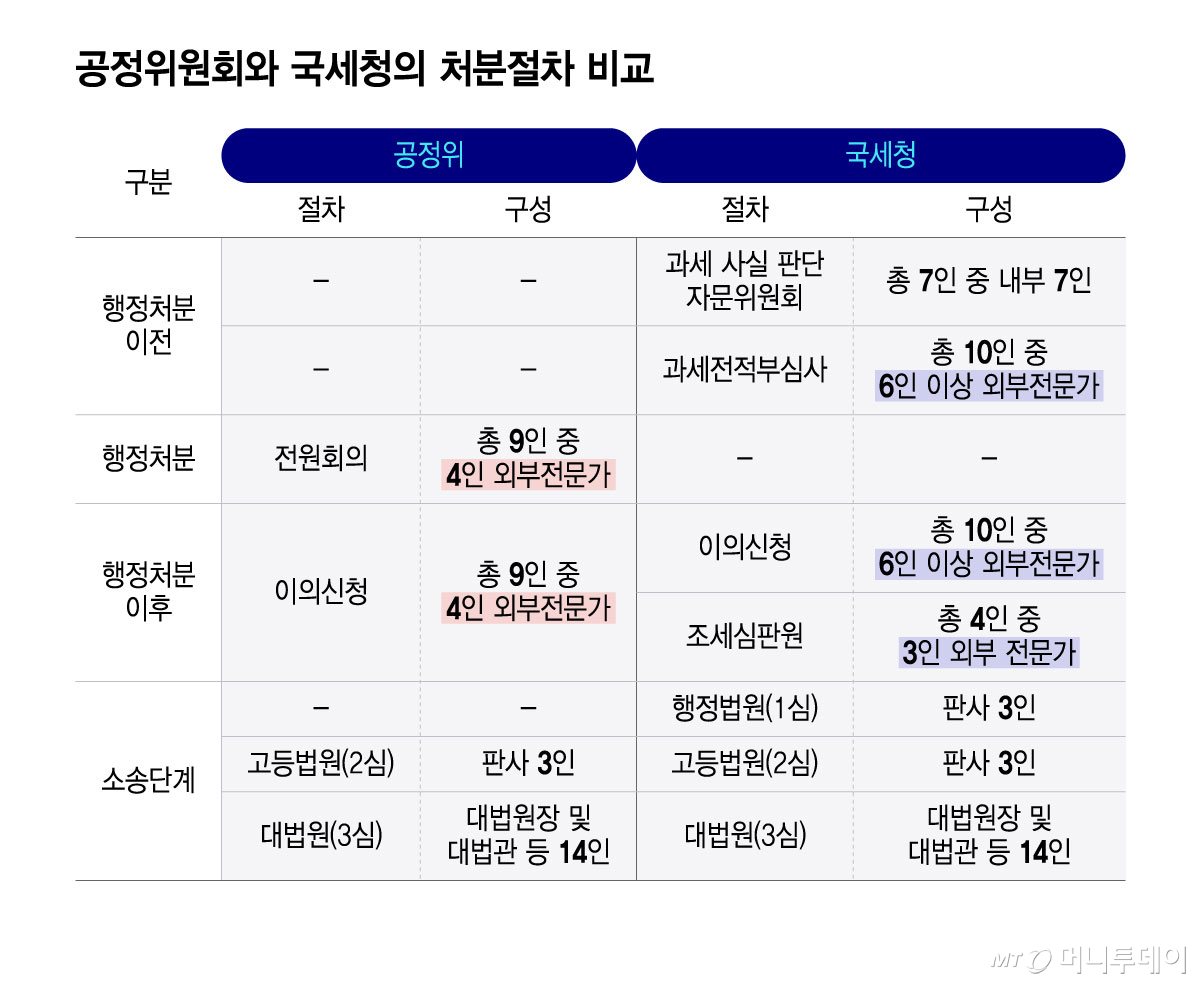
Other regulatory bodies, such as the Financial Services Commission and the Personal Information Protection Commission, face similar issues. The mere fact that an investigation by the Financial Supervisory Service has begun and sanction procedures are underway creates significant pressure on the relevant financial institution. In addition to fines, various sanctions such as institutional warnings, partial business restrictions, and disciplinary actions against employees may follow, placing a considerable burden on management.
Moreover, financial institutions rely more heavily than general corporations on regulatory oversight and licensing from financial authorities. Consequently, the sanction procedures by supervisory agencies inevitably function as significant pressure tools. This explains the substantial gap between the legal distinction that 'administrative sanctions differ from criminal penalties' and their actual impact in the market.
South Korea's judicial system separates law enforcement authorities from judicial bodies. Just because police or the prosecution service investigate allegations does not mean those institutions ultimately determine guilt or innocence. An independent court re-examines evidence and arguments to make a judgment. In contrast, in Korea Fair Trade Commission cases, a significant portion of the process—from investigation to deliberation and decision-making—is handled within a single administrative institution. The Korea Fair Trade Commission operates under a unique structure that functions both as an executive agency and an independent quasi-judicial body.
As a result, even if the Korea Fair Trade Commission imposes penalties such as fines on a specific company, the company may be found not guilty through subsequent administrative litigation. However, disciplinary actions against the company's employees are implemented immediately, and even if the outcome changes later, the company remains branded as guilty. During this period, the company's stock price and corporate valuation decline, causing economic damage. Even if the company wins the lawsuit two or three years later, recovering losses incurred during that time is difficult.
Administrative institutions such as the National Tax Service ensure the fairness and objectivity of penalties through administrative reviews and tax review proceedings before filing a first-instance administrative lawsuit after an administrative penalty. However, the Korea Fair Trade Commission lacks proper adjudicative functions in its administrative penalties, resulting in low fairness and credibility despite holding the effect of a first-instance judgment. There is an irrationality in having to challenge the validity of an administrative penalty at the second instance (Seoul High Court) without going through a first-instance trial.
Japan, which also applied a two-tier trial system for fair trade cases like South Korea, amended its laws at the end of 2013 to address such issues. It changed the jurisdiction for appeals against Korea Fair Trade Commission decisions from the Tokyo High Court to the Tokyo District Court (first-instance court), transitioning to a three-tier system.
In court proceedings, multiple rounds of arguments and rebuttals occur across several trial sessions. In contrast, the Korea Fair Trade Commission's deliberation process typically involves only one session where the accused appears, presents their views, and a decision is made immediately. Critics argue that this fails to adequately protect the accused's right to present their case and defend themselves.
Especially when the same institution exercises both deliberative and decision-making authority, it is difficult to ensure equal standing between the accused and the Korea Fair Trade Commission. The accused faces concerns of constitutional violations regarding the right to a fair trial, potential lack of neutrality and fairness on the part of the Korea Fair Trade Commission, and issues of equity compared to other administrative cases. This is why there are calls for the Korea Fair Trade Commission to improve its system by fully separating investigative and deliberative functions and transitioning from a two-tier to a three-tier trial system.
Former Judicial Jeong Chaek-yeon-gu (Director) Hong Ki-tae (lawyer at Taeyang Law Firm) stated, "In fair trade law violation cases, where fact-finding and evaluation are intertwined, a single-instance fact-finding structure has many weaknesses." He added, "Internal review is merely an internal procedure; equating it with judicial review is problematic. Therefore, there is no need to confine the Korea Fair Trade Commission within a two-tier trial system."

 in LIVING

