

![[Seoul=NEWSIS] Reporter Kim Myeong-nyeon = Democratic Party of Korea Euljiro Committee Chairman Min Byung-deok and former National Assembly Speaker Woo Won-shik, along with other Democratic Party of Korea lawmakers, are seen pushing shopping carts during the "Chuseok Homeplus Survival Shopping Campaign" held at the Seoul Homeplus Yeongdeungpo store on the afternoon of the 1st. September 1, 2026. kmn@newsis.com /Photo=Kim Myeong-nyeon](https://thumb.mt.co.kr/cdn-cgi/image/f=avif/21/2026/10/2026101113292156248_1.jpg)
The sense of crisis over liquidation (bankruptcy) has risen again for major mart Homeplus just two months after its reopening. Recent sales have plummeted to approximately 30% of the level immediately after reopening, putting the urgently procured 20 billion won in DIP (Debtor-in-Possession financing) at risk of depletion. The atmosphere is also such that the M&A (mergers and acquisitions) card, considered the last chance for recovery, is gradually losing its momentum.
According to industry sources on the 11th, total sales across Homeplus's 67 stores during the holiday period in early this month dropped to an average of 3 billion won per day, a level roughly 30% of the 10.9 billion won recorded on the first day of reopening.
This is interpreted as being due to a sharp decline in customer revisit rates, caused by the inability to properly stock shelves because product supply was hindered by unsettled supplier payments. An industry official explained, "Homeplus failed to secure the most popular gift sets for the Chuseok peak season due to payment settlement issues, and with most products other than some fresh food being filled with PB (private brand) items, its competitiveness has significantly declined."
In the early days of Homeplus's reopening, although a "Save Homeplus" movement was launched by political circles and sales temporarily recovered to normal levels, it effectively amounted to only a "brief surge in popularity." Recently, the departure of anchor tenants (core leased stores) such as Olive Young and Daiso from the stores is also cited as a background for the decline in customer foot traffic.
It is also pointed out that the 20 billion won in DIP injected in early last month was partially used to cover overdue supplier payments and employee salaries, meaning it could not be actively utilized for new product supply, which is most critical for normalizing operations. Consequently, Homeplus has fallen into a vicious cycle of deepening sales slumps and worsening financial difficulties.
Homeplus has ultimately moved to reduce its workforce. It is accepting applications for voluntary retirement from the 7th until the 22nd. Typically, applicants for voluntary retirement receive severance pay along with several months' salary as consolation payments; however, this time, the only condition attached to applicants was the lump-sum payment of overdue salaries and holiday bonuses. This signifies that the company lacks financial flexibility.
Efforts to push forward M&A, the last remaining card for recovery, are also stagnant. Homeplus's sale agent sent teaser letters to potential acquirers last month, but it appears no company has expressed concrete intent to acquire. Major distribution companies previously mentioned as acquisition candidates are also denying the possibility of acquiring Homeplus. This is due to concerns that risks such as strong labor union intervention in management and contingent liabilities would be substantial for an acquirer to bear.
Industry observers predict that the liquidation crisis will intensify again from late this month, after the National Assembly's budget hearings. This is because if sales recovery remains slow and deficits accumulate due to expenditures on supplier payments and labor costs, as is currently the case, financial difficulties could erupt at any time.
If the bulk sale of Homeplus's remaining business units, including its large mart operations, fails, it is widely predicted that the company will proceed with de facto liquidation through partial store sales.
Immediately after Homeplus filed for corporate rehabilitation last year, the accounting firm assessed the company's going-concern value at 250.59 billion won and its liquidation value at 368.16 billion won, with the liquidation value being more than 1 trillion won higher. In principle, this would have led to liquidation; however, the court accepted an application for a rehabilitation plan extension of over one year and six months, considering the employment instability and social impact resulting from the mass layoff of approximately 20,000 Homeplus employees.
MBK Partners, Homeplus's largest shareholder, canceled 250 billion won worth of common shares in mid-last month to reduce the burden on a new acquirer. However, due to accumulated deficits and sluggish sales causing a sharp drop in the company's value, there has been little reaction in the M&A market.
Accordingly, predictions are emerging that Homeplus is highly likely to proceed with partial store sales if M&A fails. MBK has previously sold prime stores located in core commercial areas with high foot traffic or near subway stations, such as the Gyeonggi Bucheon Sangdong branch and Daejeon Dunsan branch, to real estate development companies for 30 billion to 40 billion won.
It is also discussed that Homeplus might sell stores in batches of around 30, similar to past Kim's Club Mart sale cases, or that Chinese e-commerce companies like AliExpress or Temu might purchase some stores as logistics hubs for rapid fresh food delivery. However, the consensus is that even these types of sales are unlikely to materialize if conditions such as employment succession for employees are presented.
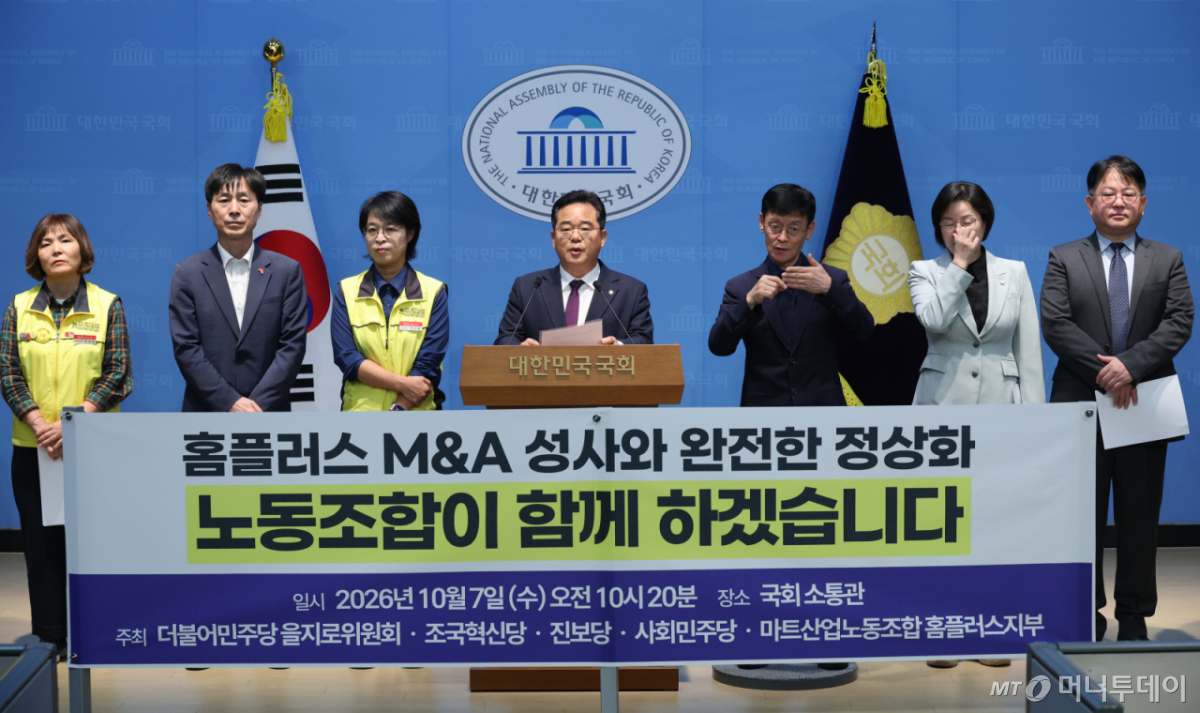
The company's labor union argues that partial store sales accompanied by workforce reductions, such as voluntary retirement, amount to de facto bankruptcy. In this case, it is predicted that mass unemployment of approximately 20,000 people will become a reality, and the issue will once again become a flashpoint in the political landscape.

 in LIVING

