

Korean agricultural machinery is expanding its territory into Europe. By leveraging products and services tailored to local conditions, ranging from tractors of various sizes adapted to different agricultural environments to lawn mowers, the industry is also penetrating the landscaping and facility management markets.
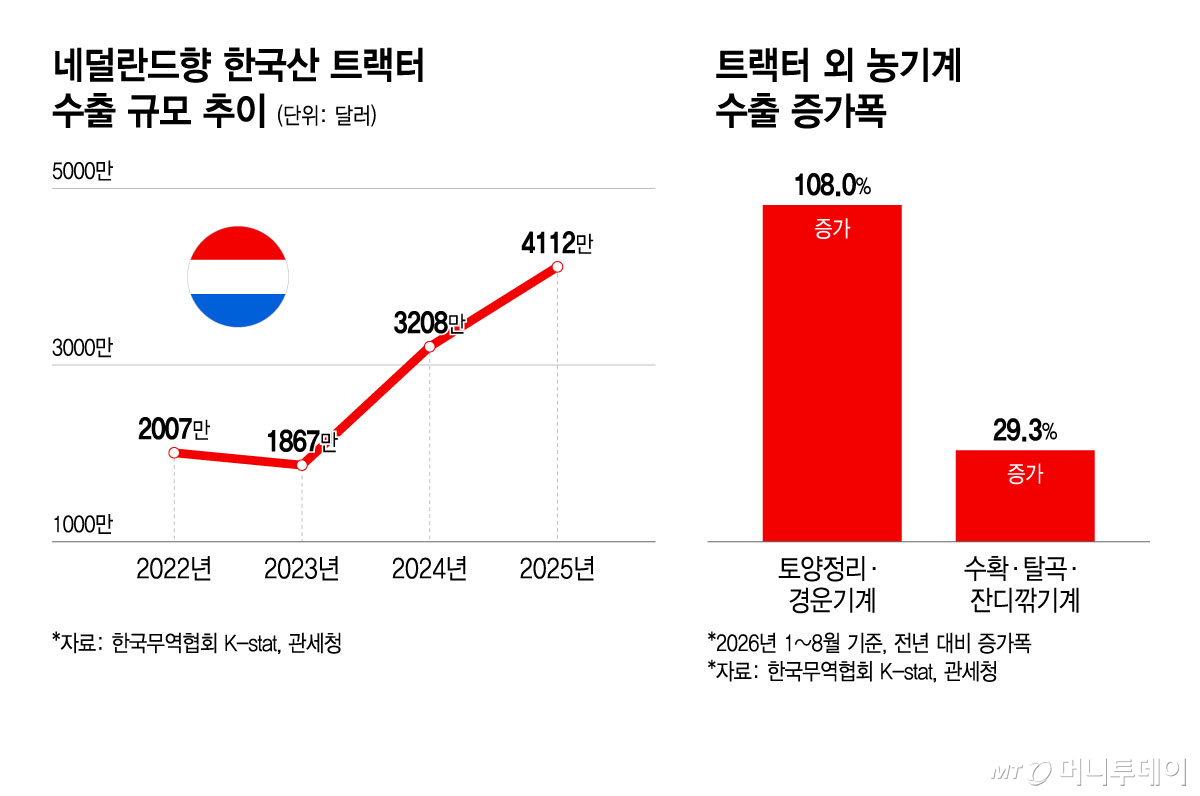
According to the Ministry of Agriculture, Food and Rural Affairs on the 5th, agricultural machinery exports in the first half of this year reached $763 million, a 3.2% increase from the same period last year. In particular, exports to the Netherlands, where domestic agricultural machinery companies have European subsidiaries, surged by 65.7% to $45.7 million. This contrasts with the approximately 2% decline in North American exports during the same period.
While tractors accounted for $41.12 million as the main export item, the growth of work-specific agricultural machinery has been notable recently. According to Korea Customs Service import and export trade statistics, exports of soil preparation and tillage machinery increased by 108% from the same period last year in January through August this year, while exports of harvesting and threshing machines and lawn mowers rose by approximately 29.3%.
Europe is a market where global agricultural machinery companies such as John Deere and CNH Industrial from the United States, Kubota from Japan, and local firms like Germany's Claas and Italy's SDF compete. Domestic companies, which are latecomers to this market, are gradually expanding their foothold by leveraging locally customized products and sales networks.
Daedong’s overseas-exclusive brand KIOTI’s European subsidiary saw its revenue in the first half of this year reach 74.1 billion won, a 31% increase from the same period last year. Its local market share rose from 2.3% to 2.5%. A diverse product lineup, including tractors, zero-turn lawn mowers (ZTR), small loaders, and utility task vehicles (UTV), is being sold in the local market.
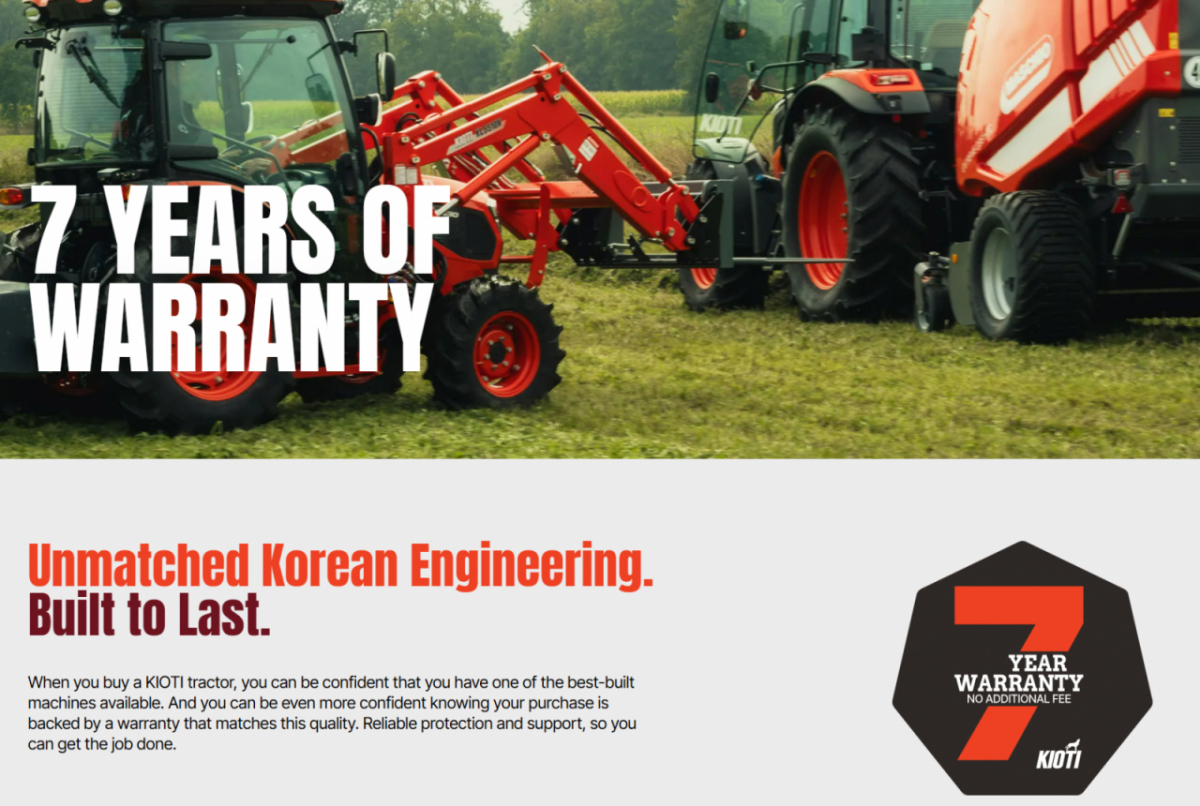
In addition to Germany and the United Kingdom, the company has expanded its presence into Spain, Italy, and France, and secured a new general distributor in Poland. Since last year, a seven-year, 5,000-hour free warranty has been applied to all tractors sold in Europe. Considering that the free warranties of European agricultural machinery are typically at the level of three to five years, this long warranty period is one of Daedong’s competitive advantages as a latecomer.
The company is also approaching the tractor market with strategies tailored to the agricultural environment of each country. In France and Spain, which have many orchards growing fruits such as grapes, it sells small "Narrow" tractors with reduced vehicle width to fit narrow planting intervals. Meanwhile, in Eastern European countries like Poland, where farmland is vast, it supplies medium-to-large tractors such as the 140th-horsepower HX series.
TYM, which established a European subsidiary in Amsterdam, Netherlands, in 2024, also made a strategic move in Europe this year by transitioning to a direct sales system by the manufacturer in Germany and France. The reason domestic companies are focusing on Europe is that the North American agricultural machinery market, its largest market, has recently been sluggish. Due to high interest rates and declining farm incomes, purchase demand has contracted, causing the size of the North American agricultural machinery market in the first half of this year to shrink by 13% compared to the same period last year.
The next battleground for domestic agricultural machinery companies in Europe is "high value-added" agricultural machinery. Domestic firms are accelerating the development of products and solutions that integrate autonomous driving, artificial intelligence (AI), and precision agriculture technologies. Daedong plans to capture overseas premium demand by leveraging AI-based driverless tractors and other agricultural machinery along with precision agriculture solutions.
An industry official said, "The European market requires detailed entry because the size of farmland and crops grown vary significantly from country to country." The official added, "How quickly domestic companies can establish products and distribution networks tailored to the characteristics of each country will determine the stability of their European business."

 in LIVING

