

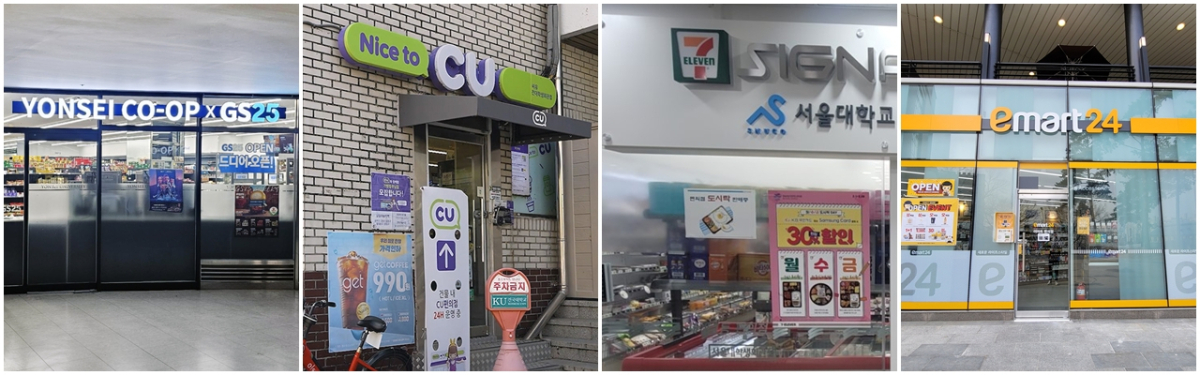
The convenience store industry is engaged in fierce territorial competition over university campuses. The brands entering each university vary, resulting in a clear distinction of the "dominant convenience store" on a campus-by-campus basis.
According to distribution industry sources on the 5th, GS25 operates 206 stores within university campuses nationwide. CU operates approximately 300 stores, Seven Eleven has 95, and E-Mart24 runs 119 stores. While CU has the highest number of stores across all universities nationwide, the brand presence varies significantly when looking at individual universities.
Convenience stores on university campuses are operated through methods such as individual bidding, where brands bid for specific store locations, and bulk bidding, where a particular brand secures operating rights for multiple stores within a campus.
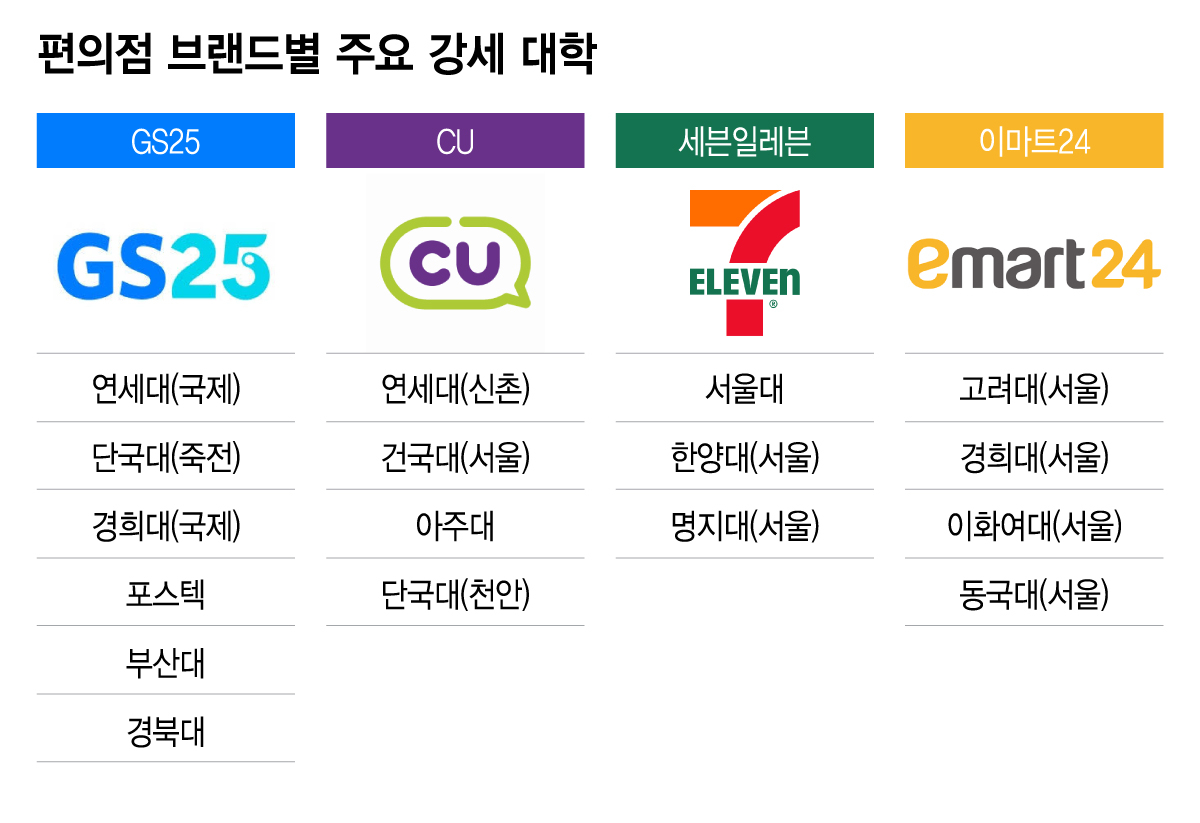
Examining the entry status by major university, Seven Eleven holds the most stores at Seoul National University with eight. At Korea University's Anam Campus, E-Mart24 has the highest number with five stores, while CU operates 10 stores at Yonsei University's Sinchon Campus.
In addition, GS25 holds the largest number of stores at institutions such as POSTECH and Dankook University's Jucheon Campus, while CU shows strong presence at Konkuk University's Seoul Campus and Ajou University. Seven Eleven operates a relatively large number of stores at Hanyang University's Seoul Campus, and E-Mart24 has a significant presence at Kyung Hee University's Seoul Campus and Ewha Womans University.
There are also cases where a specific brand takes charge of convenience store operations within a campus through bulk bidding. GS25 operates all three stores at Yonsei University's International Campus (Songdo). In the case of CU, it is operating 13 stores at Dankook University's Cheonan Campus.
University campuses are special commercial areas with distinct seasons for the start of the semester and breaks, as well as clear daily routines, resulting in significant sales fluctuations depending on the time period and hour. Nevertheless, the convenience store industry evaluates university campuses as attractive commercial zones. This is because they can achieve higher sales than regular stores during the semester-start period when student foot traffic is concentrated. In fact, sales during the semester-start period were found to be up to four times higher compared to regular stores.
However, since student demand decreases during breaks, it is important to achieve high sales during the semester while reducing the operational burden of the off-season. Accordingly, the convenience store industry has introduced unmanned and HYBErid operating models on university campuses to reduce labor costs and defend profitability during the off-season.
University campuses are also utilized as spaces to test new retail tech. This is because they can apply new technologies and services, such as unmanned payment, to college student customers who are familiar with digital devices and non-face-to-face services, and verify operational results.
An industry official stated, "Universities are a representative commercial area with high potential customer demand, and the actual performance is good," adding, "Operational experience accumulated in university stores can be expanded and applied to other commercial areas and stores."

 in LIVING

