

![[Seoul=NEWSIS] Reporter Hwang Jun-seon = Homeplus, which is undergoing corporate rehabilitation proceedings, cleared a major hurdle toward business normalization after the creditors' meeting held at the Seoul Rehabilitation Court on the 2nd approved the rehabilitation plan and received court approval. The photo shows a Homeplus store in Seoul on the 3rd. September 3, 2026. /Photo=Hwang Jun-seon](https://thumb.mt.co.kr/cdn-cgi/image/f=avif/21/2026/10/2026100715522837411_1.jpg)
Although MBK Partners (hereinafter MBK) canceled all of its common shares in Homeplus, lowering the barrier for finding a new owner, actual acquisition movements remain limited. Analysts point out that delays in discussions to relax operating regulations for large marts are acting as a variable in investment decisions, making it difficult to gauge post-acquisition growth potential.
According to industry sources on the 10th, approximately 2.4 million common shares of Homeplus held by MBK through a special purpose vehicle were fully canceled without compensation on the 14th of last month. The value of these shares is approximately 250 billion won. This measure was part of the Homeplus rehabilitation plan approved by the court on the 2nd of last month and has now been executed.
Although the sale process has proceeded since the approval of the rehabilitation plan last month and the share structure has been organized, it is difficult to say that acquisition appeal has increased based on this alone. For a potential buyer, how to normalize and grow the business after acquisition is just as important as the purchase price. In particular, the numerous challenges that must be addressed—such as restoring store competitiveness, competing with e-commerce, and regulatory uncertainty—are burdens, especially given the sluggish state of the large mart industry.
Furthermore, even if a buyer intends to plan new business ventures after acquisition, it is difficult to calculate specific investment scales and profitability while the status of regulatory relaxation remains undetermined. It is also not easy to fully reflect the additional growth potential expected from regulatory relaxation in the acquisition plan. While MBK's share cancellation has reduced the burden regarding "how much to pay," uncertainty about "how to grow it after buying" remains.
In this process, the need for discussions on relaxing large mart regulations, such as operating hour restrictions and mandatory closure days, has been highlighted again. The government has discussed regulatory relaxation for large marts since early this year, but five amendment bills to the Distribution Industry Development Act are pending in the National Assembly.
The large mart industry is seeking workarounds by building separate logistics infrastructure or expanding store-based delivery while regulations remain in place. Lotte Mart is constructing a Zeta Smart Center in Busan and has started dawn delivery services in the Busan area. E-Mart is subdividing its delivery services by utilizing stores as logistics hubs, offering options such as reserved delivery and quick delivery within approximately one hour.
This also means that separate investments and business structures must be established to respond to regulations. The reason why there are calls to address mandatory closure days in addition to dawn delivery is that dawn delivery alone has limitations in restoring the competitiveness of large marts. While utilizing separate logistics centers can somewhat circumvent operating hour restrictions, the twice-monthly mandatory closures require the stores themselves to shut down, making them difficult to resolve.
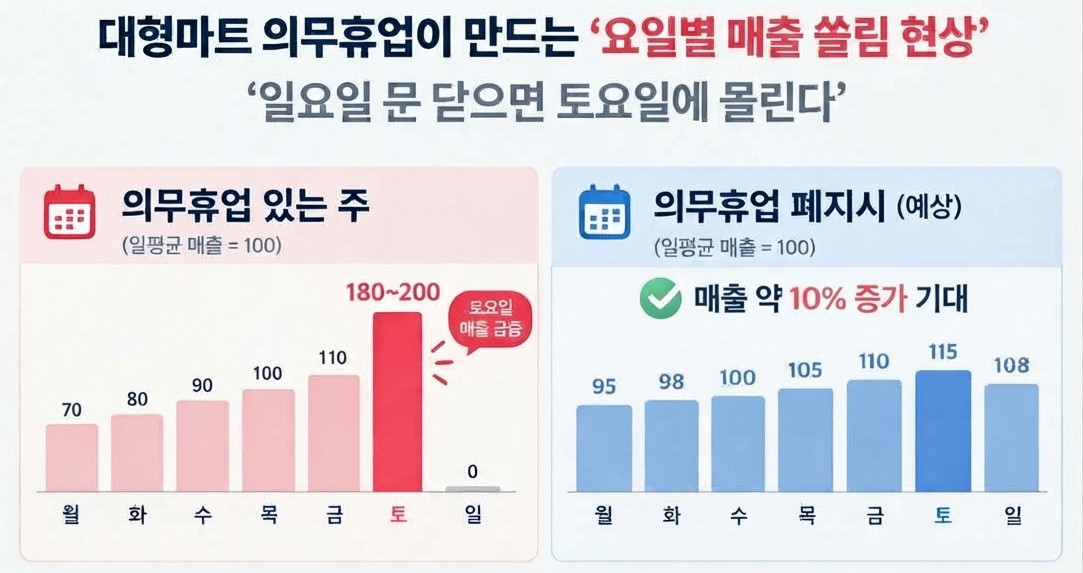
Industry insiders pointed out that the twice-monthly mandatory closures cause weekend shopping demand to concentrate on specific days, increasing inefficiencies in weekday store operations. According to Lotte Mart, if the average daily sales are set at 100, the Saturday sales index in weeks with a Sunday mandatory closure increases to 180–200, while customers drop sharply on Mondays and Tuesdays immediately following the weekend. As a result, fixed costs such as fresh food waste, labor costs, and heating and air conditioning expenses increase, reducing operational efficiency by day of the week. The company predicted that if mandatory closures are abolished, demand concentrated on weekends will be distributed across other days, improving operational efficiency and increasing sales by approximately 10%.
An industry official said, "Homeplus needs to grow its business through additional investment after acquisition, but it is difficult to formulate specific business plans in a situation where it is uncertain when and how large mart regulations will be relaxed." The official added, "Regardless of improved price conditions, if post-acquisition growth potential is not clearly visible, there is little reason for a buyer to rush."

 in LIVING

