

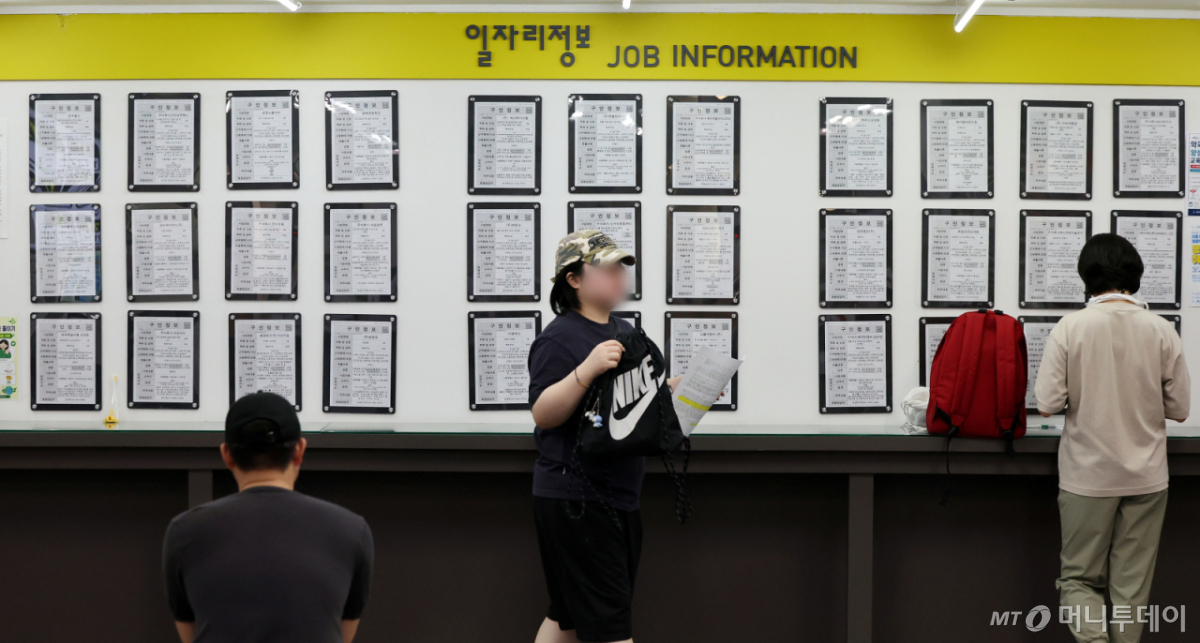
Youth unemployment jumped by the largest margin in five years and six months. The Ministry of Economy and Finance had planned to announce a youth job recovery plan on the 11th but suddenly postponed it. It is interpreted that this was because President Lee Jae-myung pointed out the youth employment problem and requested, "Please prepare innovative measures that go beyond existing frameworks." This underscores how difficult and critical youth employment has become.
Youth employment indicators continue to deteriorate. According to the recently released July Employment Trends by the Ministry of Economy and Finance, the employment rate for youth (aged 15–29) fell to 44.2%, a decline of 1.6 percentage points compared to last year. The number of employed youth decreased by 191,000, marking 45 consecutive months of decline. Amid this trend, the youth unemployment rate surged sharply by 1.3 percentage points to 6.8%, the largest increase since January 2021. In contrast, the number of employed persons aged 60 and over increased by 231,000, highlighting stark employment polarization between generations. Older workers with insufficient retirement income remain in the labor market, while young people lacking work experience cannot even cross the threshold—this is the current state of the labor market.
The government has identified AI transition, a preference for experienced hires, and the Middle East crisis as obstacles to youth employment. Even if the Middle East situation subsides, the other two issues remain as structural problems. This is because South Korea's industrial structure no longer generates jobs at the same pace as before, and job opportunities in fields preferred by young people are shrinking. The fact that employment in professional, scientific, and technical services decreased by 44,000 compared to a year ago in July clearly illustrates this trend. Additionally, layoffs in manufacturing and construction industries continue.
Government measures to resolve youth employment issues should focus on incentivizing private companies to hire young people. Government initiatives such as 'Youth New Deal,' which pours 80 billion won into vocational training and public job experience programs, are largely temporary fixes because they do not build genuine work experience for young people. Instead, the government should provide substantial tax incentives to companies that hire youth as regular employees, encouraging private firms to take action on their own. Furthermore, internship and job training programs must be designed in line with actual industry needs to ensure effectiveness. As government officials have explained, young people are trapped in a paradox: they need work experience to get hired, but they can only gain experience by being employed. The government must lead efforts to break this cycle. By strengthening tax incentives for companies that hire youth, the gap between corporate talent expectations and the capabilities of young people should be bridged at the workplace level.

 in OPINION
