

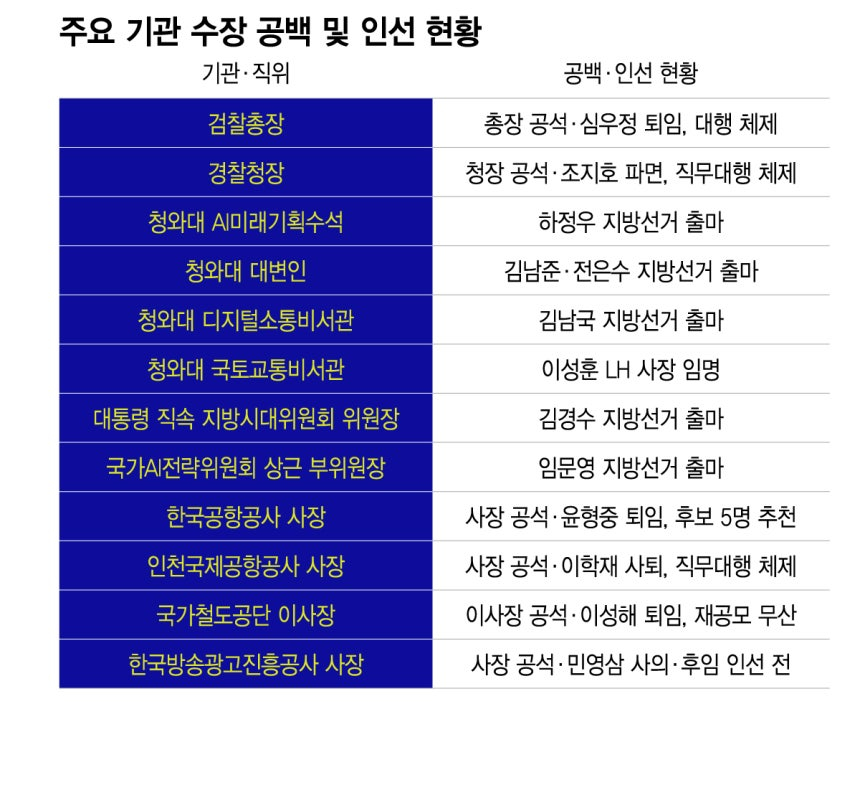
Recently, when covering appointments of heads of public institutions, the most frequently asked question is not "who will come" but "when will it be decided." This is because even after recruitment processes conclude, successors often fail to appear, leading not only to re-recruitment but also to repeated re-recruitment, resulting in a significant number of public institutions becoming accustomed to acting leadership systems.
A similar scene emerged during the President's work report on the 5th. With no head of the Prosecution Service or the National Police Agency in place, acting officials and senior executives stood before President Lee Jae-myung.
Moving down to Korea Airports Corporation, Incheon International Airport Corporation, and the Korea Railroad Corporation, "acting" becomes even more familiar. While the president's office remains unchanged and meetings proceed as scheduled, whenever major issues are raised, one often hears responses like, "The direction will be determined once a new president arrives."
The absence of a head does not immediately halt organizational operations. Flights take off and trains run, but decisions carrying heavy responsibility, such as large-scale investments or organizational restructuring, are delayed step by step until Jeong Sik (President) arrives.
The characteristic of an acting leadership system is closer to "waiting" than to "vacancy." Management teams temporarily in charge cannot predict the judgments of their successors, so they maintain existing procedures and naturally defer unresolved issues to the next meeting without reaching conclusions.
As waiting periods lengthen, organizations find it increasingly difficult to take initiative. Responsibilities continue to accumulate, yet with no ultimate decision-maker in place, maintaining the status quo becomes the safest choice.
This situation also diverges from President Lee Jae-myung's emphasis on "speed" throughout national governance. While urging swift judgment and execution on the ground, failing to appoint a responsible head in time makes it difficult to drive policy implementation effectively.
Furthermore, the long-term acting leadership system contradicts the administration's consistent emphasis on innovation and reform across the public sector since its inception. If there is no head to lead organizational changes while claiming to transform institutions, the momentum for reform inevitably diminishes.
Most importantly, many replacements of heads in public institutions were already scheduled events. Failing to fill positions whose term expiration dates have been known for years and repeatedly conducting recruitment processes makes it difficult to explain this merely as a procedure to find suitable candidates.
In some cases, leadership vacancies have persisted for over two years, yet the reasons for delays in appointments remain unclear due to the nature of personnel matters. As empty seats linger, whispers circulate both inside and outside Sejong government offices suggesting that the ruling party's "reward-based appointments" are involved.
Despite delays in appointments, no one takes responsibility. Even after the Executive Recommendation Committee completes its recommendation procedures, the relevant ministries repeatedly state they are merely waiting for the appointing authority's decision.
The saying "personnel matters are everything" did not arise arbitrarily. It is only natural that voices expressing disappointment over significant shortcomings in applying the personnel principles of placing the right person in the right position at the right time can be heard regarding this situation.

 in OPINION

