

[For more diverse corporate information on the startup mentioned in this article, please visit the Unicorn Factory big data platform 'Data Lab'.]

"In the future, the competitiveness of industrial AI will not depend on how large a model is created, but on how deeply it understands the actual work site."
"If general-purpose AI is a model that knows everything, vertical AI is an expert who knows a specific industry best," said Lee Hoon of AiMatics in a recent interview with MoneyToday's startup media platform Unicorn Factory. He added, "Ultimately, at industrial sites, AI that understands the on-site context will create greater value than general-purpose AI."
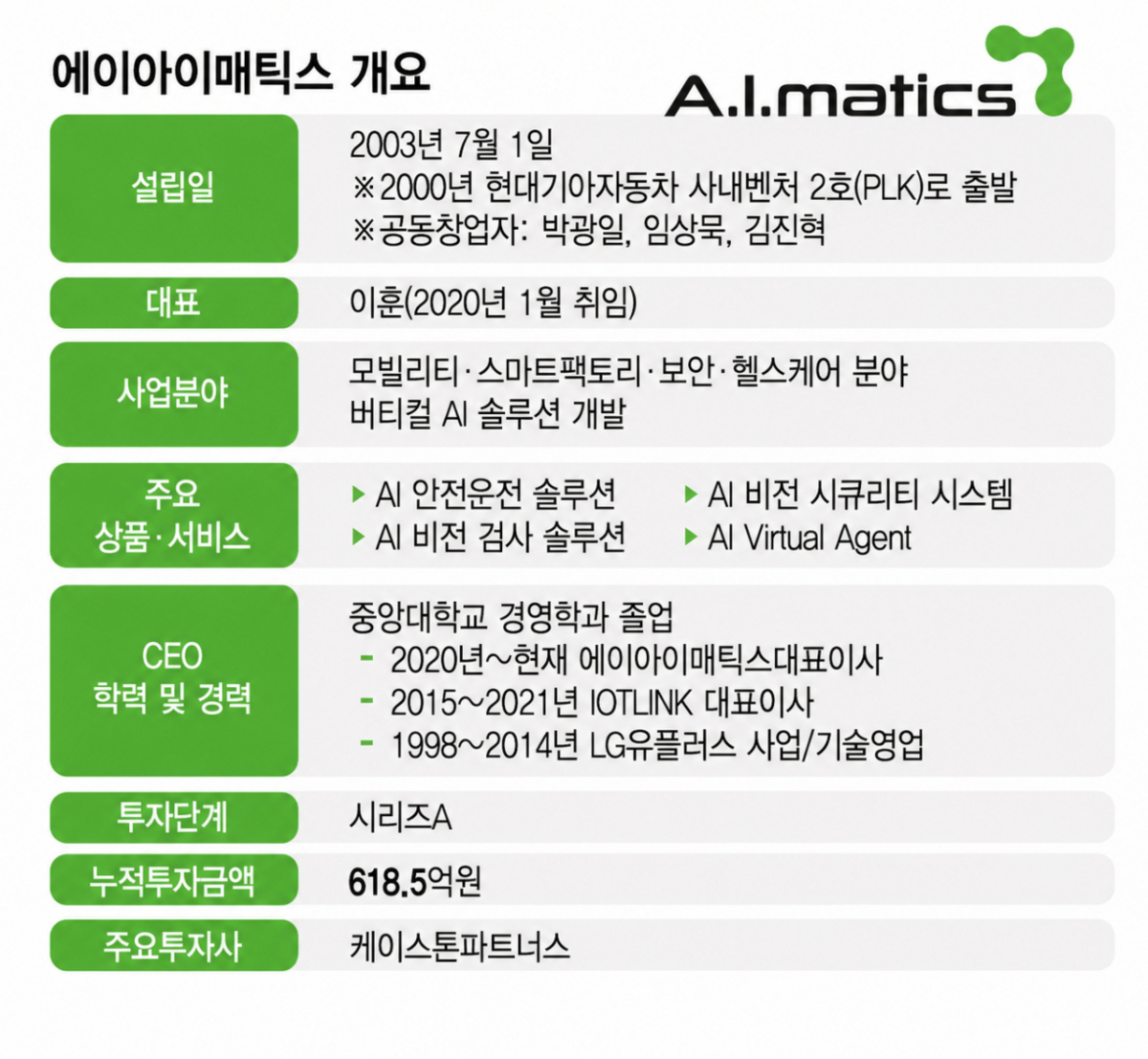
AiMatics began as an internal venture of Hyundai Motor in 2000. It grew by developing an AI safety driving solution that detects over 30 types of risky behaviors in real time using vehicle interior and exterior camera footage, including drowsy driving, mobile phone use while driving, failure to monitor the road ahead, and traffic signal violations. Based on driving data, the company calculates individual driver safety scores and provides customized coaching and vehicle management services, contributing to accident prevention for companies and reductions in insurance premiums and operating costs.
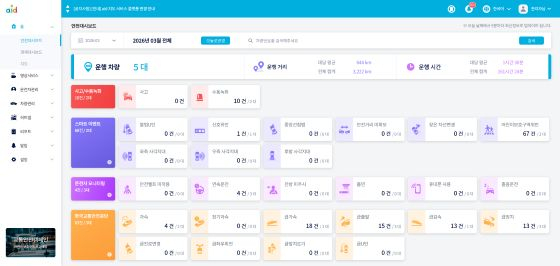
The company is moving away from its car-centric business model to develop its own 'Vision AI' models, expanding its operations into manufacturing, mobility, healthcare, and security. Lee Hoon stated, "In the past, we were the first in the world to develop lane departure prevention and color recognition technologies, but growth was limited within a subcontracting structure for large corporations. We have now shifted our business strategy toward integrating proprietary AI models with existing technologies to secure independent competitiveness."
Currently, the company supplies Vision AI inspection solutions in manufacturing, facial recognition access control systems in security, and enterprise AI chatbots in customer support. In healthcare, it is also developing an AI solution that analyzes electrocardiograms (ECG) to diagnose arrhythmias.
At the core of these solutions lies the company's self-developed AI model, 'aimNet'. Its key feature is optimization to run AI smoothly even on low-cost semiconductors from Ambarella and Rockchip in the 20,000-won range, instead of relying on NVIDIA GPUs priced over 20 million won.
AiMatics identifies data accumulated at actual work sites as the source of its competitiveness. The company was the first in Korea to receive Class A certification for unstructured data quality from an institutional investor under the Ministry of Science and ICT. Lee Hoon explained, "We analyze driving and accident footage from over 11 million clips collected from approximately 10,000 pieces of equipment, breaking them down into 1-second or 0.5-second segments to examine context before and after each clip." He added, "The core asset lies in the technology and know-how for accumulating on-site data and using it to improve AI accuracy."
AiMatics is currently focusing its efforts on smart factories. Lee Hoon noted, "China has already implemented 'dark factories' where only one person operates across ten production lines with lights off. In Korea, we expect automation to spread even to first- and second-tier suppliers within the next three to four years."
AiMatics utilizes the production lines of its largest shareholder, Dreamtek, and its affiliate Namuga as testbeds to repeatedly validate AI models and accumulate manufacturing data.
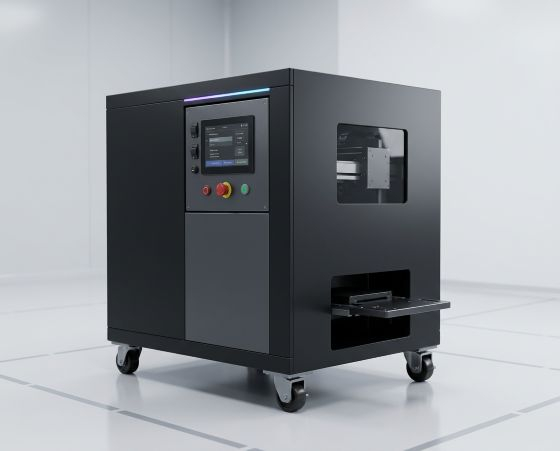
In particular, the company is targeting the 'last 10%' of manufacturing sites. While most production lines are already automated, final visual inspections still often require human workers to check for scratches, missing parts, or assembly defects.
AiMatics explained that by leveraging AI vision technology, it can detect micro-defects down to 3 micrometers (㎛) and achieve a non-detection rate of 0% and an over-inspection rate of 3% or less. The company is also building systems that link products after visual inspection with AMRs (autonomous mobile robots) for automatic transfer to the next process.
Lee Hoon stated, "Large corporation production lines are already highly automated, leaving little room for new AI entry. On the contrary, first- and second-tier suppliers with insufficient in-house AI development capabilities represent a much larger market and potential customer base." He added, "Ultimately, labor costs are the final element for cost reduction at manufacturing sites. Our goal is to reduce labor costs and boost productivity by automating part transport and final visual inspections."
"[MoneyToday startup media platform Unicorn Factory]"

 in TECH


