

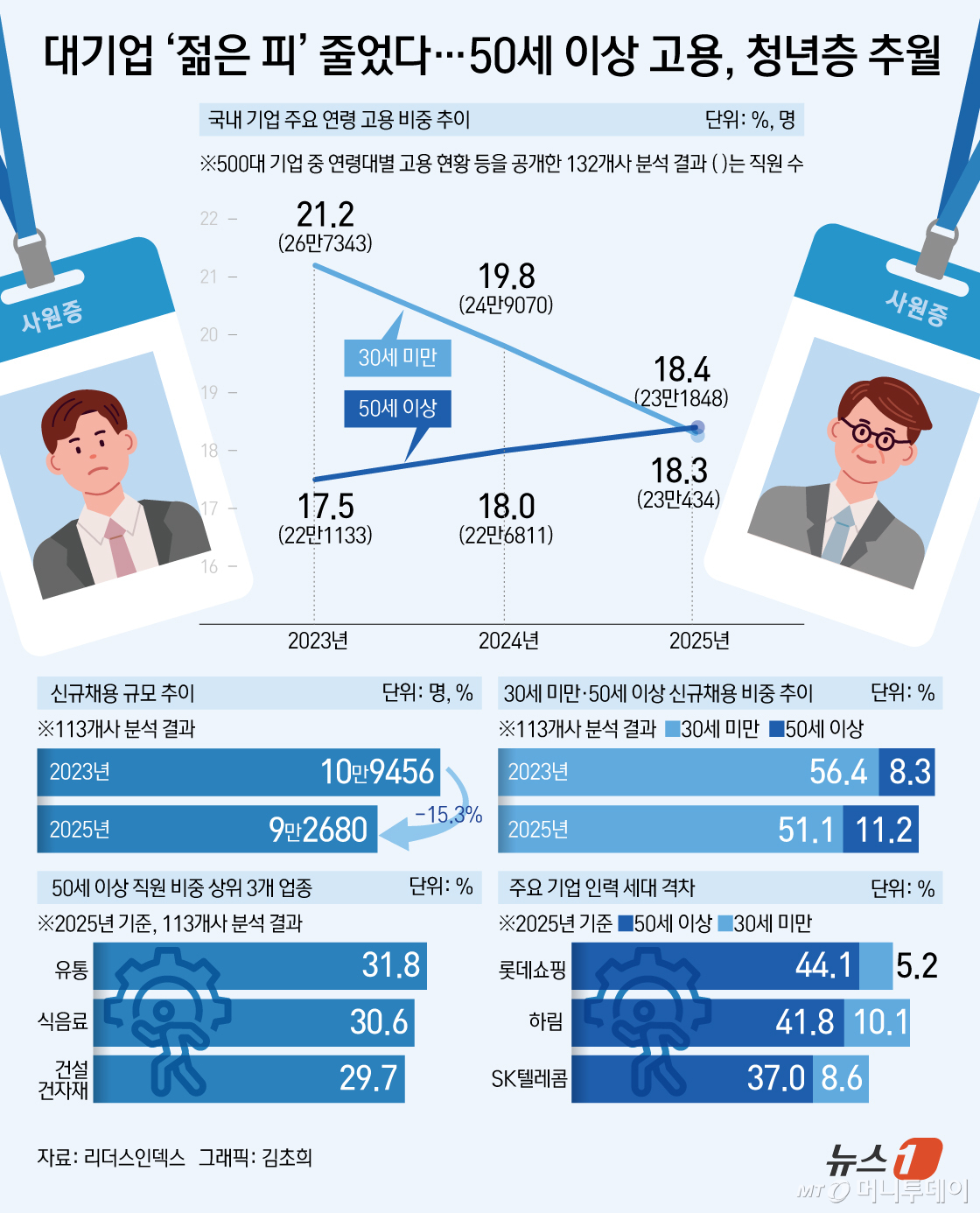
While youth employment has declined, employment among middle-aged adults has risen, revealing a generational reversal in job distribution within the labor market. According to a Bank of Korea report, 285,000 jobs for young people disappeared over the past four years. Notably, the decline in youth employment was particularly pronounced in industries highly exposed to AI (artificial intelligence), while employment among those in their 50s continued to grow. An analysis by corporate research firm Leaders Index also showed that new hiring by major domestic corporations has decreased by approximately 15% over the past two years, whereas the number of employees aged 50 and above has increased by nearly 5%. As the proportion of youth under 30 within large corporations declined, the share of middle-aged workers aged 50 and above surpassed it.
This generational employment polarization is the result of a convergence between changing hiring paradigms in major corporations and technological innovation. Large companies have abolished or scaled back regular recruitment drives and shifted toward continuous hiring focused on experienced professionals. Coupled with a trend extending retirement ages, this has delayed the departure of middle-aged workers from organizations, stagnating internal workforce circulation.
The spread of AI technology is also detrimental to youth employment. AI has rapidly replaced unskilled tasks that were previously handled by new hires. In contrast, middle-aged workers possessing face-to-face collaboration skills, seasoned on-site experience, and the ability to make complex decisions have remained relatively safe from AI-related threats.
If left unchecked, young people will be blocked from accumulating tacit knowledge on the job and honing their skills, ultimately causing the seeds of talent needed to lead future industries to wither. To restore a "career ladder" that allows young workers to gain experience and receive mentorship from established generations, it is essential to develop vocational training and talent development programs suited for the AI era. If companies find it difficult to increase hiring immediately, the government should significantly expand "government-corporate collaborative projects" through public support, creating opportunities for young people to build their careers.
Outdated labor regulations also require reform. The shift by companies toward hiring experienced professionals stems partly from a rigid labor market where employers feel they cannot easily dismiss workers once hired. With rising labor costs for the growing middle-aged workforce, companies lack the capacity to hire new graduates. Overly protective employment policies have safeguarded the job privileges of established generations while depriving young people of even the opportunity to gain practical work experience. Employment policies must not remain limited to superficial measures such as pressuring companies to hire youth or providing short-term subsidies. Structural barriers hindering workforce circulation must be addressed first. We must urgently implement labor reforms that shift from seniority-based wage systems to performance- and job-based models, thereby alleviating employment rigidity.

 in OPINION
