

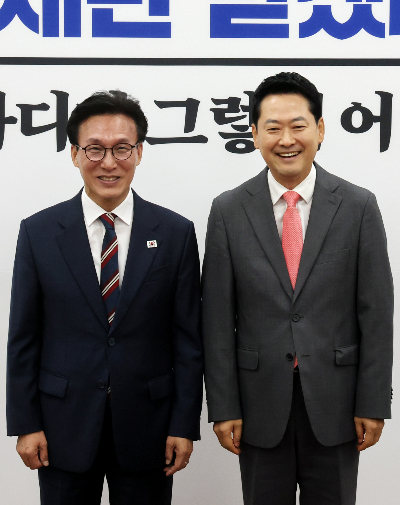
The opposition and ruling party leaders met on the 24th. This was the first meeting between Democratic Party of Korea Kim Min-seok (CEO), elected at a national convention, and People Power Party Leader Jang Dong-hyeok just one week after Kim Min-seok (CEO) took office. Both party leaders agreed in principle to engage in frequent dialogue. However, no significant progress was made on pressing issues such as the ongoing vacancy in Supreme Court appointments, budget deliberations based on excess tax revenue, and proposed revisions to real estate taxation policies.
Excluding formal events, this marks the first meeting between Yeo Ya (CEO) and Jang Dong-hyeok (CEO) since a previous encounter last April involving President Lee Jae-myung, then-Democratic Party Leader Jeong Cheong-rae, and Jang Dong-hyeok (CEO). During this brief meeting, Jang Dong-hyeok (CEO) proposed that excess tax revenue and the Future Response Fund be used for middle-class citizens, ordinary people, and youth under strict control of the National Fiscal Act. Kim Min-seok (CEO) expressed agreement in principle on a theoretical level.
Regarding the controversy over written nomination procedures for Supreme Court Chief Justice Cho Hee-dae's candidate, Jang (CEO) stated that "it must not be linked to presidential trials," while Kim (CEO) maintained a parallel-line position citing "procedural issues." Regardless of differing perspectives, given that prolonged vacancies in the Supreme Court continue to harm citizens, both Yeo Ya (CEO) and Cheong Wa Dae must work together to resolve this issue.
This meeting represents clear progress compared to last year when Jeon (CEO), then-leader of the Democratic Party, rejected dialogue with the People Power Party leader by stating "handshakes are for people." However, considering ongoing challenges such as the Middle East crisis, youth unemployment, and instability in the real estate market, inter-party dialogue must become more active. The previously discussed framework for a tripartite consultation body between the ruling party, opposition, and government—proposed after the April meeting between the President and Yeo Ya (CEO)—has not been properly implemented.
The opposition and ruling parties, including the Democratic Party and People Power Party, have clashed repeatedly in standing committees and plenary sessions where legislation is debated. In standing committees, differing opinions often led to mutual verbal attacks and heated exchanges. In plenary sessions, contentious bills proceeded through unilateral agenda-setting, yes/no debates, filibusters, forced suspensions, and voting—far from reaching consensus-based resolutions. To address livelihood issues long criticized as neglected by both parties and restore political functionality, the shared understanding among Yeo Ya (CEO) to "meet frequently" must translate into concrete action. The ruling and opposition parties must also collaborate on discussions regarding tax reform proposals including real estate policies, methods for utilizing excess tax revenue, and budget deliberations.

 in OPINION
