

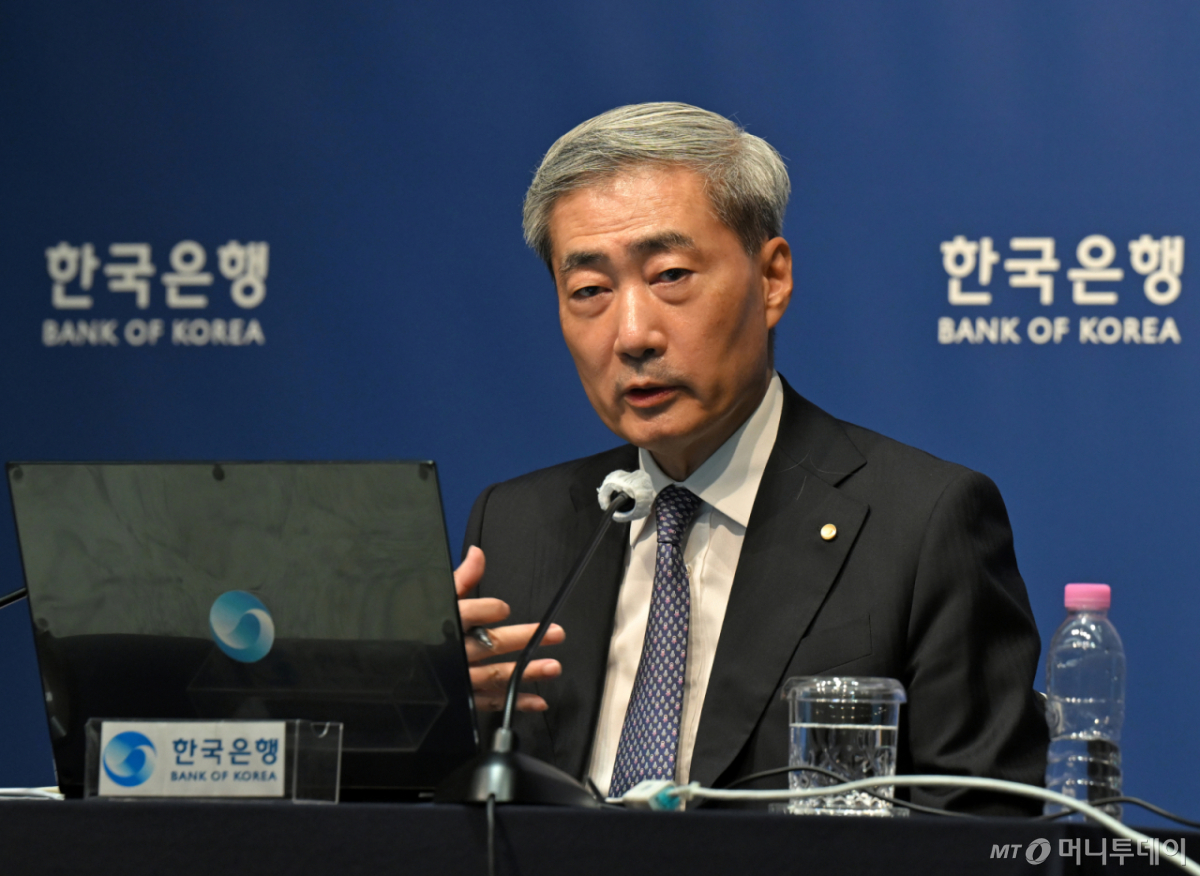
The Bank of Korea raised its base rate from an annual 2.75% to 3.0%, a 0.25 percentage point increase. This marks the second consecutive rate hike since July, ushering in a "base rate 3% era" for the first time in one year and nine months. Meanwhile, the government has signaled a record-breaking "super budget" in the range of 800 trillion won, raising concerns that the mismatch between fiscal expansion and monetary tightening will intensify.
This rate hike can be seen as a preemptive move by the Bank of Korea amid consumer price inflation falling slightly to 2.8% in July but still significantly exceeding the central bank's target of 2.0%. Governor Shin Hyun-song has consistently emphasized the message that interest rates must be raised promptly with a focus on price stability. Strong exports driven by an unprecedented boom in semiconductors have also boosted growth, easing pressure on the Bank of Korea to raise rates. The Bank of Korea revised its growth forecast for this year upward from 2.6% to 3.3%.
Tightening by the Bank of Korea is an unavoidable choice. As inflationary pressures mounted due to spillover effects from the Middle East war, the European Central Bank (ECB) moved toward tightening in June, and the Bank of Japan (BOJ) also raised its policy rate to 1%. This marks the first time in 31 years that Japanese interest rates have entered the 1st% era. The U.S. Federal Reserve is also expected to raise rates at least once more by year-end, drawing attention to Federal Reserve Chair Kevin Warsh's speech at Jackson Hole on the 28th.
The problem lies in the mismatch between the government's expansionary fiscal policy and the Bank of Korea's monetary policy. While the Bank of Korea steps on the brakes to reduce liquidity and lower inflationary pressures, the government plans to step on the accelerator by injecting money into the private sector through next year's budget in the range of 800 trillion won. If expansionary fiscal policy increases aggregate demand and fuels inflationary pressures, it could trap the Bank of Korea in a vicious cycle requiring additional rate hikes to ensure price stability.
If the two policies offset each other, what remains are their respective side effects: an expanding fiscal deficit and the burden of high interest rates. Governor Shin Hyun-song stated that if expansionary fiscal policy raises potential growth, it would not constitute a mismatch with monetary tightening; however, it takes considerable time for fiscal spending to translate into higher potential growth. While the benefits of fiscal spending are widely distributed, there is concern that the pain of high interest rates will concentrate on borrowers with variable-rate loans, self-employed individuals, and marginal firms. Fiscal policy should be determined considering the broader macroeconomic environment, including monetary policy. In particular, excess tax revenues generated by the semiconductor boom are unlikely to persist. Expansionary fiscal policies relying on such revenues must be approached with caution.

 in OPINION
