

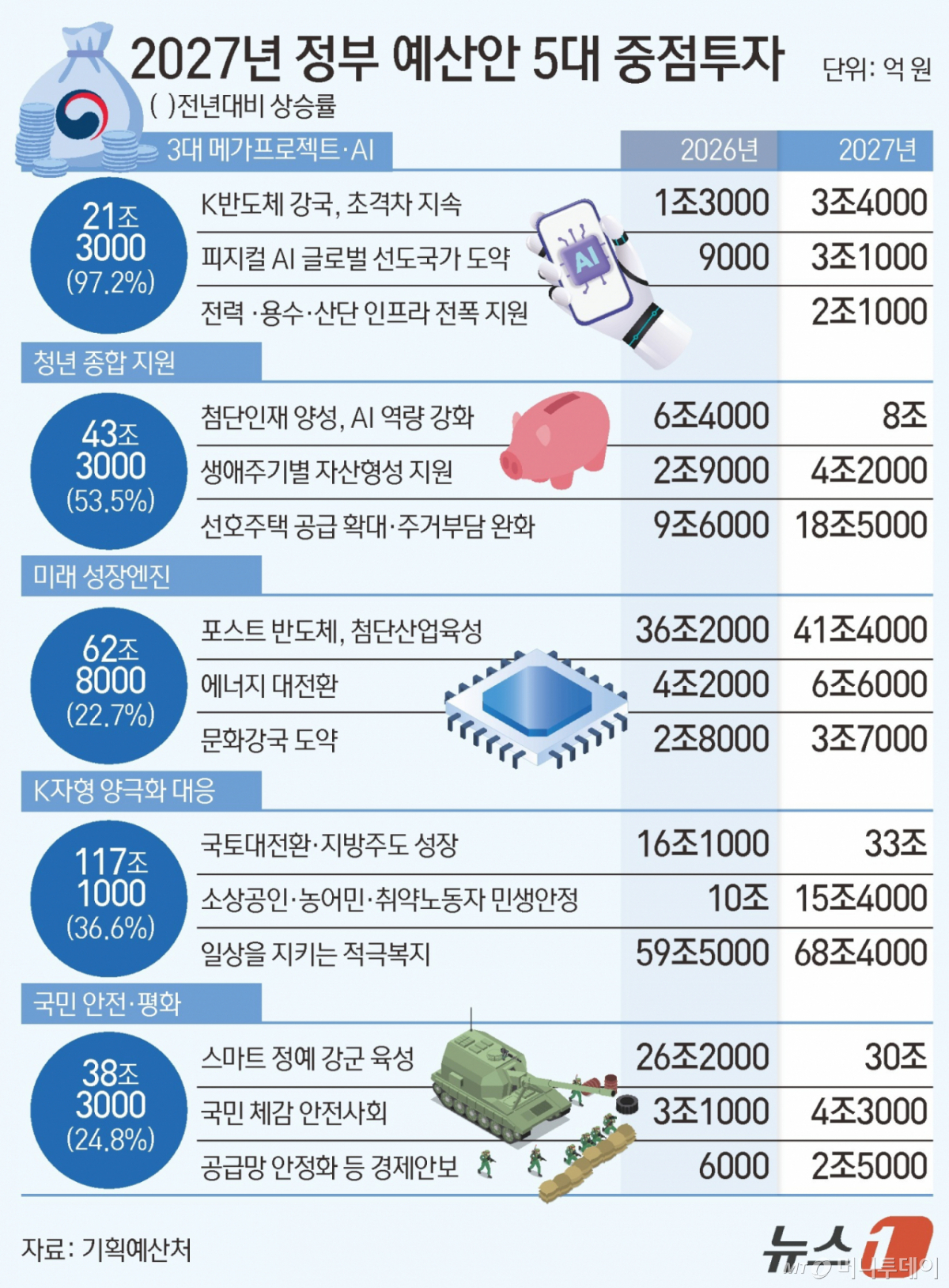
With the government finalizing next year’s budget at 821 trillion won—a 12.8% increase over this year—concerns over fiscal health are growing. A clear example is the Ministry of the Interior and Safety’s significant expansion of the Regional Love Gift Certificate budget. Next year, national debt is projected to reach the level of 1,500 trillion won, prompting voices within the Ministry of Economy and Finance that debt repayment should take priority.
Excluding local allocation taxes transferred to Local Governments next year, the Ministry of the Interior and Safety will allocate 7.634 trillion won for policy implementation. More than 40% of this funding is directed toward regional balanced growth, with the budget for supporting the issuance of Regional Love Gift Certificates rising from 1.15 trillion won this year to 1.45 trillion won next year—a 26.1% increase. The Regional Love Gift Certificate program is a policy that partially subsidizes the cost of discounted sales of gift certificates issued by local governments to boost local economic activity and increase sales for small businesses. As a result of the budget expansion, the issuance scale of Regional Love Gift Certificates next year will rise to 25.6 trillion won.
The budget for supporting the issuance of Regional Love Gift Certificates has fluctuated significantly depending on the administration. It peaked at 1.2522 trillion won in 2021 under President Moon Jae-in, then dropped sharply under President Yoon Suk-yeol to 352.2 billion won in 2023 and 299.8 billion won in 2024—reducing the amount to one-quarter of its peak. With the Lee Jae-myung administration taking office, the budget is set to surpass its previous high again next year. Increasing the Regional Love Gift Certificate budget by 300 billion won within a super-budget reliant on temporary tax revenue increases can only be seen as a populist measure. Due to last year’s amendment of the “Regional Love Gift Certificate Act,” which made national funding mandatory, this budget is difficult to reduce even when tax revenues decline.
There is insufficient rigorous performance evaluation regarding the Regional Love Gift Certificate’s positive cycle for local economies and its effect on boosting small business sales. In particular, because 5% of the discount amount must be covered by local funds, Local Governments with weak fiscal conditions face difficulties in expanding the issuance scale. Expanding the issuance scale under an 821 trillion won super-budget cannot be justified simply by appealing to regional economic revitalization while increasing national funding. This is especially true given that next year’s national debt is projected to reach 1,519 trillion won, with interest repayment on government bonds alone requiring a budget of 35 trillion won. Additionally, new projects with difficult performance measurement, such as the newly allocated 44.9 billion won for establishing a social solidarity economy promotion system, are emerging one after another. This is why the upcoming regular National Assembly session must carefully review each item of the super-budget in detail.

 in OPINION
