

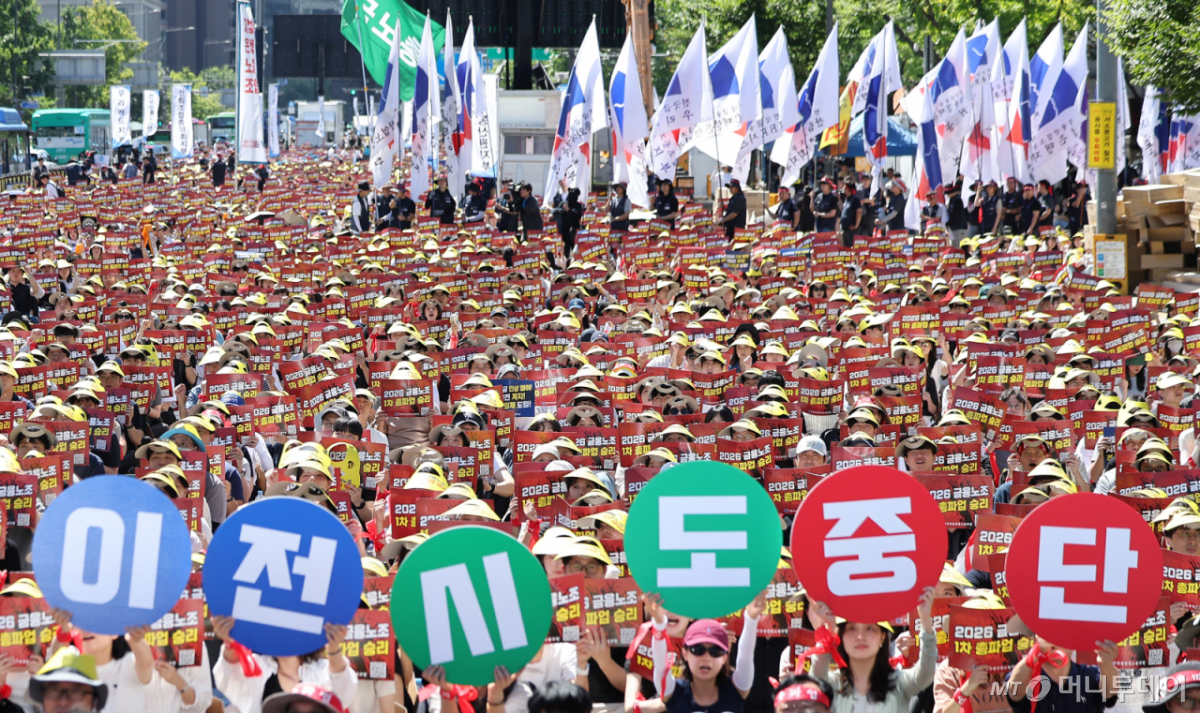
The National Financial Industry Labor Union (Financial Union) launched a large-scale general strike demanding the introduction of a 4.5-day workweek, relocation of financial institutions to local areas, and increases in real wages. This year's participation rate was slightly higher than last September's total strike, which focused on the 4.5-day workweek amid rising concerns over the relocation of policy banks and other institutions to local regions.
On the 4th, the Financial Union held its first general strike rally in the area around Sejong University in Gwanghwamun, Seoul. According to pre-filed reports by organizers, approximately 30,000 people participated in the strike; police estimates put the number at around 15,000. This marks an increase compared to last year's total strike, where police estimated about 8,000 attendees.
Union members from three major policy banks — Korea Development Bank, Export-Import Bank of Korea, and IBK Industrial Bank of Korea — showed high participation rates. At Korea Development Bank, around 2,000 out of approximately 2,200 total union members attended, excluding those required to remain on duty under labor-management agreements. About 800 of the Export-Import Bank of Korea's 1,100 union members participated. At IBK Industrial Bank of Korea, it is estimated that about half of its roughly 9,000 union members were present.
It was also confirmed that around 3,000 members of NH NongHyup Bank joined the general strike. However, participation from other commercial banks was relatively low, and no significant disruptions occurred at bank branches.
They carried hand signs with slogans such as "Secure Real Wage Increases," "Stop Relocation to Local Areas," and "Introduce a 4.5-Day Workweek," chanting demands like "Implement the 4.5-day workweek and reduce working hours" and "Stop the coercive relocation of financial institutions."
Yang Min-ho, Senior Vice President of the Financial Union, stated in his progress report that day: "In 2002, the financial sector led the way in adopting a five-day workweek, which eventually triggered changes across all industries in South Korea. This time, we aim to set a new benchmark and milestone for reducing working hours."
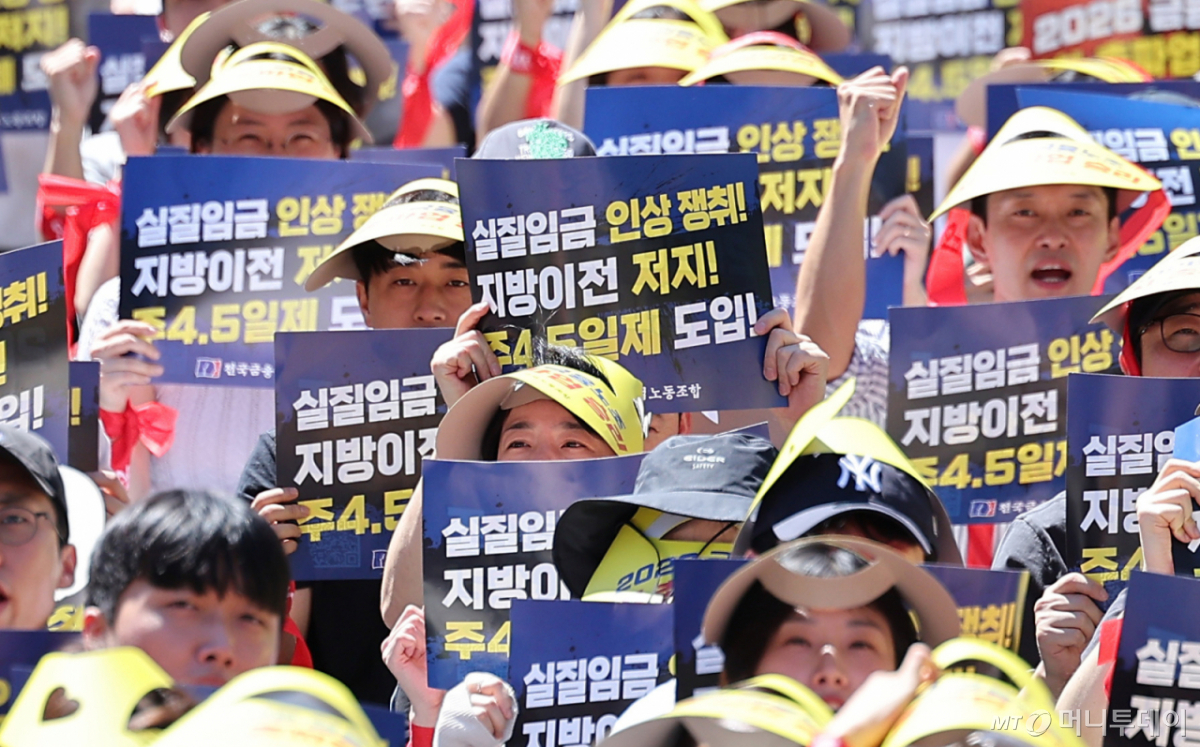
Regarding the relocation of financial institutions, they argued: "Just as with the relocation of headquarters, matters that significantly affect workers' workplaces and living environments must be negotiated and agreed upon with the union in advance. Relocating financial institutions is not the same as revitalizing regional economies. What regions truly need is genuine activation of local finance."
Yoon Seok-gu, President of the Financial Union, said: "Since the five-day workweek was implemented in 2002, there has been no reduction in operating hours for even one-tenth of a day over the past 24 years. With 95% of transactions such as remittances now conducted remotely and AI and digital technologies advancing rapidly, I wonder why working hours cannot be reduced."
Continuing on the topic of financial institution relocation, he added: "Major financial hubs like New York in the U.S., London in the UK, Singapore, and Hong Kong are concentrating their financial capabilities in single locations. Seoul has also risen to become the world's eighth-largest financial city. The reason we must remain in Seoul is not due to politics or a desire to stay away from family, but for economic reasons."
Political figures including Democratic Party of Korea lawmakers Lee Hak-young and Lee Yong-woo, People Power Party lawmaker Kim Hyung-dong, and Rebuilding Korea Party lawmaker Shin Jang-sik attended the rally, lending support to the Financial Union's demands.
The government announced plans for relocating administrative and public institutions the previous day, but did not specify in this announcement whether the Financial Services Commission or financial public institutions would be relocated. The government plans to finalize specific institutional targets for relocation in the fourth quarter of this year after undergoing a public deliberation process involving local governments and labor groups.
Previously, the Financial Union secured its right to take industrial action by winning 96.05% approval from participating members out of 87,287 total union members in a referendum on whether to support the strike held on the 12th of last month.

 in FINANCE

