

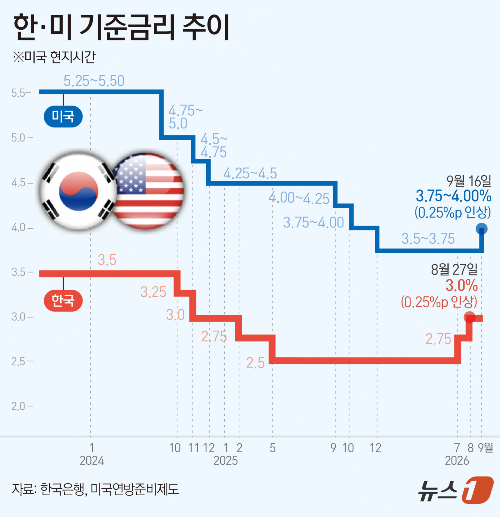
The U.S. central bank, the Federal Reserve (Federal Reserve), has raised its base rate for the first time in three years and two months. With the European Central Bank (ECB) already having increased rates and Japan expected to follow suit, global monetary tightening is now a reality. Korea must also prepare for capital outflows due to the interest rate differential between South Korea and the U.S., as well as shocks from the global economy, and take measures to manage government finances and household debt.
On the 16th (local time), the Federal Reserve raised its base rate from an annual 3.50% to 3.75% to 3.75% to 4.00%, an increase of 0.25 percentage points (p). This unanimous decision was made amid growing concerns over price instability, marking the first hike since July 2023. Due to the prolonged Middle East crisis, international oil prices per barrel have surpassed $120, and the U.S. consumer price index (CPI) in August rose by 3.4% compared to the previous year. Goldman Sachs forecasts that an additional 0.25 percentage point increase may occur in October. Following the U.S., the Bank of Japan is also expected to raise its base rate on the 18th to a 31-year high of 1.25% annually.
The global trend of interest rate hikes will also affect domestic markets. If the current 1% interest rate differential between South Korea and the U.S. widens further, it could increase downward pressure on the won and lead to capital outflows by foreign investors. Japan's interest rates are also a concern; if they rise as expected, there are worries that the flow of global institutional investors who have borrowed yen to invest heavily in overseas securities—the so-called "yen carry trade"—may change.
The Bank of Korea already raised its base rate proactively for two consecutive months in July and August, so it must carefully consider the shock to the overall economy and weigh the pros and cons of further adjustments before proceeding. Rising interest rates could trigger insolvencies among highly indebted companies and lead to increased mortgage interest payments for households. In fact, the delinquency rate on credit loans has exceeded 0.9%, and the delinquency rate on medium-term loans has already surpassed 1.0%, signaling warning lights on financial stability. Citizens must recognize the risks of indiscriminate margin investing (investing with debt) and excessive borrowing to purchase real estate.
The government should prepare for shocks to households with high debt levels and struggling companies, keeping in mind domestic interest rate hikes. Household loan balances have surpassed 2,000 trillion won for the first time in history, and corporate lending by banks is of a similar scale. It cannot be overlooked that indiscriminate cash support from the government and additional issuance of government bonds could stimulate inflation and lead to further interest rate hikes. Now is the time for the government, corporations, and households alike to pay close attention to debt management.

 in OPINION
