

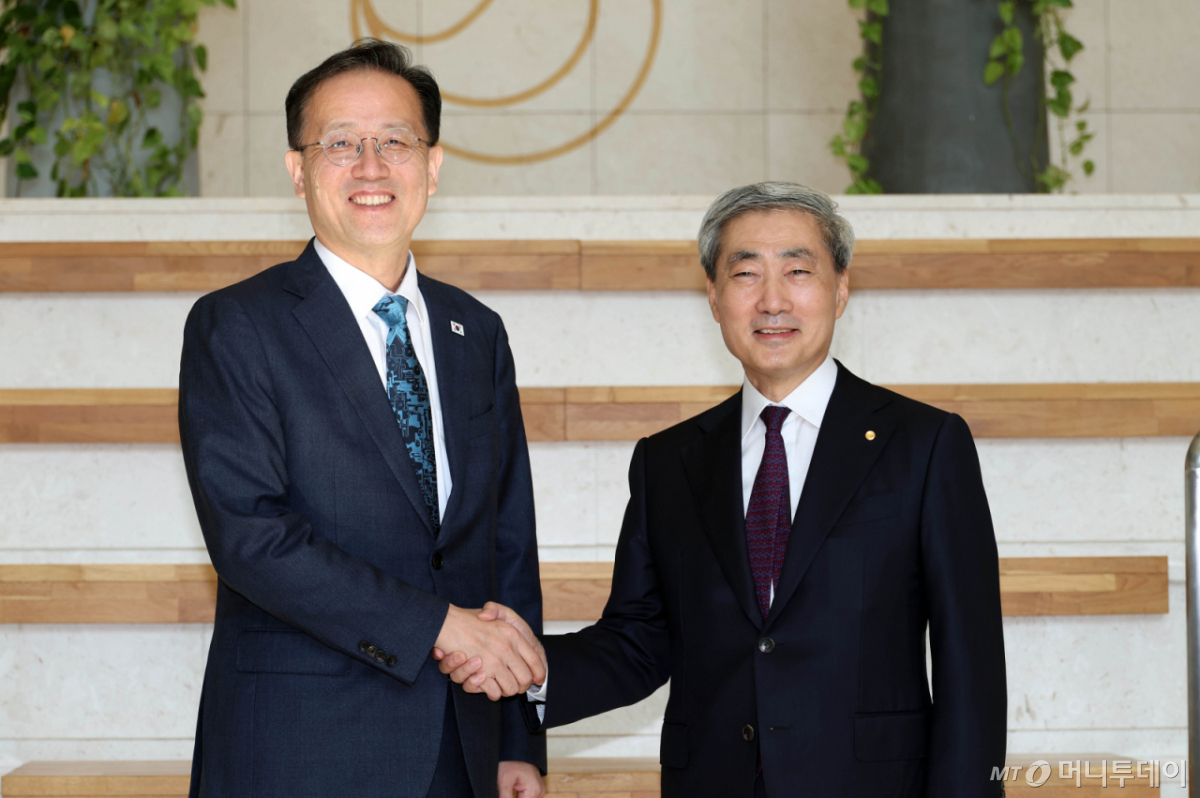
Lee Hyeong-il, Deputy Prime Minister and Minister of the Ministry of Economy and Finance, and Shin Hyun-song, Governor of the Bank of Korea, sat down together for the first time on the 28th. The Bank of Korea is tightening monetary policy in response to inflation, household debt, and overheating in the housing market, while the government has embarked on expansionary fiscal policy, led by a super budget exceeding 800 trillion won and future investments. Amid concerns from the market that fiscal and monetary policies may be diverging, the heads of the new economic team and the monetary authority met.
The Bank of Korea recently raised its base rate for two consecutive times, bringing it up to 3.0%. High oil prices stemming from the Middle East war are fueling inflationary concerns, while a semiconductor boom is driving recovery in exports and the economy, leading to increased income and demand. Meanwhile, home prices in the metropolitan area and household loans are stirring again. In fact, apartment prices in Seoul have risen for 85 consecutive weeks, tying the record for the longest streak of increases on record. This is the backdrop for the Bank of Korea’s preemptive move toward tightening despite the recovery in growth.
In contrast, the government’s fiscal management stance is expansionary. Next year’s government budget was set at a record high of 821 trillion won. Forecasts suggest that surplus tax revenue due to strong semiconductor exports could exceed 60 trillion won. Based on increased tax revenue and other factors, the government plans to establish a Future Response Fund worth 162 trillion won to invest in growth drivers, youth, regions, and talent.
Although overshadowed by the semiconductor boom, external conditions surrounding The Korea Economic Daily are not favorable. Prolonged high oil prices due to the extended Middle East war continue to create uncertainty in inflation and exchange rates. Furthermore, with expanded fiscal spending and increased government bond supply in major countries, the U.S. 30-year Treasury yield recently hit 5.48%, its highest level since 2004. Japan’s 10-year yield also rose to its highest level since 1996. In Korea, the 10th-year government bond yield recently surpassed 4.5%, marking its highest level since October 2022.
In a situation where long-term interest rates are rising globally due to high oil prices and inflationary instability, it is problematic for fiscal and monetary policies to send conflicting signals to the market. Therefore, it is significant that the two leaders agreed to comprehensively examine the interconnections among financial, foreign exchange, and real estate markets, and to strengthen a cooperation system for early identification and response to risk factors. Existing consultation channels, such as market situation review meetings, must also be operated more effectively. It is hoped that this meeting between the two leaders will not remain merely a routine greeting, but serve as a starting point to enhance policy predictability and market confidence. Consistent action matters more than words.

 in OPINION
