

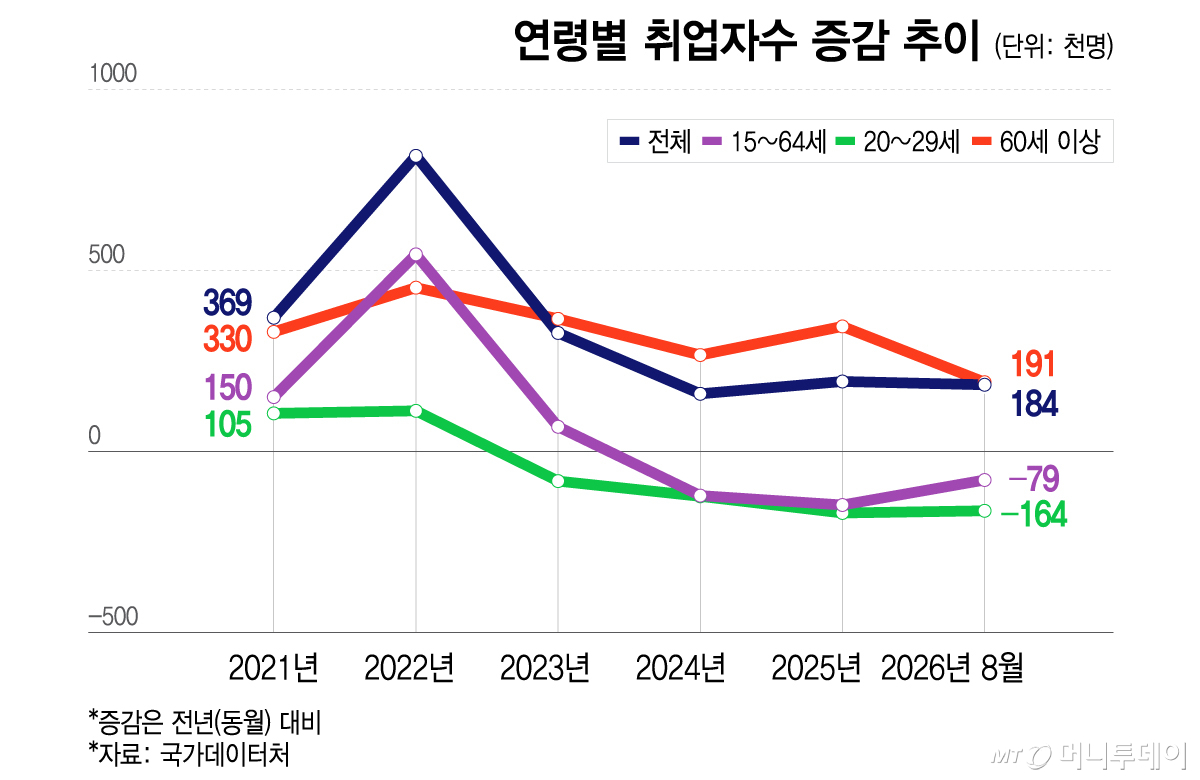
Although employment indicators are improving, quality jobs that young people desire are not increasing. This is due to a statistical illusion where the overall employment rate rises as the proportion of public jobs for the elderly increases. Furthermore, pro-labor policy drives such as the Yellow Envelope Act are solidifying a "dual structure" in the labor market, which actually raises the threshold for young people to enter employment. To resolve the job crisis among youth, there is an urgent need for a medium-to-long-term employment creation strategy that stimulates productivity, investment, and demand in the private sector.
According to the National Data Center, as of last August, the total number of employed persons aged 15 and over increased by 184,000 from the previous year to reach 29.151 million. The employment rate for those aged 15 and over also reached 63.3%, the highest level since August 1982. While overall indicators show a favorable trend, a closer look reveals that the situations of the elderly and youth are diametrically opposed. The number of employed persons aged 60 and over increased by more than 190,000, whereas the number of employed persons in their 20s decreased by 164,000.
While changes in population structure due to aging are a factor, the government's expansion of public jobs has also created an illusion in employment indicators. The number of public jobs increased from 1.13 million in 2015 to 2.08 million in 2025. This year alone, senior citizen jobs are expected to reach a record high of 1.15 million. Although public jobs such as those for the elderly have been effective in improving poverty issues among the elderly and vulnerable groups, they tend to focus on temporary and short-term employment with low wages, making them unattractive to young people.
The government has not been idle regarding the job crisis among youth. In its "Plan to Restore Youth Employment" released last month, it pledged to train 300,000 specialized professionals by 2030 and supply 300,000 jobs in the private and public sectors as well as startup opportunities. The problem is that this plan fails to reflect actual demand, such as excluding large corporations from policy support, which young people prefer. Furthermore, the implementation of pro-labor policies like the Yellow Envelope Act, which expands the scope of user liability for main contractors, has led companies to reduce new hiring to minimize risks, creating a further obstacle to youth employment. Authorities should not simply look at the total number of employed persons but must separately aggregate private sector employment to assess the quality of indicators. Above all, there is a need for an employment recovery strategy centered on the private sector rather than expanding short-term jobs dependent on fiscal spending. The extension of statutory retirement ages promoted by the government and the ruling party may exacerbate the job crisis among youth as benefits concentrate on regular employees in large corporations. Before extending the retirement age, measures to secure youth employment must be established first.

 in OPINION
