

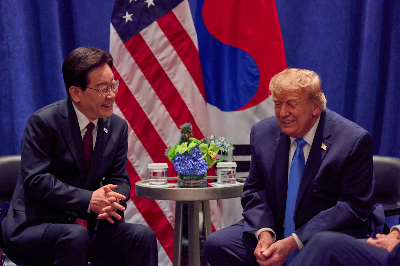
President Lee Jae-myung concluded his tour of the United States and Mexico and returned home on the 27th. The previously uncertain summit with U.S. President Donald Trump was successfully held, and a meeting with Mexican President Claudia Sheinbaum also took place. However, no tangible results were achieved in concluding Korea-U.S. trade negotiations, and no substantive discussions occurred regarding tariffs imposed by Mexico on major Korean export items.
The summit between President Lee and President Trump on the 22nd lasted approximately 30 minutes. The meeting was reportedly arranged that morning following the decision to proceed with South Korea's first strategic investment project in the United States: the construction of a gas-fired combined-cycle power plant in Texas. At the meeting, discussions covered areas such as cooperation between South Korea and the U.S. on nuclear submarine and shipbuilding issues, transfer of wartime operational control, and other matters, but no concrete outcomes were reached. The two leaders also exchanged views on the possibility of North Korea-U.S. dialogue.
Prior to departure, President Lee made broad remarks during a press conference regarding the nature of South Korea's deployment to the Strait of Hormuz. Regarding investments in the United States, the ruling party repeatedly emphasized the semiconductor mega-project in the Honam region, raising concerns among U.S. counterparts. There are growing worries that foreign policy and trade issues are being leveraged for domestic political reasons, such as boosting approval ratings and preparing for various elections. While South Korea has reported progress on its strategic investment project plan to the National Assembly, the United States and President Trump have postponed final announcements. In contrast, Japan's investment project in the U.S. has already begun, and phone calls between U.S. and Japanese leaders have taken place following the outcome of the U.S.-China summit.
During the summit with Mexico, which marked the first state visit in 16 years, key issues in negotiations to revise the investment protection agreement were resolved comprehensively. Cooperation on supply chains, including additional imports of Mexican crude oil, also yielded positive results. However, no proper discussions took place regarding the 10th% to 50% tariffs that Mexico has imposed since this year on Korean-made automobiles, parts, steel, and home appliances. While internal circumstances in Mexico may explain this, it remains a regrettable point given the lack of meticulous preparation for the summit.
Looking ahead, Korea-U.S. relations face an unpredictable situation due to various trade and security issues. Regarding the deployment to the Strait of Hormuz, South Korea must respond flexibly to U.S. pressure from the perspective of national interest. With President Trump approaching the midterm elections in November, it is essential to strengthen communication with the United States to ensure that South Korea does not remain on the sidelines during any potential North Korea-U.S. dialogue phase.

 in OPINION
