

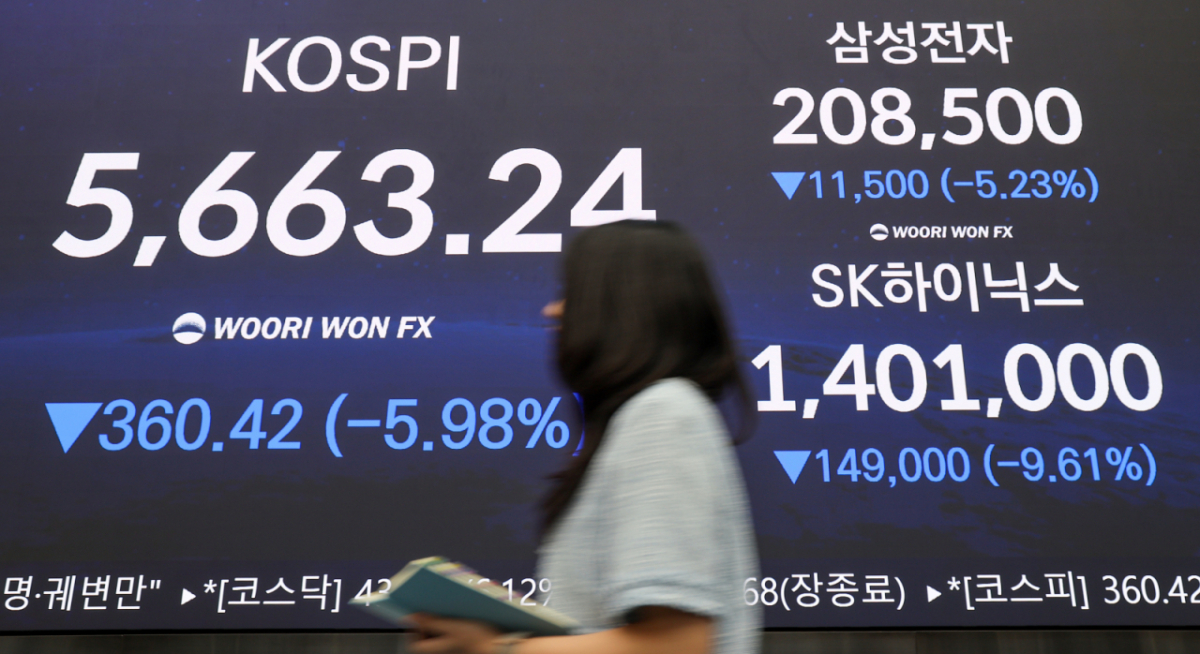
On the 29th, both the KOSPI and KOSDAQ indices closed with sharp declines of around 6% following an unprecedented two-day consecutive activation of circuit breakers (temporary suspension of trading). The KOSPI and KOSDAQ saw circuit breakers triggered for two consecutive days, following the previous day. This marks the first time in history that circuit breakers have been activated simultaneously on both major markets for two consecutive days.
Although SK Hynix announced its largest quarterly earnings in history, it plummeted as concerns over peak semiconductor prices and debates about AI (artificial intelligence) investment profitability gained prominence in the market.
The KOSPI index closed trading at 5,663.24, down 360.42 points (5.98%) from the previous day. The intraday high was 6,228.52 (+3.40%), while the low reached 5,262.77 (-12.63%). The fluctuation range amounted to 965.75 points. While retail investors and foreign investors sold net amounts of 1.9767 trillion won and 1.2157 trillion won respectively, institutional investors purchased a net amount of 3.1489 trillion won.
The Korea Exchange activated Circuit Breaker Level 1 for the KOSPI market at 12:32:32 p.m. on this day. This is a measure to suspend trading for 20 minutes if the index falls by more than 8% from the previous day's close and remains in that state for one minute. At the time of the circuit breaker activation, the KOSPI index had fallen 492.10 points (8.17%) from the previous day's closing price to 5,531.56. In the KOSDAQ market, Circuit Breaker Level 1 was activated earlier at 12:19:12 p.m. when the index dropped 56.85 points (8.05%) to 649.00.
This is the first time a circuit breaker has been triggered for two consecutive days in the KOSPI market, while there have been precedents of two-day consecutive activations in the KOSDAQ market during the 2008 global financial crisis and when the U.S. credit rating was downgraded in 2011. So far this year, circuit breakers have been triggered 9 times in the KOSPI market and 4 times in the KOSDAQ market.
Earlier on this day, sell-side sidecars (futures market circuit breakers) were also activated in the KOSPI market at 10:55 a.m. and the KOSDAQ market at 10:56 a.m., temporarily halting program trading effects. This brings the total number of sidecar activations for the year to 43 times in the KOSPI market and 27 times in the KOSDAQ market. Activations in the sell direction occurred 23 times and 13 times, respectively.
Samsung Electronics closed trading at 208,500 won, down 5.23%. SK Hynix closed at 1.401 million won, down 9.61%. Earlier, SK Hynix disclosed that its consolidated sales and operating profit for the second quarter of this year were 79.3187 trillion won and 60.5426 trillion won, respectively. This represents increases of 257% and 557% in sales and operating profit compared to the same period last year. However, pressure on the entire semiconductor sector was exacerbated by the pursuit of Chinese memory semiconductor companies and market doubts surrounding AI investment profitability.
△SK Square (-8.11%) △Samsung Electro-Mechanics (-7.63%) △Samsung Life Insurance (-6.84%) △Samsung Biologics (-4.52%) △LG Energy Solution (-4.30%) △KB Financial Group (-3.09%) △Samsung Electronics Preferred (-3.03%) △Hyundai Motor (-2.88%) and others also declined.
The KOSDAQ index closed trading at 662.68, down 43.17 points (6.12%). The intraday high was 719.39 (+1.92%), while the low reached 630.99 (-10.61%). Retail investors sold net amounts of 457 billion won, while foreign investors and institutional investors purchased net amounts of 308.3 billion won and 146.4 billion won, respectively.
△Jusung Engineering (-9.86%) △EcoPro BM (-9.04%) △ABL Bio (-7.99%) △EcoPro (-7.29%) △Wonik IPS (-7.04%) △Rino Industrial (-5.52%) △Alteogen (-4.72%) and others declined.
Middle East tensions and the U.S. Federal Open Market Committee (FOMC) base rate decision to be announced at 3 a.m. on the 30th Korean time are expected to be key variables determining the direction of the stock market. Kang Jin-hyuk, a researcher at Shinhan Investment Corp., stated, "Disappointment selling occurred following SK Hynix's conference call due to the lack of shareholder return content," and added, "With Middle East instability continuing, there is a wait-and-see sentiment ahead of the FOMC interest rate decision."

 in STOCK
