

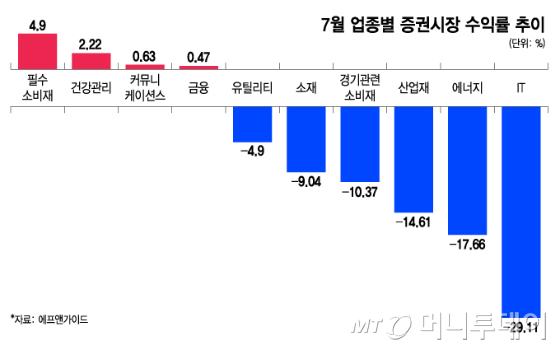
Over the past month of July, while the KOSPI index experienced volatility including a drop of more than 20%, the essential consumer goods sector — widely regarded as a representative defensive sector — posted returns that significantly outpaced leading stocks. In particular, the food, beverage, and tobacco sectors drove the overall performance of the essential consumer goods category.
According to financial information platform FNGuide and the financial investment industry on the 6th, during July alone, the essential consumer goods sector in the KOSPI market recorded the highest return at 4.90%.
The second-highest returning sector was health management with a 2.22% return, followed by communications with a 0.63% return. Compared to the KOSPI index’s 22.19% decline in July, these sectors achieved relatively strong performance.
In contrast, the IT sector, which includes leading KOSPI stocks such as semiconductors, saw its returns fall by 29.11% over July, underperforming relative to the broader index. The energy sector declined by 17.66%, and industrial materials fell by 14.61%.
This trend in sector-based stock market performance mirrors that of the U.S. market. An So-eun, a researcher at KB Securities, stated, “With memory and semiconductor stocks undergoing corrections, the NASDAQ index also declined in the U.S., yet defensive sectors such as healthcare and essential consumer goods showed relatively strong trends recently.” She added, “While AI infrastructure-related stocks failed to meet high earnings expectations and saw sharp declines in share prices, Coca-Cola’s earnings surprise helped drive strength in the essential consumer goods sector.”
Looking at detailed return metrics within Korea’s essential consumer goods sector, the food, beverage, and tobacco category posted a notable 4.92% return. In particular, KT&G’s stock price defense during the downturn stood out. Over July alone, its share price rose from 169,700 won to 179,100 won — an increase of 5.5%. On the 29th and 30th of last month, when circuit breakers were triggered for two consecutive trading days in the KOSPI, KT&G’s stock actually rose by more than 2%.
Ha Hee-ji, a researcher at Hyundai Motor Securities, said, “Its core business centered on overseas combustible cigarettes remains robust, and additional shareholder return policies such as dividend increases per share and new share buybacks are also expected.”
However, some experts advise investors to note that distortions may have occurred in the food sector’s returns during July due to thematic investment activities.
Specifically, Hanseong Enterprise, a food company, saw its stock price surge from 4,300 won to nearly 17,340 won — an increase of almost 300% — in July. As concerns arose that Hanseong Enterprise might meet KOSPI delisting criteria following the tightening of those requirements in July, individual investors launched a campaign to purchase its shares, primarily through online platforms. This movement gained momentum after it became known that Hanseong Enterprise had long sponsored peace concerts for UN veterans, leading to its emergence as an so-called “patriotic theme stock.”
A securities industry official remarked, “Considering that essential consumer goods returns were in the negative 7% range in June when the KOSPI index exceeded 9,000 points, it appears these stocks fulfilled their defensive role effectively during July’s sharp market decline. While we should remain mindful of the possibility that some companies’ fundamentals may have been distorted by the patriotic theme stock frenzy, given their market capitalization sizes, the overall impact is likely to be limited.”

 in STOCK
