

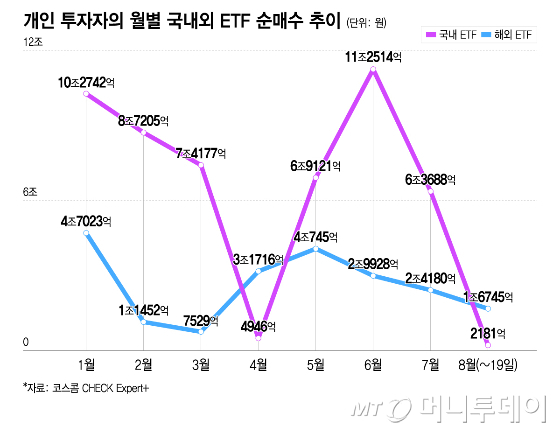
'Roller KOSPI' Fatigued individual investors are turning to U.S. index ETFs as a safe haven. Since August, they have purchased foreign-listed ETFs more than seven times the volume of domestic-listed ETFs with underlying assets in Korea. In particular, there has been a strong inflow into representative U.S. index ETFs that historically show an upward-trending return curve when invested in steadily over time.
According to KOSCOM CHECK Expert+ data as of yesterday this month, individual investors made net purchases totaling 218.1 billion won in domestic-listed ETFs tied to the Korean stock market. In contrast, they purchased 1.6745 trillion won worth of ETFs invested in overseas markets. The difference in net purchase value alone reached approximately 7.6 times.
The trend of individual investors preferring foreign-listed ETFs over domestic ones has returned for the first time in about four months since April. Reviewing the monthly net purchase trends of domestic and foreign ETFs by individual investors this year, April was the only month when they bought more foreign ETFs than domestic ones. At that time, individuals made net purchases of 494.6 billion won in domestic markets and 3.1716 trillion won in overseas markets.
Among foreign ETFs, inflows concentrated mainly on U.S. index ETFs such as the S&P 500 and NASDAQ. The top three most net-purchased ETFs by individuals among all domestically listed ETFs were 'TIGER U.S. S&P 500', 'KODEX U.S. NASDAQ100', and 'KODEX U.S. S&P 500'. The combined net purchase value of these three products reached 811.3 billion won, accounting for 43% of the total net purchase value of all ETFs (1.8954 trillion won) during the same period. Just these three products accounted for nearly half of the total net purchases across all ETFs.
Even ETFs listed outside Korea saw investors choosing U.S. index ETFs. According to the Korea Securities Depository's securities information portal, as of the 19th (local time) this month, the top three most net-purchased foreign-listed ETFs were 'ProShares Ultra QQQ (2x Leveraged NASDAQ100)', 'Invesco NASDAQ 100', and 'Vanguard SP 500'. All three recorded net purchase amounts exceeding $1.3 million.
Experts in the financial investment industry cite volatility as a common reason for individual investors shifting from 'retail investors (domestic)' to 'retail investors in overseas stocks'. Following extreme market volatility in July, including two consecutive days of circuit breaker activations on Korea's two major markets, individual investors appear to have moved toward U.S. indices with relatively smaller fluctuations. On that day as well, the KOSPI market triggered a buy-side sidecar (futures market circuit breaker).
Park Seung-jin, a senior manager at Hana Securities, stated, "Given that individual investors experienced significant volatility in the domestic stock market, they are now favoring momentum-driven or sector-specific investments such as semiconductors over broad index exposure. The U.S. has a track record of delivering strong performance for long-term index investments, which likely explains why steady investors are turning to U.S. index ETFs."
Another analysis suggests that the recent decline in the won-dollar exchange rate to the 1300th won range for the first time in about 11 months also contributed to the increased scale of net purchases by allowing relatively cheaper access to foreign ETFs. Park Woo-yeol, a researcher at Shinhan Investment Corp., explained, "The won has strengthened recently, with the exchange rate falling into the high 1300s range. At this point, exchange rate gains from purchasing U.S. equity ETFs should also be considered."

 in STOCK
