

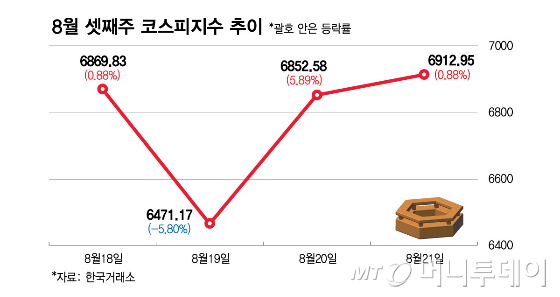
Last week, the KOSPI was weighed down by a sharp surge in U.S. Treasury yields and faltered at the 7,000-point threshold, but large shareholder return announcements from SK Hynix and Samsung Electronics helped cushion the decline. This week, two major variables loom: Nvidia's earnings report on the 26th and the Jackson Hole meeting on the 28th. Depending on whether Nvidia can defend its margins and how the Federal Reserve perceives inflation at Jackson Hole, it remains to be seen if the upward trend in yields will reverse and whether the domestic stock market will reclaim the 7,000-point level.
According to data from Korea Exchange on the 23rd, last week (August 18–21) the KOSPI closed at 6,912.95, down 64.99 points (0.93%) from Friday's close of 6,977.94. During this period, foreign investors and institutional investors sold net amounts of 237.552 billion won and 185.124 billion won, respectively. In contrast, individual investors were the only buyers, purchasing a net amount of 194.119 billion won.
Last week, domestic markets showed a trend where concerns over rising interest rates constrained the KOSPI's upside. On August 18 (local time), the U.S. 30-year Treasury yield climbed intraday to as high as 5.33%, marking its highest level in nearly 19 years since 2007. Concerns over fiscal deficits in major economies, large corporate bond issuances by big tech firms to fund AI infrastructure investment (CAPEX), and ongoing tensions between the U.S. and Iran following the expiration of a peace memorandum of understanding (MOU) all contributed to pushing yields higher.
To curb rising rates, the U.S. Treasury Department decided to more than double its buyback (repurchase) volume of long-term bonds in the market, leading to some stabilization in long-term bond yields. On the 19th (local time), the Treasury announced it would expand its buyback size per session from the previous $2 billion to at least $4 billion. The following day, U.S. Treasury Secretary Scott Bessent stated in an interview with the media that the buyback amount could exceed $4 billion per session.
The floor of the stock market was supported by large shareholder return announcements from major semiconductor stocks. On the 19th, SK Hynix announced it would return more than 50% of its cumulative free cash flow (FCF) through next year and simultaneously pursue share repurchases and cancellations totaling 40 trillion won along with dividends. Two days later, Samsung Electronics unveiled its "2026 Shareholder Return Implementation Plan," expected to amount to approximately 90–110 trillion won, equivalent to 50% of FCF. The company also plans to implement cash dividends totaling around 30 trillion won, including regular third-quarter dividends.
This week, the market is expected to closely monitor the direction of AI investment sentiment and interest rate volatility. Key upcoming events include Nvidia's earnings announcement on the 26th, the U.S. July PCE price index, and speeches at the Jackson Hole Economic Policy Symposium hosted by the Federal Reserve System (Fed) on the 28th.
Experts in the financial investment industry highlight several factors to watch in Nvidia's earnings report: beating earnings expectations, raising guidance for the next quarter, and maintaining high gross profit margins. In particular, analysts suggest that during the early transition phase from its current flagship AI chip, "Blackwell," to the next-generation chip, "Rubin," the quality of growth should be assessed through gross margin indicators.
NH Investment & Securities researcher Na Jeong-hwan stated, "Typically, in the initial stages of new product launches, margins are diluted due to cost pressures before yield stabilization is achieved." He added, "Even if sales increase, if margins are eroded, doubts may arise about the profitability of AI investments themselves."
Some opinions also suggest that if inflation slowdown is confirmed in July's PCE data and concerns over monetary policy ease following the Jackson Hole meeting, Treasury yields could stabilize and preference for risk assets could strengthen again.
Daishin Securities FICC division head Lee Kyung-min said, "Current forecasts for July's PCE and core PCE show year-on-year increases of 3.6% and 3.3%, respectively, similar to June levels. It is crucial whether the trend of slowing inflation continues." He further noted, "Given that the minutes from the July FOMC (Federal Open Market Committee) confirmed that the Federal Reserve remains concerned about inflation, attention should be focused at Jackson Hole on Chair Kevin Warsh's interpretation of inflation and his outlook on potential additional rate hikes."

 in STOCK
