

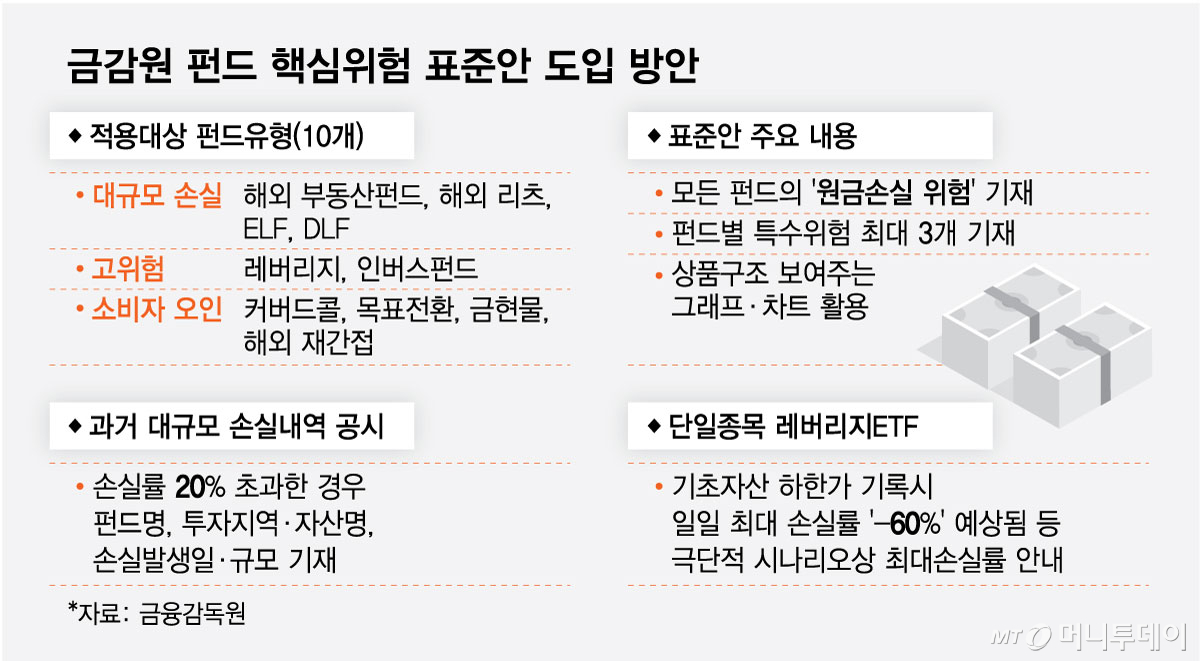
Starting September 30, when launching new public offering funds that previously experienced a loss rate exceeding 20% of the invested principal, fund names and loss amounts must be disclosed in product explanation documents. The Financial Supervisory Service has mandated this standard format for clearly stating key risks to protect investors, with industry reactions indicating it could reduce risks of incomplete sales.
On the 25th, the Financial Supervisory Service announced the introduction of a "standard framework for key risks in funds," learning from the full-loss incident involving overseas real estate funds. The framework applies to products with significant past losses, high-risk structures, or types prone to consumer misunderstanding—totaling 10 categories.
The standard framework will apply to: △overseas real estate funds that resulted in total loss of invested principal; △overseas REITs (Real Estate Investment Trusts); and △ELFs (Equity-Linked Funds) and △DLFs (Derivative-Linked Funds), both of which have faced issues related to principal losses and incomplete sales.
Additionally, the framework will cover △leveraged funds, including single-stock leveraged ETFs that track daily returns at twice the rate; △inverse funds; △covered call funds; △target conversion funds; △gold spot funds; and △overseas feeder funds. Overseas feeder funds were included due to Financial Supervisory Service's blind test results showing many respondents had no understanding of these products.
The standard framework primarily emphasizes the risk of principal loss. Up to three specific risks per fund may be listed, using expressions more accessible to investors rather than complex financial or legal jargon. Key information must be highlighted for visibility. Visual aids such as graphs and charts illustrating profit-and-loss performance will also be utilized.
A core element of this standard framework is the detailed disclosure of past loss history. For example, if a fund under a securities company like A Securities has previously exceeded a 20% loss rate, the fund name, investment region and asset names, date of loss occurrence, and loss amount must be specified.
In particular, for single-stock leveraged ETFs, it must be explicitly stated that if Samsung Electronics or SK Hynix hit their daily lower limit of -30%, the ETF could incur a maximum daily loss of -60%.
The Financial Supervisory Service has established this standard framework for key risks in public offering funds due to recent incidents involving incomplete sales and large-scale losses, particularly in overseas real estate funds and single-stock leveraged ETFs. Major banks and securities firms sold overseas real estate funds in Belgium, New York, and other locations that resulted in 100% loss of principal in the second half of last year, leading to EOD (loss of entire investment) cases. Some banks have also initiated voluntary compensation for incomplete sales.
Industry reactions indicate that standardizing risk disclosures could reduce risks associated with incomplete sales. A financial sector official stated, "The standard framework will present product risks more clearly and consistently, aiding sales staff in explaining these to customers." They added, "Especially by providing specific examples of past losses, it is expected to lower the likelihood of incomplete sales."
The fund key risk standard framework prepared by the Financial Supervisory Service is scheduled to take effect on September 30. A Financial Supervisory Service official remarked, "Investors will be able to clearly understand the risks of high-risk funds through this standard framework." They further stated, "We will continue to implement tasks under the roadmap for improving financial consumer protection without delay."

 in STOCK
