

The stock market boom in the first half boosted the earnings of large securities firms but also increased their reliance on brokerage within fee income. As domestic stock trading slowed down in the third quarter, the battleground for securities firms has shifted from "trading more" to "earning steadily even with less trading." The competitiveness of post-brokerage revenue engines—wealth management (WM), investment banking (IB), trading and proprietary capital investment (PI), and commercial paper and comprehensive investment accounts (IMA)—is now under scrutiny.
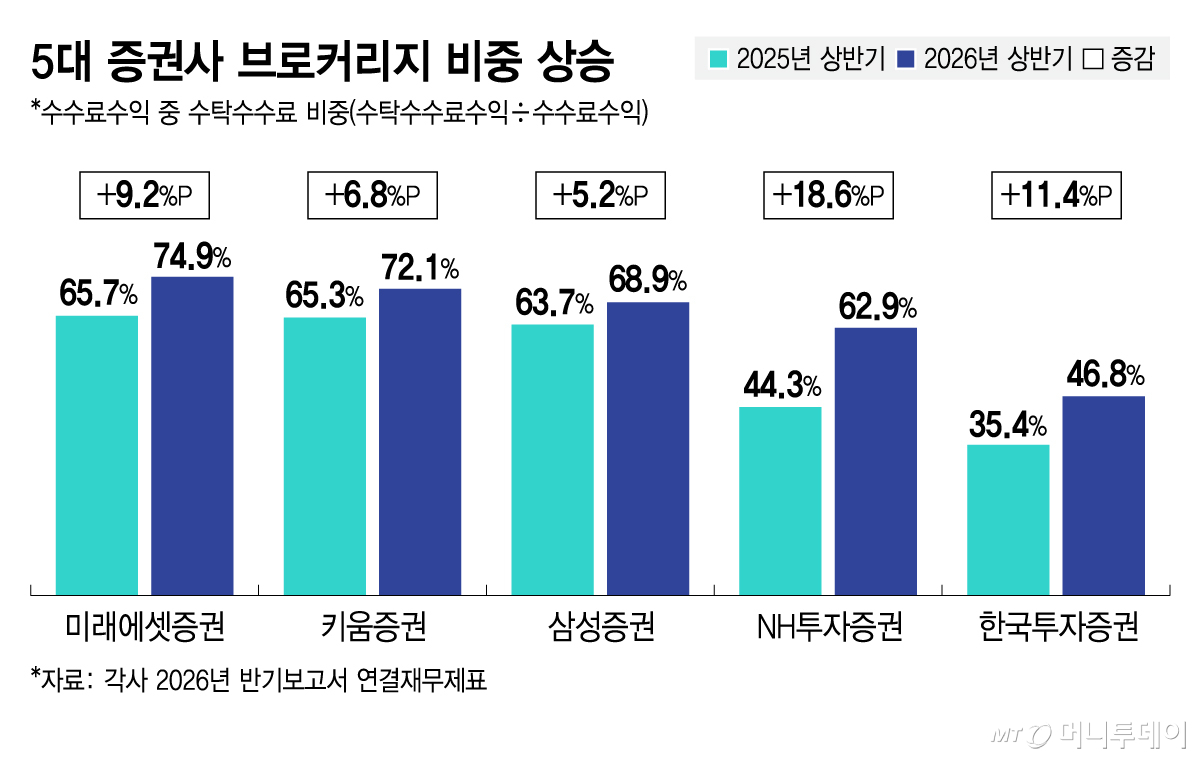
An analysis of the semiannual reports of each securities firm released on the 1st shows that all five major securities firms—Mirae Asset Securities, Korea Investment & Securities, Kiwoom Securities, NH Investment & Securities, and Samsung Securities, which ranked highest in net profit for the first half of this year—saw an increase in the share of custody fees in their fee income compared to the same period last year.
NH Investment & Securities saw the largest rise, climbing from 44.3% to 62.9%, a jump of 18.6 percentage points. Korea Investment & Securities rose from 35.4% to 46.8%, an increase of 11.4 percentage points. Mirae Asset Securities increased from 65.7% to 74.9%, up by 9.2 percentage points. Kiwoom Securities rose from 65.3% to 72.1%, a gain of 6.8 percentage points, while Samsung Securities climbed from 63.7% to 68.9%, an increase of 5.2 percentage points. All figures were calculated based on consolidated fee income and custody fee income.
Although large firms have been pushing for revenue diversification, brokerage revenue grew faster than other fee-based businesses in the first half, leading to a sharper concentration within fee income. However, there are concerns that the brokerage boom of the first half is unlikely to continue unchanged into the second half.
Im Hee-yeon, a research fellow at Shinhan Investment Corp., who diagnosed a slowdown in domestic trading in the third quarter, stated, "WM has emerged as the common growth axis following brokerage," and analyzed that firms are "undergoing a structural shift toward fee income based on account balances." This means moving from transaction-fee-centric models to recurring revenue streams based on customer assets.
Post-brokerage strategies and challenges vary by firm. Samsung Securities stands out for its WM expansion. In the first half, financial product sales revenue reached 200 billion won, up 192.5% from the same period last year, while lab sales revenue hit 82.1 billion won, a 494.1% increase. Asset management performance and financial services also rose by 20% to 728.8 billion won. However, WM revenue scale still does not match brokerage. The challenge is to grow recurring revenue based on customer assets to levels comparable to brokerage.
Mirae Asset Securities operates with a structure that combines WM, sales and trading (S&T), and PI. In the first half, operating profit in the WM segment was 1.1437 trillion won, S&T generated 393.4 billion won, and PI plus other segments contributed 2.8229 trillion won. However, WM includes securities brokerage, so it cannot be viewed as pure asset management revenue, while PI and S&T performance can fluctuate depending on market conditions. Given their diverse revenue sources, the challenge is to link these to recurring income less susceptible to market swings.
NH Investment & Securities relies on asset management returns and interest income to complement brokerage. Of its 2.2603 trillion won in net operating profit for the first half, asset management performance and related interest income amounted to 831.5 billion won (36.8%), exceeding brokerage's 795 billion won (35.2%). In contrast, financial product sales were 125.9 billion won (5.6%), and IB was 205.5 billion won (9.1%). Since asset management and interest income are also influenced by market conditions, interest rates, and credit environments, the challenge is to grow fee-based revenue sources such as WM and IB alongside them.
Korea Investment & Securities shows a relatively even distribution of revenue sources based on net operating profit: brokerage at 25.2%, asset management (AM) at 10.7%, IB at 10.7%, and trading at 29.8%. However, the largest segment, trading, is subject to market-driven volatility, and IB is also affected by deal and credit cycles. The next challenge is to convert its already diversified business structure into stable recurring revenue.
Kiwoom Securities faces the clearest challenges. While it boasts a strong customer base with a domestic stock retail market share of 25.3% in the first half, custody fees accounted for 72.1% of its fee income—the highest among the five firms. The core challenge is to convert brokerage customers into WM clients and significantly increase the absolute scale of asset management revenue.
Commercial paper and IMA are also new revenue engines for large firms, but business expansion alone does not guarantee revenue stability. As fundraising and asset management scales grow, so does the importance of managing credit and liquidity risks. A securities industry official stated, "Ultimately, post-brokerage competition is not about how many revenue sources a firm has," adding, "The key lies in how well each firm can compensate for its weak revenue structures to generate recurring income less affected by market conditions."

 in STOCK
