

Retail investor A decided to switch the brokerage used for trading overseas stocks. After comparing transaction fees, A noticed Samsung Securities' fee discounts and benefits for transferring assets from other brokerages. A already had an account with Samsung Securities. However, A used the Samsung account only for domestic stock trading, keeping overseas stocks in a Kiwoom Securities account. Ultimately, A transferred five overseas stock holdings from the Kiwoom Securities account to Samsung Securities.
A did not sell and repurchase the stocks. Instead, A utilized "outbound transfer from another brokerage" to move the existing holdings to a different brokerage account. The request was submitted via Kiwoom Securities' HTS (Home Trading System) by entering the counterparty brokerage, account number, stocks to be transferred, and quantities. In the field asking for the reason for withdrawal, A selected one of several options: "Complaints over fees."
It is no longer unusual for investors to hold multiple securities accounts. Nowadays, investors do not just open multiple accounts; they use different brokerages depending on their investment purposes. When better conditions arise, they even move the assets they hold.
Investor B said, "I use Kiwoom Securities' MTS (Mobile Trading System) when focusing on stocks, and Toss for mindless systematic investment (regular investing without much judgment)." Investor C uses Mirae Asset Securities for pension savings accounts and Shinhan Investment Corp for Personal Comprehensive Asset Management Accounts (ISA), but has not yet decided where to place their Individual Retirement Pension (IRP). Some investors even view charts via Kiwoom Securities' MTS while placing actual orders through a different brokerage.
Why invest so complicatedly? The answer lies in the numbers of brokerages. When switching investment products, even strong brokerages change.
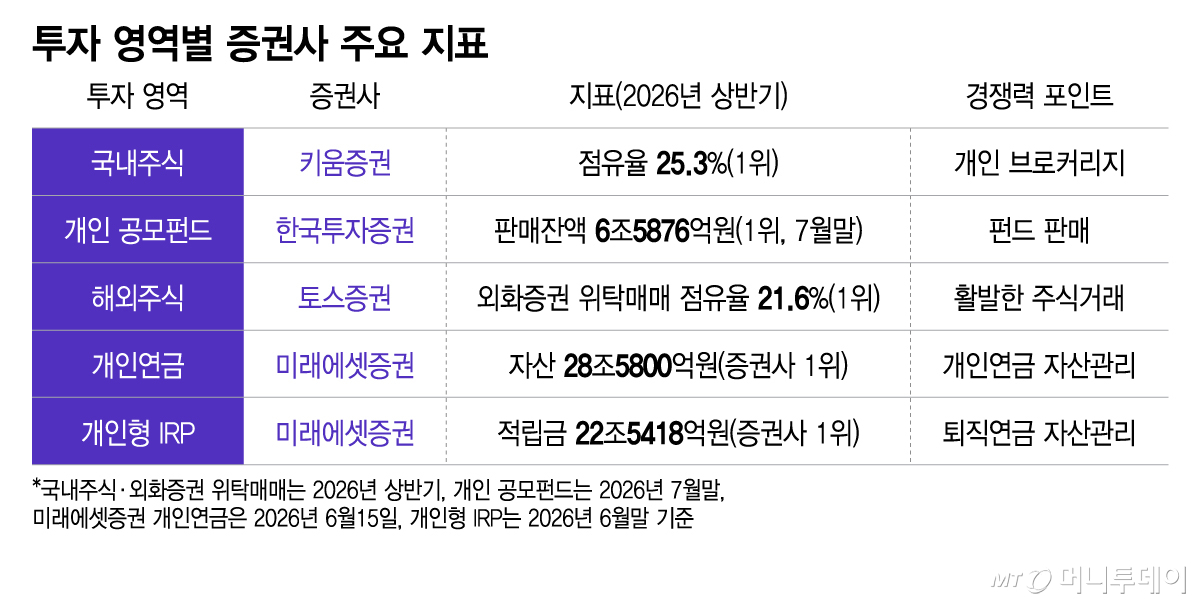
Kiwoom Securities held a 25.3% retail (individual) market share in the domestic stock market in the first half of this year, ranking first in the industry. This means that for every four won of transaction value when individual investors buy and sell domestic stocks, one won goes through Kiwoom.
However, if you shift your focus from stocks to funds, the rankings change. An analysis of statistics from the Korea Financial Investment Association showed that as of late July, Kiwoom Securities' outstanding balance of public funds sold to individuals was 318.1 billion won, ranking 16th among brokerages. Korea Investment & Securities had 6.5876 trillion won, Samsung Securities had 5.6428 trillion won, and Mirae Asset Securities had 4.9522 trillion won. Korea Investment & Securities' outstanding balance of public funds sold to individuals is about 20.7 times that of Kiwoom Securities. A brokerage that accounted for about one-quarter of individual investors' transaction value in domestic stock trading holds a completely different position in the sale of public funds.
Kiwoom Securities' total outstanding balance of public fund sales is not small either, reaching 7.6199 trillion won. However, only 318.1 billion won of this amount represents individual sales, accounting for just 4.2%. This means Kiwoom's foundation for selling public funds leans much more heavily toward corporations and financial institutional investors than individuals. This is a point where both Kiwoom's strengths and weaknesses are revealed simultaneously.
Going to Mirae Asset Securities reveals another market. Mirae Asset Securities manages the largest assets in the industry for overseas stocks and pensions. Overseas stock assets surpassed 50 trillion won last October, and pension assets grew to 80.81 trillion won as of the end of June this year.
The strong players also differ in overseas investment transactions. In the first half of this year, the amount of foreign currency securities entrusted trading through Toss Securities was about 367 trillion won, ranking first in the industry with a market share of 21.6%. Toss Securities also recorded the top position in foreign currency securities custody fees.
While Mirae Asset Securities stands out in the scale of assets entrusted by overseas stock customers, Toss Securities has emerged as a new strong player in actual trading. If Kiwoom Securities is the leader in domestic individual stock trading, Toss Securities has carved out its presence by surpassing major brokerages in overseas stock trading.
Ultimately, there is no single brokerage that is the strongest in all investment areas simultaneously. In the past, an investor's question was simple: "Which brokerage is the best?" Now the question has changed to: "Which brokerage is best for what kind of investment?" This difference scatters investors' money across multiple brokerages.
If this is "selective use," there are even more advanced investors who practice "switching." Retail investor D realized that the domestic stock transaction fees they paid were relatively high while investing in domestic stocks, pension savings, and ISA. When D asked the existing brokerage if fees could be lowered, the answer was difficult. D ultimately moved to KB Securities.
Stocks in the general account were transferred to another brokerage account via outbound transfer from another brokerage. Pension savings and ISA accounts were also switched to different financial institutions. However, for these two accounts, the procedure involved selling existing holdings to convert them into cash before transferring. Even with "brokerage transfers," methods vary depending on whether assets or account types are involved.
Investor E even considered switching brokerages due to tax calculation methods. While trading overseas stocks at Kiwoom Securities, E began examining capital gains tax issues upon selling some U.S. stocks. E noticed differences in how each brokerage calculates capital gains from overseas stock transactions. E visited a Samsung Securities branch to inquire about how taxes would be calculated if their overseas stocks were transferred there, then applied for an outbound transfer from another brokerage. However, after receiving a proposal from the existing brokerage, E did not immediately move the stocks. The mere fact that moving was possible gave the customer room for negotiation.
Investor F moved their ISA. After comparing ETF (Exchange-Traded Fund) investment convenience and event benefits, F transferred to Korea Investment & Securities. It is no longer just stock trading; even tax-saving accounts held for long periods have become targets for switching brokerages after comparison.

It is not only investors who move. Brokerages openly beckon to competitors' customers. Events offering cash payments for bringing domestic or overseas stocks held at other brokerages are common. Generally, the larger the amount transferred, the greater the reward paid.
When A moved overseas stocks from Kiwoom Securities to Samsung Securities, fee discounts and benefits for inbound transfers from other brokerages influenced the decision. In the past, retail competition among brokerages was "Open an account with our company." Now it has advanced a step further: "Bring your stocks from another company to ours." This is because the assets customers actually bring in are more important than the number of customers. The competition is no longer about whether an investor chooses you, but which assets of that investor they can attract.
From the brokerage's perspective, difficult customers have emerged. These are "select-and-switch" investors who practice "selective use" by using different brokerages for different investment purposes and add "switching" by moving assets and accounts when conditions change. Domestic stock trading goes to Brokerage A, U.S. stocks to Brokerage B, and pensions to Brokerage C. Some even open accounts with Brokerage D for IPO housing subscriptions.
Investors may view charts on one brokerage's MTS but place orders through another company. They move stocks if fees are lower or exchange conditions are better. If a desired product is more abundant, or if tax calculation methods, ISA/pension services, or event conditions are favorable, even accounts used for long periods can be switched. This is why securing a single account does not mean a brokerage has secured a customer's investment assets.
The criteria for brokerage competition must change. In the past "primary brokerage" competition, it was important to keep one customer within their own company. However, if one customer uses multiple brokerages simultaneously, the situation changes. What becomes important is how much of that customer's total investment funds they can secure in our company. This is the "share of wallet" competition commonly discussed in the financial industry.

 in STOCK


