

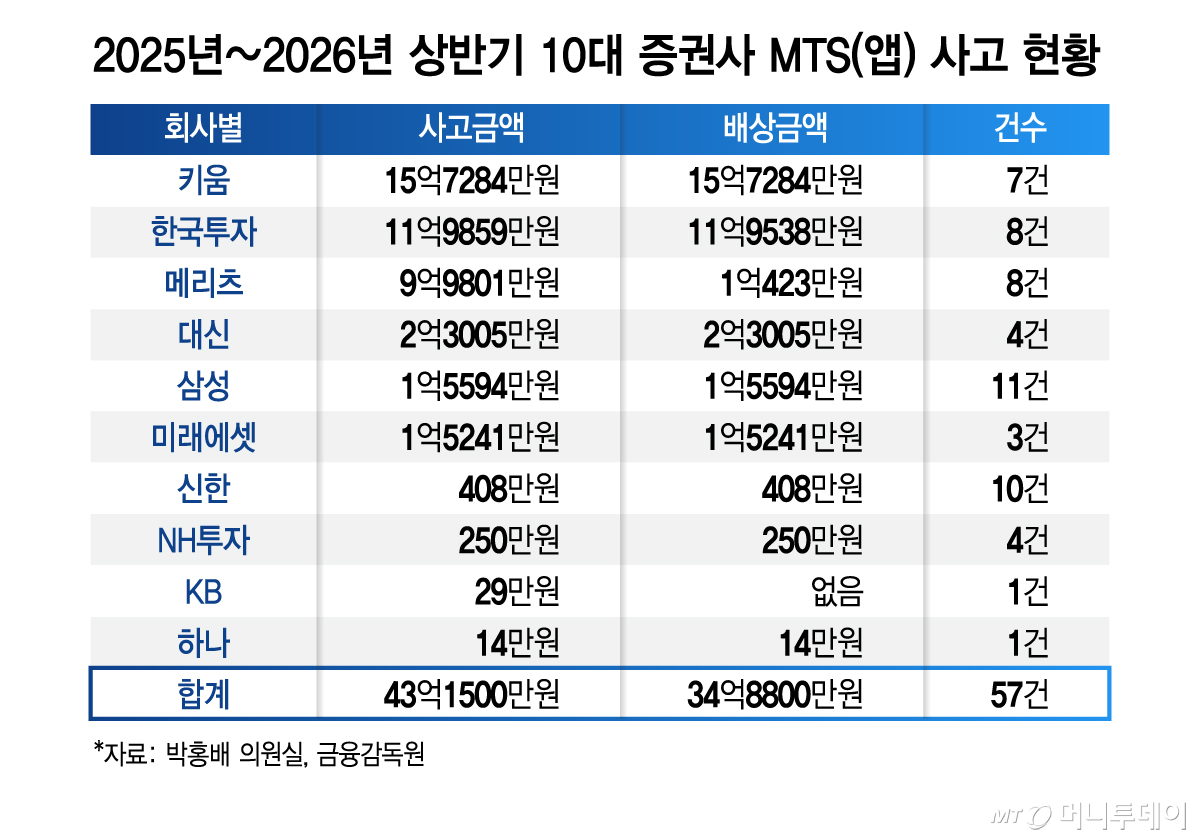
Large securities firms that increased their brokerage (commission) revenues due to rising individual stock trading volumes experienced a total of 57 MTS (Mobile Trading System) incidents over the past 1 year and 6 months, amounting to approximately 4.3 billion won. The amount compensated by securities firms to customers alone reached 3.5 billion won. Considering that most transactions via MTS are conducted by ordinary individual investors, concerns have been raised that securities firms have neglected efforts to prevent investor losses caused by IT system failures.
According to data submitted on the 7th by the Financial Supervisory Service to the office of Park Hong-bae, a member of the Democratic Party of Korea serving on the National Assembly's Political Affairs Committee, a total of 57 MTS (app) incidents occurred at the 10th major securities firms from last year through the first half of this year. The total incident amount was approximately 4.315 billion won, and the amount compensated by securities firms to customers totaled about 3.488 billion won. This results in an average compensation of 61.19 million won per incident.
Breaking it down by securities firm, Kiwoom Securities recorded the highest incident amount at 1.57284 billion won. Korea Investment & Securities followed with 1.19859 billion won, and Meritz Securities came in third with 998.01 million won. Daishin Securities reported 230.05 million won, Samsung Securities 155.94 million won, and Mirae Asset Securities 152.41 million won in MTS incidents. Among the 10th firms, six experienced 'hundreds-of-millions-won' MTS incidents over the past 1 year and 6 months.
In terms of incident count, Samsung Securities had the most with 11 cases, followed by Shinhan Investment Corp (10 cases), Korea Investment & Meritz Securities (8 cases each), and Kiwoom Securities (7 cases). According to the Financial Supervisory Service, MTS incidents were primarily caused by three factors: program errors, system failures, and external factors, with program errors accounting for the majority of all incidents.
The problem lies in the fact that most transactions via MTS are conducted not by professional investors but by ordinary individual investors, meaning so-called 'retail investors' could suffer significant losses. According to data submitted by the Financial Supervisory Service to Park Hong-bae (Rep.), an incident occurred at Kiwoom Securities on November 6 last year, causing connection delays lasting approximately 5 hours and 54 minutes. The incident amount was about 93.92 million won, and it appears that Kiwoom Securities compensated the full amount.
Expanding the timeframe to the past five years, there were 9 cases of access disruptions lasting one hour or longer in MTS or HTS systems from 2021 through the first half of this year. Mirae Asset Securities compensated a total of 3.91766 billion won after experiencing a 1-hour and 10-minute connection delay in its MTS on March 19, 2021. Shinhan Investment Corp was found to have compensated customers 38.44 million won following a 1-hour and 18-minute access disruption on December 2, 2021.
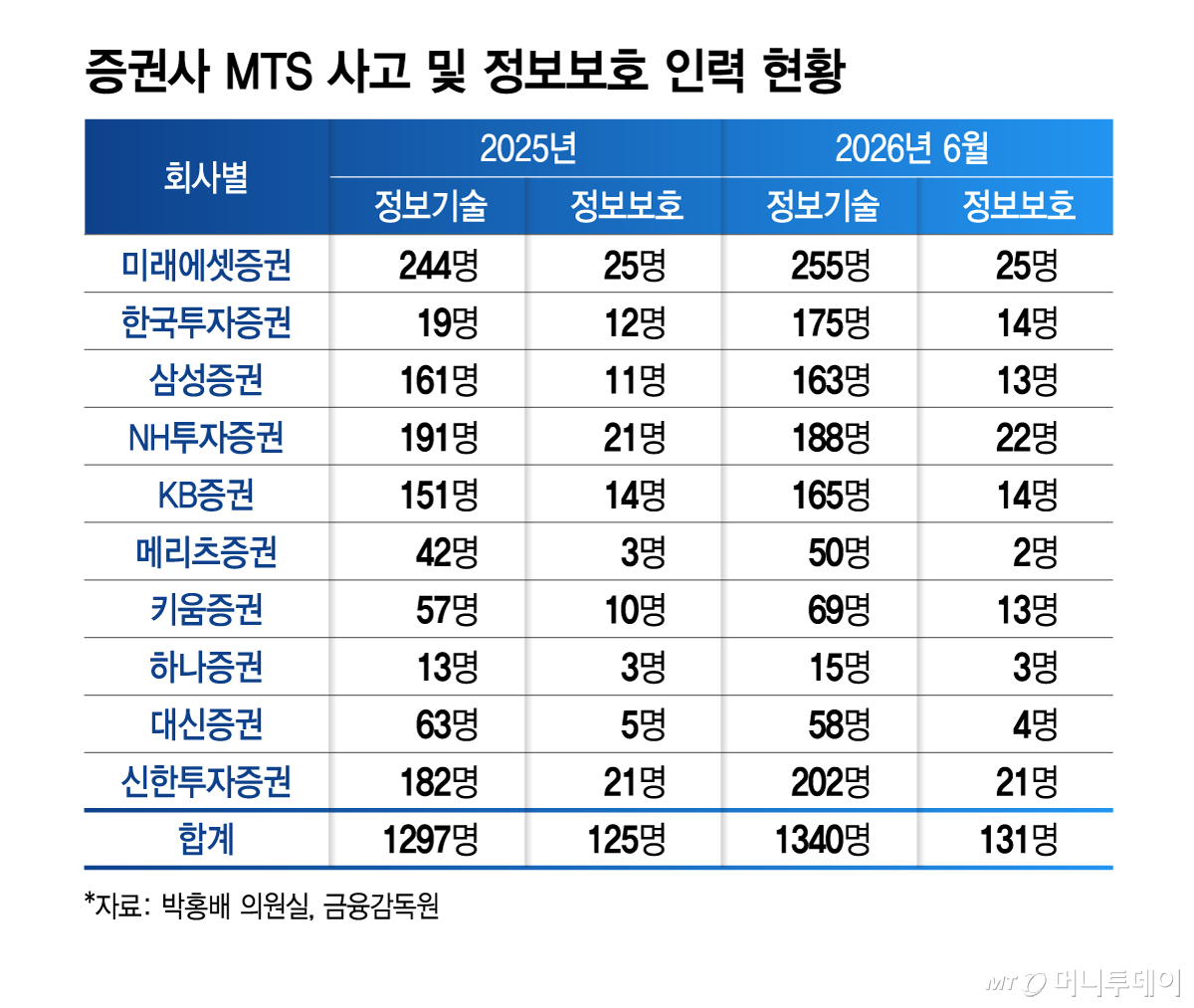
A more serious issue is that securities firms are not actively expanding their information security staffing. As of the first half of this year, the total number of information security personnel at the 10th major securities firms was 131, averaging just 13.1 per firm. Although no incidents related to personal information protection due to MTS disruptions have been reported through the first half of this year, experts argue that more proactive investment is needed given the increasing frequency of individual MTS transactions and the sensitivity of investment information stored within MTS platforms.
In fact, only four of the 10th major securities firms—Korea Investment & Securities, Samsung Securities, NH Investment & Securities, and Kiwoom Securities—were confirmed to have increased their information security staffing this year. Mirae Asset Securities, which has the largest number at 25 personnel, maintained the same level as last year. Shinhan Investment Corp (21 personnel), KB Securities (14 personnel), and Hana Securities (3 personnel) also kept their numbers unchanged. In contrast, Meritz Securities reduced its staff from three to two, and Daishin Securities cut its team from five to four, reducing by one person each.
Securities firms explained that they are reforming MTS systems in the second half of this year to enhance investor convenience and strengthen information protection. They also stated that the large compensation amounts reflect proactive measures taken by securities firms to prevent customer losses. A securities firm official said, "The amount of money involved in MTS incidents does not necessarily indicate the scale of system failures or the extent of damages." He added, "For cases where customer inconvenience and damage have spread, securities firms are actively providing compensation from the customers' perspective."
As MTS incidents continue to rise, the Financial Supervisory Service also instructed securities firms to conduct internal inspections during its first Consumer Risk Response Council meeting held on March 20 this year. The council stated, "Recent frequent IT system failures in securities firm trading systems are the result of inadequate basic internal controls at financial institutions," and added, "Firms must implement self-inspections including securing electronic financial infrastructure processing performance and strengthening program controls." It was pointed out that during periods of expanding market volatility, financial incidents could occur, such as the use of proprietary funds for the purpose of recovering investment losses caused by MTS failures.
Last month, the Financial Supervisory Service's IT Inspection Bureau and Financial Investment Inspection Division conducted an on-site inspection at Toss Securities, where concerns about inadequate investor protection within MTS systems have been repeatedly raised, and also held interviews with consumer and information security executives.
In this regard, Park Hong-bae (Rep.) emphasized, "While securities firms' profits have increased significantly, investment in stable trading environments and information protection remains insufficient." He added, "Since damages caused by IT system failures ultimately fall on investors, securities firms must actively expand relevant personnel and investments, and financial authorities should strengthen management and supervision to prevent recurring IT incidents."

 in STOCK

