

As semiconductor stocks continue to dominate, U.S. regulations on major indices compiled and announced by the Korea Exchange (KRX) are tightening. With additional derivatives regulations and supervisory authorities in place, while the immediate impact on the domestic market is expected to be limited, some express indirect concerns such as the possibility of reduced trading by institutional investors.
According to the Korea Exchange (hereinafter referred to as the Exchange) and the financial investment industry on the 9th, the Exchange recently distributed a circular to the financial investment industry dealing with derivatives, providing guidance on precautions related to the planned transition of the KRX 300 index. Through the circular, the Exchange announced that due to the increasing weight of a single stock within the KRX 300 index, the KRX 300 will be reclassified as a narrow-based index under U.S. laws and regulations starting on the 15th.
The KRX 300 is a stock price index composed of 300 high-quality stocks from KOSPI and KOSDAQ. Its distinctive feature is that it covers both KOSPI and KOSDAQ. It is used not only domestically but also by global institutional investors as the representative benchmark index for our capital market. It is also evaluated as an index that relatively reflects leading companies across industries in a balanced manner.
A narrow-based index is a classification system defined by the U.S. Commodity Futures Trading Commission (CFTC). An index is classified as a narrow-based index if it meets any one of the criteria, such as a single stock’s weight exceeding 30% or the combined weight of the top five stocks exceeding 60%.
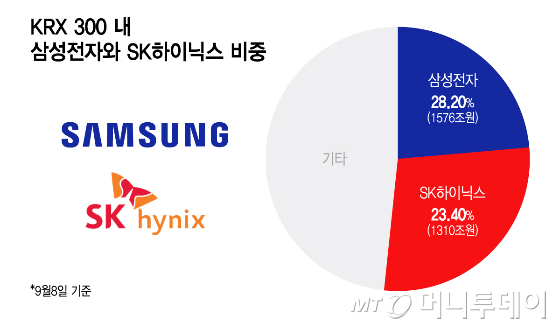
Given that the circular sent by the Exchange to the financial investment industry stated that the weight of the single highest-weighted stock within the KRX 300 index has increased, it appears that the significant rise in Samsung Electronics’ weight—the number one company by total market capitalization in the domestic market among the stocks included in the KRX 300—was a key factor in its reclassification as a narrow-based index. An Exchange official explained, “As of June 15, the KRX 300 met the criteria for transition to a narrow-based index for at least 45 days within the preceding three months. After a three-month grace period, it will be officially converted to a narrow-based index on the 15th.” As of the 8th, Samsung Electronics’ weight within the KRX 300 was approximately 28%.
Among the Koo Seong-han (CEO) indices managed by the Exchange, the Korea Value-Up Program Index, which includes only 100 stocks including Samsung Electronics, and the KOSPI 200 index with 200 stocks, have already been converted to narrow-based indices around the first half of this year.
The securities industry is paying attention to the fact that even the KRX 300, which was considered a relatively balanced index, has been reclassified as a narrow-based index. This is seen as evidence of how severe the concentration in the domestic stock market has been this year.
Consequently, the capital market anticipates that regulations on futures trading by U.S.-based investors investing in the KRX 300 will be strengthened going forward. Once an index becomes a narrow-based index, it will be subject to regulations not only from the CFTC but also from the U.S. Securities and Exchange Commission (SEC). This is because it will be viewed as a security future rather than a general stock price index. As a result, additional laws and derivatives regulations under SEC jurisdiction will apply, and the nature of the index will change, making it difficult for individual investors entrusting their investments to access it. It is expected that only qualified institutional investors will be able to access it.
However, experts in the domestic financial investment industry expect that the impact on the domestic stock market, as well as on stock prices of stocks included in the index, will not be significant immediately. They argue that this is merely a change in the nature of the index under U.S. law and that the proportion of individual investors in the United States who entrusted investments was not large. A securities industry official stated, “While the direct impact on the spot market will be limited, it is true that the regulatory burden on U.S.-based institutional investors’ trading of KRX 300 will increase. In terms of KRX 300 futures, changes in foreign trading volume or liquidity may be detected.”

 in STOCK
