


The financial investment industry has proposed a 1 trillion won venture secondary market investment as a social contribution initiative, but it is being evaluated as "insufficient." Unlike social contribution activities by the banking sector that directly benefit financial consumers—such as interest refunds and interest rate cuts—the perceived impact on investors remains low. Even within the financial investment industry, there are calls for social contribution measures that investors can directly feel.
According to reports from financial authorities on the 9th, the Korea Financial Investment Association recently announced a joint plan with the securities industry to pursue investments of this scale over three years. However, internal reactions within the financial authorities indicate "this is insufficient." This stems from the need for enhanced investor education or infrastructure investment that investors can directly experience, rather than relying solely on venture market investments.
Consequently, there is speculation that a related message may be delivered at the meeting between Lee Chan-jin, Chief of the Financial Supervisory Service, and CEOs of securities firms scheduled for the end of this month. It is reported that Chairman Lee has shown particular interest in the securities industry's social contribution plans.
A financial authority official stated, "Since investors are the source of record-breaking profits achieved by securities firms in the first half of this year, shouldn't efforts be directed toward areas where investors can directly feel the benefits?"
The background of the social contribution discussion lies in the steep performance growth of the securities industry. The combined net profit for the top 10 securities firms based on own capital reached a total of 10.27 trillion won in the first half of this year, surpassing the 10th trillion won mark for the first time. This represents more than double the figure from the same period last year and also exceeded last year's full-year net profit of 9 trillion won within just six months. In particular, the boom in the stock market during the first half led to increased trading volumes, significantly boosting commission revenues and contributing to performance improvements.
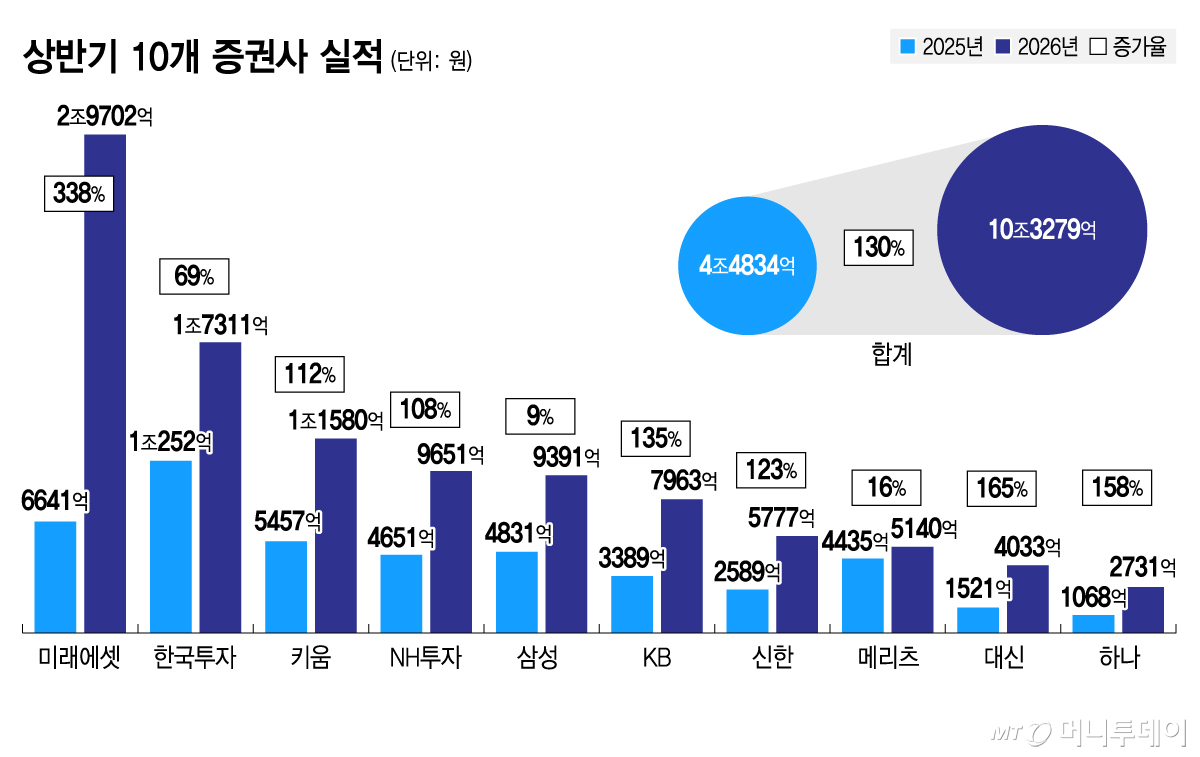
Given that profits were generated from investors, there are calls for social contribution measures that directly benefit investors rather than indirect methods like venture market investments. The banking sector has already expanded mutually beneficial and inclusive financial practices such as interest refunds, interest rate cuts, and debt restructuring that provide direct benefits to investors.
Suggestions raised both inside and outside the industry include enhancing financial investment education and investor protection, supporting asset formation for youth and vulnerable groups, providing funding to small and medium-sized enterprises and venture companies, and establishing public welfare and mutually beneficial funds. Academic circles have also called for strengthened financial investment education. With numerous high-risk products such as 'margin investing' (investing with debt) increasing the risk of investor losses, there is a need to go beyond simply transmitting investment knowledge and instead strengthen education that properly instills awareness of risks.
As record-breaking profits coincide with an elevated status in capital markets, demands for the securities industry to fulfill corresponding social roles are expected to grow further. With the issue of responsibility for single-stock leverage ETFs (exchange-traded funds) emerging as a key topic in next month's national audit, there is also a possibility that the political sphere will demand social responsibility from securities firms. This follows criticism that individual investors suffered losses while only securities firms' profits increased following the introduction of single-stock leverage ETFs.
According to Kang Jun-hyun, a member of the National Assembly's Political Affairs Committee representing the Democratic Party of Korea, commission revenues generated by securities firms through entrusted trading via single-stock leverage ETFs totaled 89.35 billion won as of the end of July.

 in STOCK

