

While both involve investing in high-dividend stocks, it has been found that the one-year return difference between covered call ETFs and regular high-dividend stock ETFs can exceed 60 percentage points. This is because the covered call structure, which generates premium income by selling call options, actually eroded returns during periods of rising stock markets. When the sold KOSPI 200 call options moved in a direction opposite to the held assets, losses widened further.
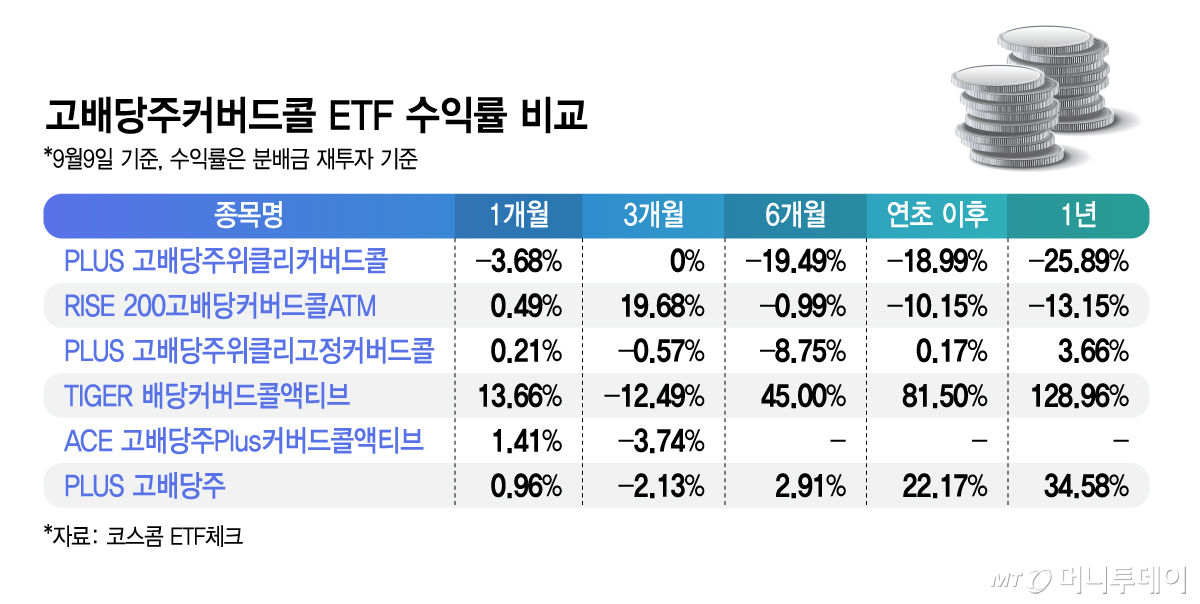
According to KOSCOM's ETF Check on the 9th, as of that day, the one-year return (based on reinvestment of distributions) for 'PLUS High Dividend Stock Weekly Covered Call' was -25.89%. Over the same period, the return for the regular high-dividend stock ETF 'PLUS High Dividend Stock' stood at 34.58%, resulting in a return gap of 60.47 percentage points between the two ETFs.
Not only 'PLUS High Dividend Stock Weekly Covered Call', but returns for other high-dividend stock covered call ETFs were generally underperforming compared to regular high-dividend stock ETFs. 'RISE 200 High Dividend Covered Call ATM' and 'PLUS High Dividend Stock Weekly Fixed Covered Call' recorded returns of -13.15% and 3.66%, respectively.
Even when narrowing the period to the past one month, the results remain the same. The one-month return for PLUS High Dividend Stock Weekly Covered Call was -3.68%, while that for PLUS High Dividend Stock was 0.96%. Returns for RISE 200 High Dividend Covered Call ATM (0.49%) and PLUS High Dividend Stock Weekly Fixed Covered Call (0.21%) were also lower than those of PLUS High Dividend Stock.
The generally low returns of covered call ETFs stem from their inherent characteristics. Covered call ETFs generate premium income by selling the right to purchase underlying assets at a specific price (call options), which is then used as distributions (dividends). Consequently, while distribution yields are high, they cannot fully reflect gains when the underlying stock rises. Over the past year, as the domestic stock market rose and high-dividend stocks increased, covered call ETFs failed to keep pace with stock price appreciation due to their product structure.
Additionally, the fact that KOSPI 200 call options sold by high-dividend stock covered call ETFs moved differently from the high-dividend stocks themselves negatively impacted returns. Asset management companies must sell call options traded in the options market to operate covered call ETFs; however, there are virtually no call option products based on high-dividend stock indices as underlying assets. As a result, high-dividend stock covered call ETFs are forced to sell KOSPI 200 call options while holding high-dividend stocks, and when the movements of these two assets diverged, returns declined further.
For example, if the high-dividend stocks held by a high-dividend stock covered call ETF fall by 5% while the KOSPI 200 rises by 10%, the ETF incurs losses both from its stock holdings and from the sold KOSPI 200 call options. The divergence in movements between high-dividend stocks and the KOSPI 200 led to amplified losses.
However, even among covered call ETFs, returns varied depending on the strategy employed. 'TIGER Dividend Covered Call Active', while a covered call ETF, posted one-year and one-month returns of 128.96% and 13.66%, respectively, outperforming PLUS High Dividend Stock.
A representative from Mirae Asset Asset Management explained: "We adopted an active strategy that flexibly adjusts option strike prices and selling proportions according to market conditions, allowing participation in stock price gains during upward trends while securing premiums during sideways or downward trends." They added, "Furthermore, by selecting stocks that consider both dividend yield and dividend growth potential, the performance of the underlying stocks themselves was also strong."
Experts in the financial investment industry advised that investors could actually incur losses if they invest based solely on dividend yields, urging careful examination of the underlying asset portfolio and call option strategies when investing in covered calls.
A representative from the fund management industry stated: "Since covered calls involve simultaneous profit-and-loss dynamics between held stocks and sold call options, whether the directions of the underlying assets and sold options align is a key criterion for product selection." They continued, "For the profit-and-loss structure to function as designed, when underlying assets rise, the sold call options must move accordingly; therefore, investors should verify directional alignment when selecting ETFs."

 in STOCK
