

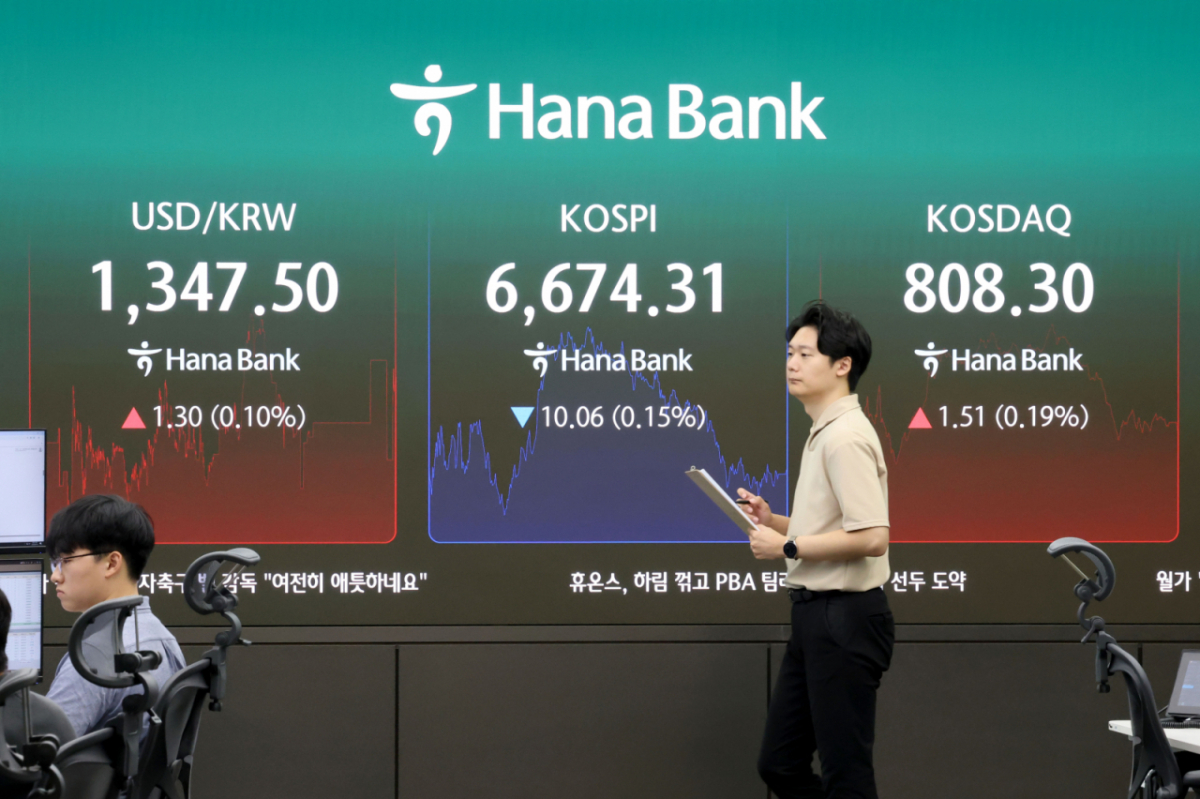
The KOSPI opened lower on the 15th. Rising U.S. benchmark interest rates and a sharp decline in U.S. semiconductor stocks amid discussions about slowing AI development acted as downward pressure on the domestic market.
At 9:06 a.m. on that day, the KOSPI index was calculated at 6,632.10, down 52.27 points (0.78%) from the previous trading session. Based on cumulative data from the Korea Exchange and NextTrade, retail investors purchased net worth of 549 billion won, institutional investors sold net worth of 307.6 billion won, and foreign investors sold net worth of 273.4 billion won.
Among the top market capitalization stocks, Samsung Life Insurance and KB Financial Group showed weakness in the 2nd% range, while Samsung Electric, Samsung C&T, and Samsung SDS declined in the 1st% range. Samsung Electronics, SK Hynix, Hyundai Motor, LG Energy Solution, and Samsung Biologics traded near flat. SK Square held a strong flat trend.
By sector, KOSPI construction, machinery equipment, transportation equipment, electricity and gas, insurance, general services, metals, medical precision, distribution, and finance showed weakness in the 1st% range. Securities, telecommunications, logistics warehousing, textiles and apparel, real estate, non-ferrous metals, food and tobacco, manufacturing, electrical and electronics, paper and wood, and chemicals traded near flat. In contrast, entertainment and culture, pharmaceuticals, and IT services held a strong flat trend.
KOSPI 200 night futures closed down 1.87%.
On the 14th (local time), the U.S. Dow Jones Industrial Average fell 0.29% from the previous day, the S&P 500 index dropped 0.48%, and the NASDAQ Composite Index declined 0.56%. The Philadelphia Semiconductor Index plummeted 5.86%.
Rising U.S. market interest rates and concerns over AI moderation were cited as background factors for the stock market decline. The yield on the U.S. 10-year Treasury bond surged to 5.014% during trading before closing in the 4.9% range.
International oil prices added upward pressure on interest rates. November Brent crude futures closed up 1.02% at $105.68, while October West Texas Intermediate (WTI) crude futures closed up 1.34% at $101.39. According to FedWatch, the U.S. interest rate futures market reflected a more than 90% probability that the Federal Open Market Committee (FOMC) would raise rates by 0.25 percentage points (25 basis points) in September.
Kiwoom Securities researcher Han Ji-young stated, "The fact that the leading digits of the U.S. 10-year Treasury yield have changed is acting as a psychological burden, but the U.S. stock market closed after recovering a significant portion of its early-session losses." She added, "What matters more than breaking through the 5th% level itself is whether additional gains at current levels will lead to multiple de-rating in stock prices."
Regarding the domestic market, she noted, "Frequent news on AI regulation and safety may increase short-term price volatility for semiconductor stocks," but also said, "Since development has not been halted, even if companies implement safety measures at their own discretion, it is worth considering that government regulatory pressure could ease in the medium term."
The KOSDAQ index stood at 802.49, down 4.30 points (0.53%) from the previous day. After opening higher near a strong flat level, it quickly turned lower. As of this moment, retail investors purchased net worth of 73.7 billion won, while foreign investors sold net worth of 68.9 billion won and institutional investors sold net worth of 4 billion won.
Among the top market capitalization group, Wonik IPS and Juseong Engineering declined in the 3rd% range, while Reno Industrial and Simtek fell in the 1st% range. EcoPro, EcoPro BM, and IOTech were fluctuating near a weak flat level. In contrast, HLB, Robotis, and Altogen showed strength in the 1st% range, while Rainbow Robotics held a strong flat trend.
By sector, KOSDAQ metals, construction, machinery equipment, and electrical and electronics declined in the 1st% range. Chemicals, manufacturing, transportation equipment, non-ferrous metals, distribution, finance, medical precision, food and tobacco, textiles and apparel, paper and wood, logistics warehousing, and IT services traded near flat. In contrast, telecommunications, entertainment and culture, general services, pharmaceuticals, publishing media, and other manufacturing held a strong flat trend.
The won-dollar exchange rate stood at 1,347.5 won in the Seoul foreign exchange market at 9:00 a.m., up 1.3 won from the previous day.

 in STOCK
