

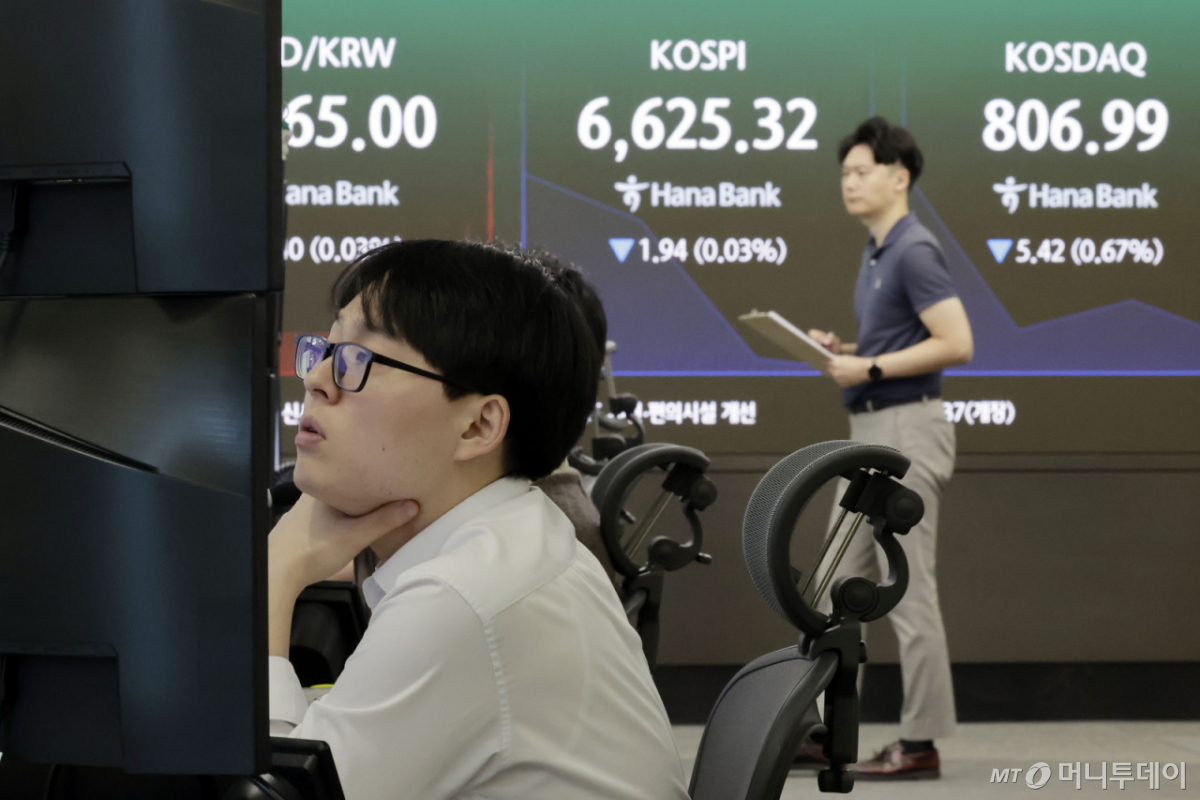
With U.S. 10-year Treasury yields surging to their highest level in three years, breaking above 5% intraday, the domestic stock market is walking on thin ice. On this day, foreign investors and institutional investors shunned both the KOSPI and KOSDAQ. This reflects growing investor caution ahead of the Federal Reserve System's base rate decision early on the 17th Korean time. However, experts diagnosed that conditions for a bubble collapse have not yet been met.
As of 10:46 a.m. on the 16th, the KOSPI index was up 16.33 points (0.25%) from the previous day at 6,643.59 points. The KOSPI opened the session down 16.02 points (0.24%) at 6,611.24 points, swinging between weakness and strength in the early trading hours. However, it is currently moving within a flat range with low volatility.
In the KOSPI, individual investors initially showed solo net buying behavior but began to exit just 30 minutes after the market opened. Instead, funds from pension funds and financial investment firms flowed into institutional investors. At this moment, individual investors and foreign investors are selling stocks worth 55.1 billion won and 814.2 billion won, respectively, on a net basis. In contrast, institutional investors are currently buying stocks worth 334.2 billion won on a net basis.
This trend is analyzed as reflecting market macro conditions. The U.S. 10-year Treasury yield, the global interest rate benchmark, surpassed the 5th% level intraday on the 14th. Industry observers report that this marks the first time since October 2023 that yields have broken through the psychological resistance line of 5%.
International oil prices are also surging. Saudi Arabia's east-west pipeline was closed due to Houthi rebel attacks in Yemen, and crude oil loading operations at the Red Sea Yanbu terminal were halted, intensifying upward pressure on oil prices. Consequently, on November futures contracts for Brent crude traded at the London ICE Futures Exchange on the 15th (local time), prices closed up 2.90% from the previous session at $108.75 per barrel. On the New York Mercantile Exchange, October delivery West Texas Intermediate (WTI) crude futures closed trading for the same period up 4.38% at $105.83 per barrel.
Adding to this, domestic semiconductor stocks are showing sluggish trends amid a confluence of negative factors, including market caution over the Federal Reserve System's base rate hike on the 17th (local time) and concerns about AI (artificial intelligence) speed control discussions. At this moment, Samsung Electronics is up 0.70% from the previous day, while SK Hynix is up 1.48%, showing slight movements.
Experts judge that the likelihood of a September base rate hike by the U.S. Federal Reserve is virtually high, but they dismissed concerns that this would halt the stock market rally.
Kim Min-gyu, a researcher at KB Securities, stated, "Since oil prices have surged sharply, the base effect will disappear after March next year, potentially weakening upward pressure on supply-side inflation." He added, "The stock market has already reflected a significant portion of uncertainty regarding interest rates since the outbreak of the U.S.-Iran war, so short-term shocks are unlikely to be severe."
Noh Dong-gil, a researcher at Shinhan Investment Corp., said, "Discussions on AI development speed control triggered by Anthropic's Dario Amodei have evolved into an agenda as major companies and management teams continue to respond. With AI model performance improving rapidly, concerns that it may escape human control are also growing." He noted, "Since the discussion on speed control has just begun, we cannot deny the possibility and impact of future international regulations based solely on recent strong corporate earnings. However, it is also difficult to conclude that regulatory discussions alone will accelerate the peak of AI investment and semiconductor demand."

 in STOCK
