

The financial authorities have launched special measures with the industry to prevent stock market volatility from expanding due to so-called margin investing (investing with debt). Given that the financial authorities have previously emphasized informing the securities industry about the structures of credit financing and unsettled transactions, as well as the risks of forced sales, it is expected that efforts will focus on providing guidance on precautions according to investor characteristics and strengthening the duty to explain.
According to the financial authorities on the 20th, the Financial Supervisory Service announced at the 'National Report Conference on Financial Consumer Protection Achievements' held on the 17th that it would prepare improvement measures for credit financing and unsettled transactions. This comes from the need to strengthen responses to prevent market volatility from expanding excessively due to margin investing (investing with debt).
A financial authority official stated, "We are in discussions with the industry and expect to announce measures soon." Lee Eoung-won, Chairman of the Financial Services Commission, also said in a congratulatory message at the 29th-anniversary conference of the Korea Financial Investment Association that day, "We will closely manage stock market leverage such as credit financing and prepare more detailed volatility mitigation mechanisms, including the introduction of emergency measures by the Financial Services Commission to ensure market stability during crises."
The measures are expected to focus on preventing investor damage by fully and timely informing them of the risks of margin investing (investing with debt) and the forced sale structure. Accordingly, the authorities are reviewing options such as restricting unsettled transactions for minors, requiring additional confirmation documents from elderly investors, providing pre-simulations on conditions for forced sales and potential loss ranges, and improving pre-notification procedures for forced sales. Since it is impossible to completely ban margin investing (investing with debt), the focus has been placed on the duty to explain risks, aiming to improve institutions tailored to individual investor characteristics such as minors and elderly investors, allowing them to utilize margin investing (investing with debt) within a range they can bear.
In addition, options are being discussed to directly reduce the scale, such as lowering credit lending limits for each securities firm from 100% of their own capital, and adjusting margin deposit rates and collateral ratios for credit financing. Given that major securities firms previously took independent measures in March, such as temporarily suspending credit trading loan services or reducing limits due to a surge in margin investing (investing with debt), it is expected that activating similar measures during urgent situations like an expansion of stock market volatility may be possible.
The financial authorities have taken steps to prepare measures based on the judgment that there is a high correlation between recent stock market volatility and margin investing (investing with debt). As of the end of last month, the KOSPI stood at 6,820, up 62% from the end of the previous year (4,214). During this process, volatility also expanded significantly. The daily return volatility of the KOSPI rose from 1.4% last year to 3.6% in the first half of this year, a 2.5-fold increase.

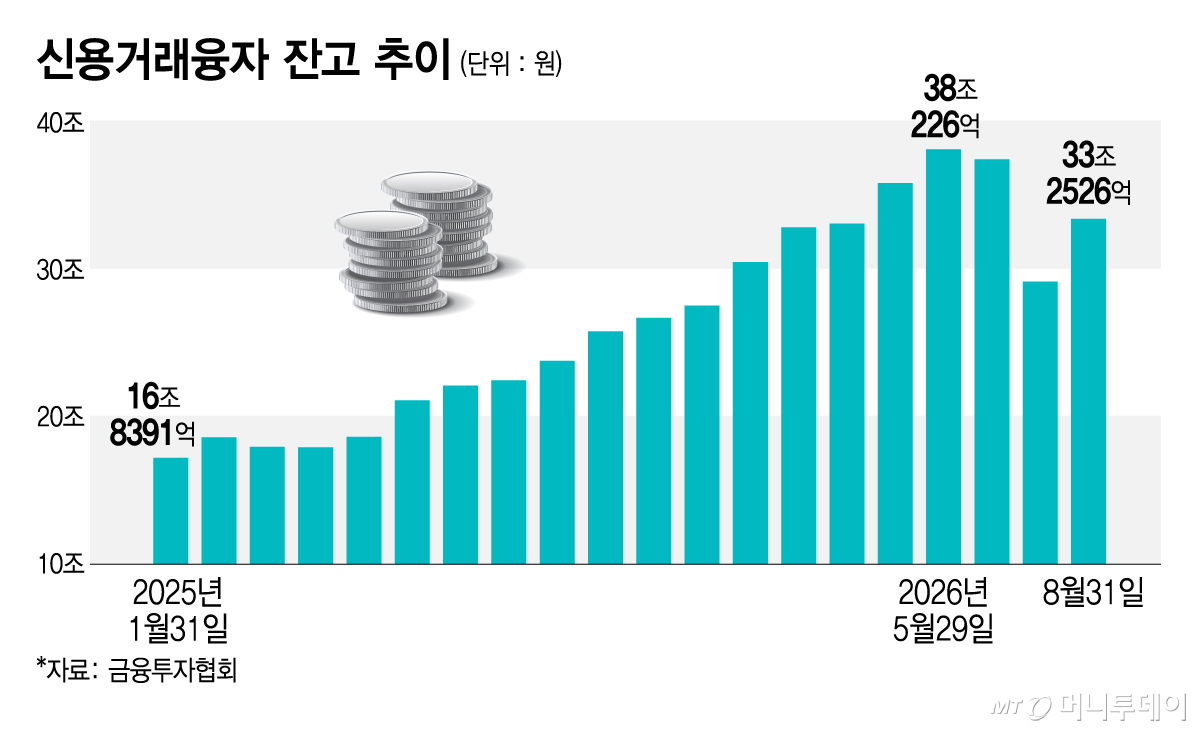
According to statistics from the Korea Financial Investment Association, as of the end of last month, the outstanding balance of credit trading loans in the domestic stock market reached 33 trillion 252.6 billion won, nearly doubling from January of last year (16 trillion 839.1 billion won). At the end of May, it also recorded a historic high of 38 trillion 206 billion won on a month-end basis. Credit trading loans refer to the amount investors borrow from securities firms to purchase stocks.
Unsettled funds from entrusted transactions reached a yearly high of 1 trillion 661.4 billion won as of the end of July. Unsettled funds from entrusted transactions represent margin investing (investing with debt) where investors borrow short-term funds from securities firms to invest.
The problem is that as margin investing (investing with debt) increases, the risk of losses for individual investors grows and market volatility can also expand. Credit trading loans involve paying only a certain percentage of the credit trading guarantee deposit and borrowing the remainder from a securities firm to purchase stocks; if stock prices fall and the collateral ratio drops below a certain level, the stocks are forcibly sold (forced sale). Assuming a collateral ratio of 45%, if stock prices fall by 45%, investors will lose their entire principal.
Unsettled funds from entrusted transactions also typically allow investment with only 30% to 40% of the investment amount, but the shortfall must be covered within three trading days. Failure to do so results in the forced sale of the relevant stocks at the opening simultaneous auction on the next trading day. Forced sales against unsettled funds reached a yearly high of 122 billion won as of the end of July. During the same period, the proportion of forced sales relative to unsettled funds surged to 9.4%. If market prices plummet and forced sale volumes are dumped all at once, it can trigger additional stock price declines, creating a vicious cycle that expands market volatility.

 in STOCK

