

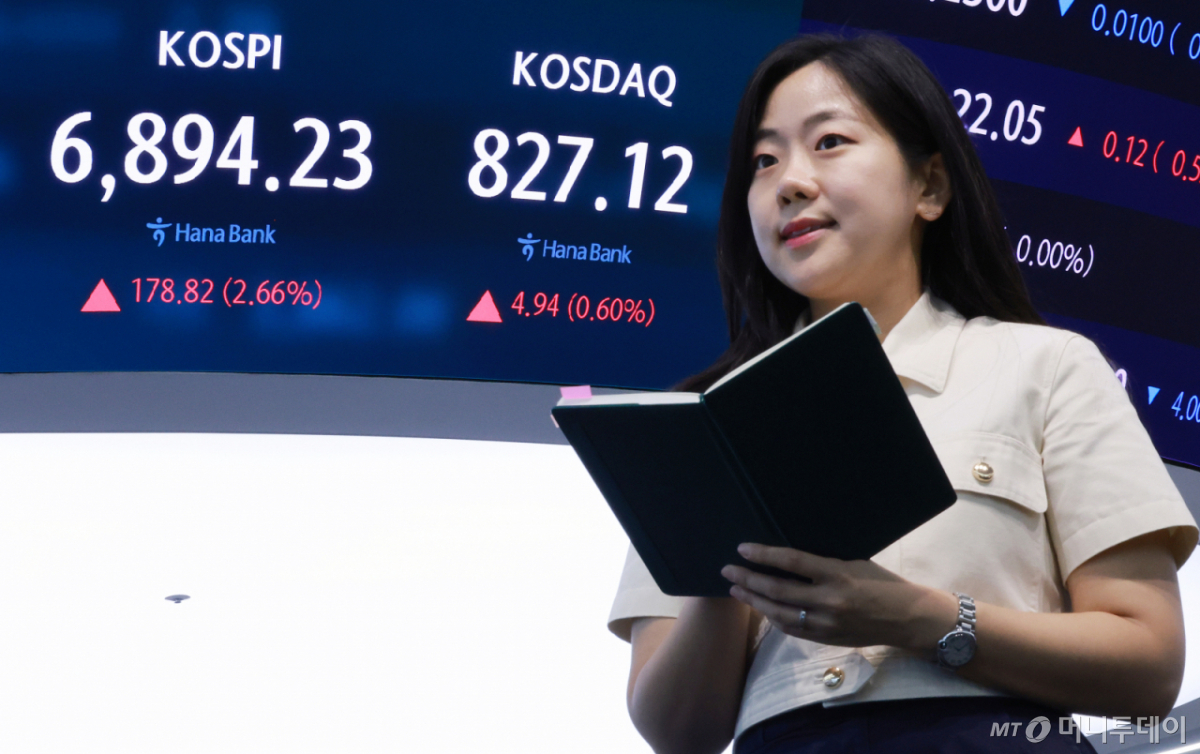
This week (the 21st–25), the domestic stock market is expected to experience volatile trading ahead of the Chuseok holiday. This is due to numerous external variables that could shake the market, including the U.S.-China summit, Middle East war risks, and potential fallout from a U.S. base rate hike. Some forecasts suggest KOSPI may fluctuate between 6,400 and 7,500 points.
According to Korea Exchange data for last week (the 14th–18), KOSPI closed at 6,894.23, down 15.68 points (0.23%) from the previous Friday’s close of 6,909.91. During this period, foreign investors and retail investors sold net amounts of 8.7627 trillion won and 271.3 billion won, respectively, in the KOSPI market. Institutional investors purchased a net amount of 879.9 billion won.
Last week, KOSPI initially declined due to concerns over AI (artificial intelligence) growth moderation and heightened caution ahead of the U.S. Federal Open Market Committee (FOMC) meeting in September, but rebounded after the FOMC concluded. This was because monetary policy uncertainty eased and international oil prices fell. Additionally, Jensen Huang, CEO of NVIDIA, stated that semiconductor sales next year will double compared to this year, reviving investor sentiment toward semiconductor stocks.
This week, domestic stock markets are also expected to react sensitively to external variables such as the fallout from a U.S. base rate hike, the U.S.-China summit, and Middle East war risks. With the domestic market closed for the Chuseok holiday on the 24th and 25th, caution is likely to increase ahead of the long weekend. NH Investment & Securities forecasts that KOSPI will fluctuate between 6,400 and 7,500 points this week.
The most significant topic at the U.S.-China summit scheduled for the 24th (local time) that will have the greatest impact on the domestic stock market is the AI agenda, which is directly linked to semiconductor controls against China. If the United States eases its semiconductor regulations on China, investor sentiment toward domestic semiconductor stocks could deteriorate. Conversely, bans on chip and equipment sales to China would be favorable for domestic semiconductor stocks.
Other key variables include the fallout from a U.S. base rate hike and Middle East war risks. Lee Kyung-min, head of FICC Research at Daishin Securities, stated, “As the Federal Reserve’s monetary policy path becomes clearer through the FOMC, uncertainty regarding the final interest rate has been contained.” He further analyzed, “With the U.S. midterm elections approaching, President Donald Trump is showing a conciliatory attitude toward resolving geopolitical risks with Iran, and China’s engagement in dialogue with Iran represents a positive development for oil price stability.”
Experts in the financial investment industry advised that despite external variables, KOSPI remains undervalued, so investors should increase their allocation.
Na Jeong-hwan, a researcher at NH Investment & Securities, said, “The consensus estimate for this year’s KOSPI net profit is 806 trillion won, and next year’s is projected at 1,048 trillion won, maintaining an upward trend. The KOSPI’s 12-month forward price-to-earnings ratio (PER) stands at 5.5 times, the lowest in history.” He added, “The current market situation is one where stock prices are suppressed not by actual earnings but by doubts about earnings. As AI company earnings reports, including Micron’s on the 30th, become available, these concerns will gradually dissipate.”
Historically, KOSPI has tended to rebound after the Chuseok holiday, so buying stocks before the holiday could also be a viable strategy. Based on the past 10 years, the average KOSPI return over the five trading days preceding Chuseok was -0.42%, while the average return over the five trading days following the holiday was 0.68%.
The same executive explained, “As we navigate a hawkish FOMC and approach the Chuseok holiday, there is a possibility of short-term volatility expansion due to selling pressure from cautious investors. However, this should be viewed as an opportunity to increase allocations.” He further noted, “Typically, supply and demand turn conservative ahead of holidays, but after the holiday, pent-up demand flows in, leading to clear rebound trends. Therefore, if the stock market performs poorly in the short term, a buy strategy targeting a post-holiday rebound remains valid.”
Experts highlighted semiconductors as a sector worth watching due to excessive price declines and undervaluation relative to earnings. Samsung Electronics’ decision to implement a special dividend is also a key investment factor. To receive the special dividend, investors must purchase Samsung Electronics or its preferred shares by the 28th.
Lee Jae-won, a researcher at Yuanta Securities, advised, “Investors should maintain a strategic focus on semiconductor stocks and large-cap KOSPI companies.” He added, “If oil prices and market interest rates stabilize further and foreign net buying continues, the recent correction could present a buying opportunity.”

 in STOCK
