

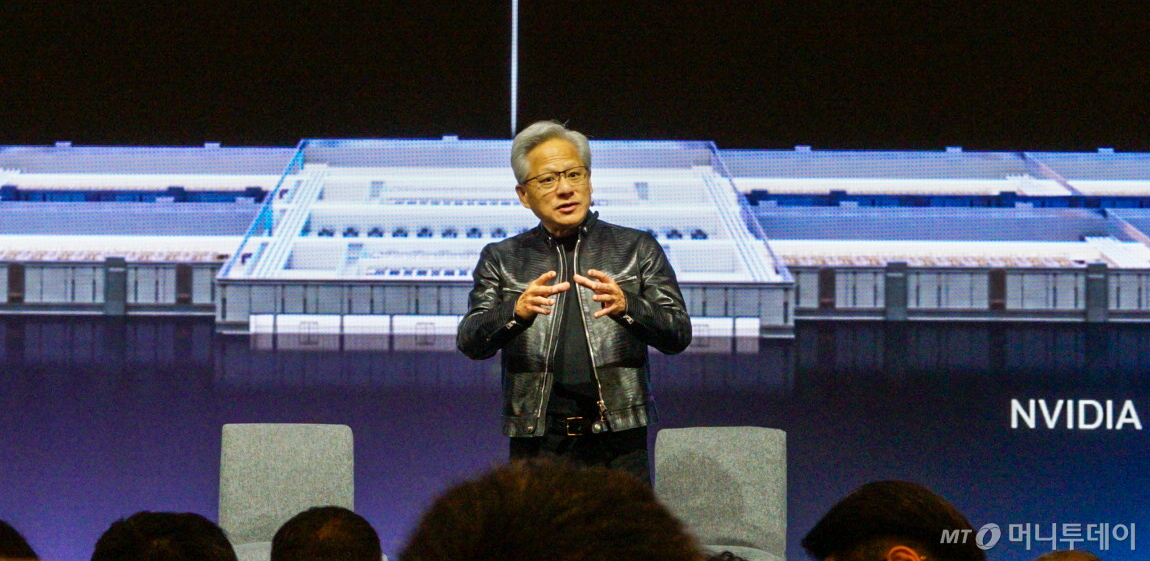
Semiconductor stocks, which had faltered amid debates over AI speed control, rallied again following a single remark by NVIDIA CEO Jensen Huang.
According to data from Korea Exchange on the 19th, Samsung Electronics closed regular trading on the 18th at 261,000 won, up 8,500 won (3.37%) from the previous trading day. SK Hynix recorded a gain of 112,000 won (6.42%), closing at 1.857 million won.
CEO Huang's remarks sparked investor sentiment in the semiconductor sector. On the 17th (local time), ahead of attending an AI summit hosted by King Charles III in Scotland, CEO Huang told reporters, "We expect NVIDIA to sell twice as many chips next year compared to this year," adding, "This is because AI is making a very significant contribution to various industries and the economy."
Experts in the financial investment industry analyzed that despite the high-interest-rate environment, semiconductor demand remains robust, as CEO Huang stated.
Kim Dong-won, head of research at KB Securities, said, "Although the yield on 20-year government bonds has reached the 6.0–7.5% range, we estimate that from January to September this year, the volume of bonds issued by U.S. hyperscalers for AI infrastructure investment increased eightfold year-on-year to 337 trillion won." He added, "This reflects investor confidence that despite accepting high borrowing costs, investments can be recovered within a few years through profit growth generated in AI cloud and AI services, which is driving expanded investment." He further stated, "The biggest beneficiaries of AI demand, which remains stronger than interest rates, are Samsung Electronics and SK Hynix."
Analyses also suggest it is unlikely that the recently surfaced debate over AI speed control will lead to reduced investments across the industry. This is because it is practically difficult for all companies to reach a consensus on simultaneously slowing down development speeds. In particular, given that the United States and China are engaged in a technological hegemony competition, there is a general view that a gap between agreements on joint slowdowns and their actual implementation is inevitable.
Lee Jae-won, a researcher at Yuanta Securities, explained, "Until actual order reductions are confirmed, it is difficult to definitively interpret recent semiconductor corrections as signals of AI investment cuts." He added, "We maintain our top preference for semiconductors and large-cap KOSPI stocks from a strategic perspective."
The researcher further stated, "Profit differentiation continues even within the IT (information technology) sector. Samsung Electronics is scheduled to distribute approximately 30 trillion won in cash dividends in the third quarter, and SK Hynix has announced plans for additional shareholder return policies following its 40 trillion won share buyback and cancellation." He concluded, "Responses centered on semiconductors, with performance and shareholder returns confirmed around the Chuseok holiday period, remain valid."

 in STOCK
