

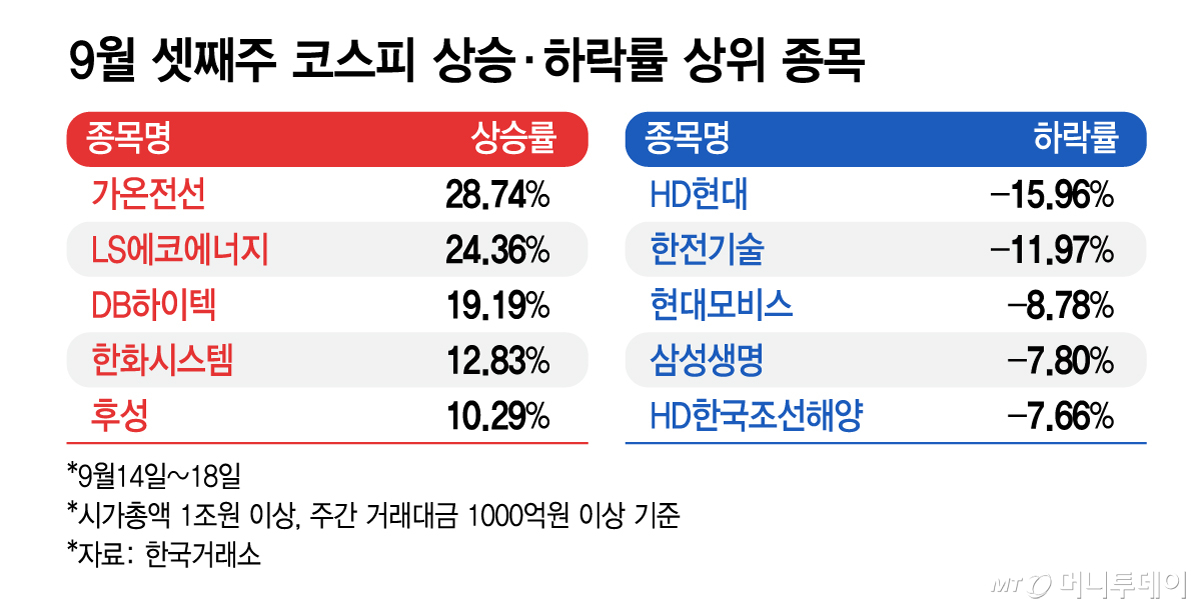
During the third week of September (September 14–18), power sector stocks and semiconductor materials, components, and equipment (MCE) stocks surged in the KOSPI market. This was due to reduced uncertainty over monetary policy following the U.S. Federal Open Market Committee (FOMC) meeting in September and renewed AI momentum. In contrast, nuclear power and shipbuilding stocks, which had recently shown an upward trend, declined as profit-taking selling emerged.
According to Korea Exchange on the 19th, the KOSPI closed at 6,894.23 points on the third week of September, down 15.68 points (0.23%) from Jeonju’s level of 6,909.91. Amid major monetary policy schedules including the FOMC and Bank of Japan (BOJ), concerns over AI pace control surfaced early in the week, causing the KOSPI to falter. However, on the 17th (local time), Jensen Huang, CEO of NVIDIA, stated that he expects NVIDIA’s chip sales next year to double this year’s volume, reviving AI momentum.
As a result, semiconductor MCE stocks surged. DB HiTek, a system semiconductor foundry company, jumped 19.19% from September 14 to 18. Huseung, which sells specialty gases and refrigerants for semiconductors, rose 10.29%. Semiconductor substrate companies Samwha Condenser and Daedeok Electronics also gained 5.24% and 3.2%, respectively.
Semiconductor leaders Samsung Electronics and SK Hynix rose only 0.58% and 2.48%, respectively. Although both stocks surged after CEO Huang’s remarks, their weekly gains remained relatively low due to declines of 4.05% and 6.35% on September 14, when AI pace-control concerns first emerged.
Performance in the power sector was also notable. Among KOSPI stocks (with market capitalization over 1 trillion won and weekly trading volume exceeding 100 billion won) during the third week of September, Gaon Electric Wire had the highest gain at 28.74%. LS Eco Energy ranked second with a 24.36% increase. News that LS Eco Energy would collaborate with Gaon Electric Wire’s U.S. subsidiary to target the North American distribution market caused both companies’ stock prices to surge sharply.
On the 15th, LS Eco Energy announced it had supplied medium-voltage (MV) underground cables to a solar power plant in the United States in cooperation with Gaon Electric Wire. Gaon Electric Wire’s U.S. subsidiary, LSCUS, signed a contract with local customers, and LS Eco Energy’s Vietnamese production facility, LS-VINA, will manufacture the products. The supplied cables will be used to collect electricity generated at the solar power plant and transmit it to substations.
News that Hanwha Systems would participate in the United Arab Emirates (UAE) integrated air defense network construction project stirred the defense sector. On the 15th (local time), Hanwha Systems signed a memorandum of understanding with EDGE Group, the UAE’s largest state-owned defense company, regarding the integrated air defense network project. As a result, Hanwha Systems’ stock price rose 12.83% over the week. Another defense stock, LIG Defense & Aerospace, also gained 9.73%.
Baek Jong-min, a researcher at Yuanta Securities, stated, “After being silent since the beginning of the year due to events such as the Iran war, cooperation with the UAE worth $35 billion (approximately 48 trillion won) in defense has resumed.” He added, “Not only Hanwha Systems, the contracting party, but also companies related to L-SAM, Cheongung-II, and Cheonmu, including LIG D&A and Hanwha Aerospace, are expected to benefit.”
In contrast, HD Hyundai Heavy Industries’ stock price plummeted 15.96% due to a partial strike by its union and profit-taking selling in shipbuilding stocks. HD Hyundai Heavy Industries slipped 7.66%.
Stocks that had risen on expectations of U.S.-focused investment projects, including Korea Electric Power Corporation Technology (-11.97%), KEPCO (-7.10%), and Doosan Enerbility (-6.50%), all declined during the third week of September.
Hyundai Mobis (-8.78%), along with Hyundai Motor (-4.58%) and Kia (-3.71%), saw their stock prices fall due to the strengthening won and concerns over Chinese vehicles entering the U.S. market.

 in STOCK
