

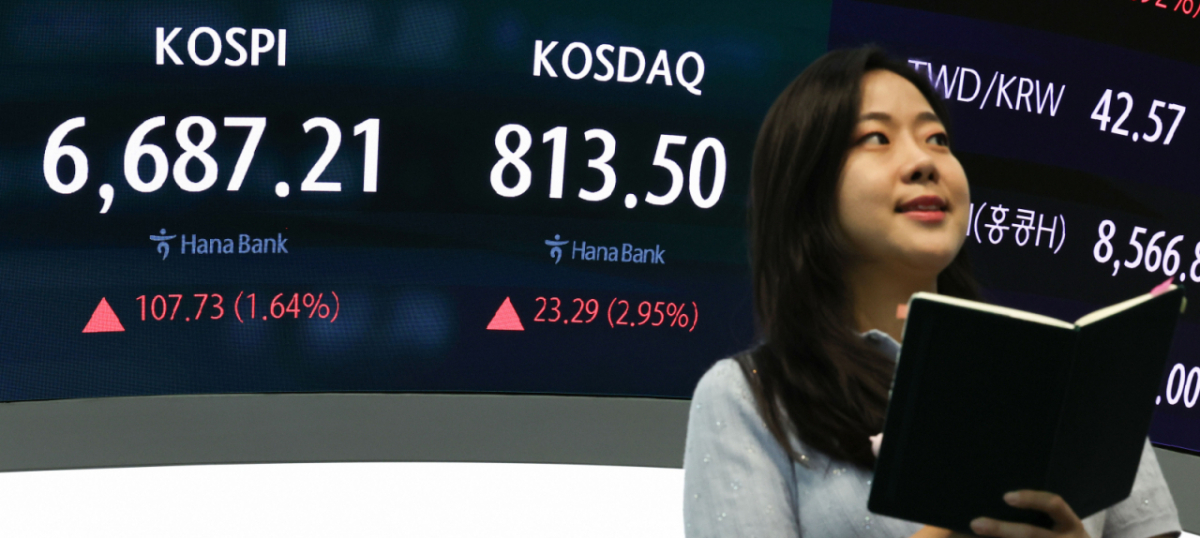
Expectations of a U.S. interest rate freeze and South Korea's record-breaking current account surplus drove strong performance in the semiconductor and robotics sectors on the 4th. Although global risk asset investor sentiment partially recovered, analysts warn that macroeconomic variables such as next week's U.S. inflation data release, the European Central Bank's (ECB) monetary policy decision, and unwinding of the yen carry trade must be closely monitored.
On this day, the KOSPI closed regular trading at 6,687.21, up 107.73 points (1.64%) from the previous trading day. The KOSPI opened at 6,654.36 and widened its gains during the session, rising more than 2% at one point.
Net purchases by institutional investors and foreign investors drove the KOSPI's rise. As of 4:23 p.m., institutional investors bought net 2.5835 trillion won, while foreign investors bought net 549.1 billion won; however, retail investors sold off 4.6783 trillion won worth of stocks.
The KOSPI showed clear strength centered on large-cap semiconductor stocks. Samsung Electronics closed at 255,000 won, up 5,500 won (2.20%) from the previous trading day. SK Hynix closed at 1.647 million won, up 51,000 won (3.20%). SK Square rose over 6%, and Samsung Electro-Mechanics gained over 3%, both showing strong performance.
Conversely, large-cap financial stocks, which had served as defensive plays during the downturn, also declined. KB Financial Group closed at 172,000 won, down 5,900 won (3.32%), and Shinhan Financial Group also fell over 3%.
With renewed military tensions between the U.S. and Iran pushing oil prices higher, the refining sector also showed strength. SK Innovation, S-Oil, and GS Energy all closed with gains.
The KOSDAQ rebounded for the first time in four trading days, settling at the 810th level. The KOSDAQ closed at 813.50, up 23.29 points (2.95%) from the previous trading day. Starting the day at 802.32, the KOSDAQ expanded its gains as buying pressure from foreign investors and institutional investors flowed in.
Shin Han Investment Corp. researcher Kang Jin-hyuk analyzed: "The KOSPI rose over 1% as investors relieved by remarks from Federal Reserve officials hinting at a September interest rate freeze began to enter the market." He added, "The KOSDAQ rebounded for the first time in four trading days as buying pressure flowed into growth stocks led by robotics shares amid improving macroeconomic conditions."
Although risk asset investor sentiment has somewhat recovered, monetary policy directions from the U.S. and Europe next week are expected to be key variables.
Kiwoom Securities researcher Kim Yu-mi stated: "Next week, attention should focus on U.S. inflation data and the ECB's monetary policy meeting." She noted, "Given that recent U.S. job openings and ADP (private employment research firm) employment figures were weaker than expected, concerns about an interest rate hike at the September FOMC (Federal Open Market Committee) may ease if inflation remains within market expectations."
Continuing, researcher Kim added: "In ECB monetary policy decisions, attention should be paid to the possibility of additional interest rate hikes given high inflation pressures." She observed, "While concerns about further tightening in the U.S. are easing, if tightening expectations persist in the eurozone, a divergence between U.S. and European monetary policies will emerge, exerting moderate downward pressure on the dollar."
Analysts also note that factors dampening investor sentiment remain, including renewed Middle East tensions and the yen carry trade.
Daishin Securities researcher Lee Kyung-min pointed out: "Amid ongoing military clashes between the U.S. and Iran, U.S. Vice President JD Vance stated that the U.S. would not engage in dialogue unless Iran halts attacks on commercial shipping, further heightening tensions in the Middle East." He added, "WTI (West Texas Intermediate) and Brent crude futures exceeding $91 and $95 respectively pose burdens to the stock market."
Continuing, researcher Lee explained: "The sharp decline in the dollar-yen exchange rate is also a variable. With expectations of an interest rate hike by the Bank of Japan (BOJ) in September rising, the yen's strengthening has expanded concerns about unwinding the yen carry trade, which limits preference for risk assets."

 in STOCK
