

Major players in the non-performing loan (NPL)(NPL) market, NPL specialist firms, have increased corporate bond issuance volumes beyond their initial fundraising targets to secure refinancing funds amid rising interest rates. As the cost of raising funds through corporate bonds is likely to rise, managing bond purchase prices and recovery periods will determine the second-half performance of these specialist firms.
According to the investment banking industry on the 26th, Woori Financial F&I, an NPL specialist firm, received orders totaling 952 billion won in a demand forecast for raising 150 billion won on the 1st, then increased its issuance amount to 244 billion won on the 9th. The raised funds appear to be used for refinancing, including repayment of existing corporate bonds (142 billion won) maturing on the 11th.
Daihan F&I secured orders totaling 1.589 trillion won for a 150 billion won fundraising in its demand forecast on the 7th and issued 300 billion won on the 15th. The raised funds will be used to repay 14 cases of commercial paper (CP) and short-term electronic debt maturing between September 16 and October 13.
Hana F&I also received orders totaling 687 billion won for a 150 billion won fundraising on July 27, increasing its issuance amount to 265 billion won. Of this, 215 billion won was allocated for refinancing and 50 billion won for operating funds.
According to Samjong KPMG, in the second quarter of this year, specialist firms including Union Asset Management, Daihan F&I, Hana F&I, and Woori Financial F&I accounted for 89.2% of total NPL investment cases and 90.3% of the investment amount.
NPLs in the banking sector are increasing. According to the Financial Supervisory Service on the 23rd, NPLs held by domestic banks as of the end of June totaled 18.9 trillion won, an increase of 1.2 trillion won from the end of March. The ratio of NPLs to total loans rose from 0.60% to 0.63%. New NPLs in the second quarter amounted to 7.2 trillion won, an increase of 1.7 trillion won from the previous quarter, while the amount resolved was 6.1 trillion won.
Corporate loan NPLs accounted for 15.2 trillion won, or 80.4% of the total. New SME (small and medium-sized enterprise) NPLs increased by 1.2 trillion won from 3.3 trillion won in the first quarter to 4.5 trillion won in the second quarter.
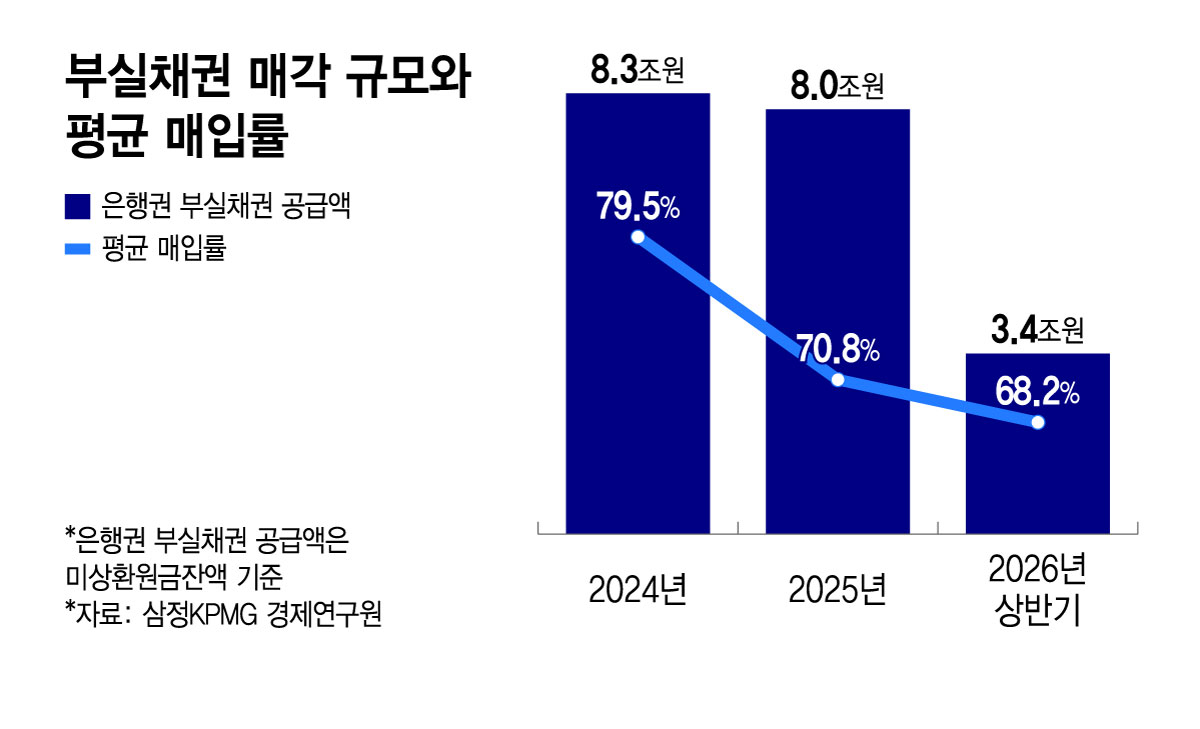
NPLs supplied by banks to the market were recorded at 8.3 trillion won in 2024, 8 trillion won last year, and 3.4 trillion won in the first half of this year, based on outstanding principal balances (OPB).
The Bank of Korea raised its base rate from 2.50% to 2.75% annually in July, then increased it again to 3.00% last month on the 27th. The Bank of Korea has stated its intention to decide on the timing and pace of further rate hikes.
Samjong KPMG expects that NPL sales from banks will increase in the second half of this year, centered on commercial and residential collateral bonds for SMEs (small and medium-sized enterprises) and individual business owners. It forecasted that specialist firms' profits will depend on funding costs and recovery strategies.

 in STOCK
