

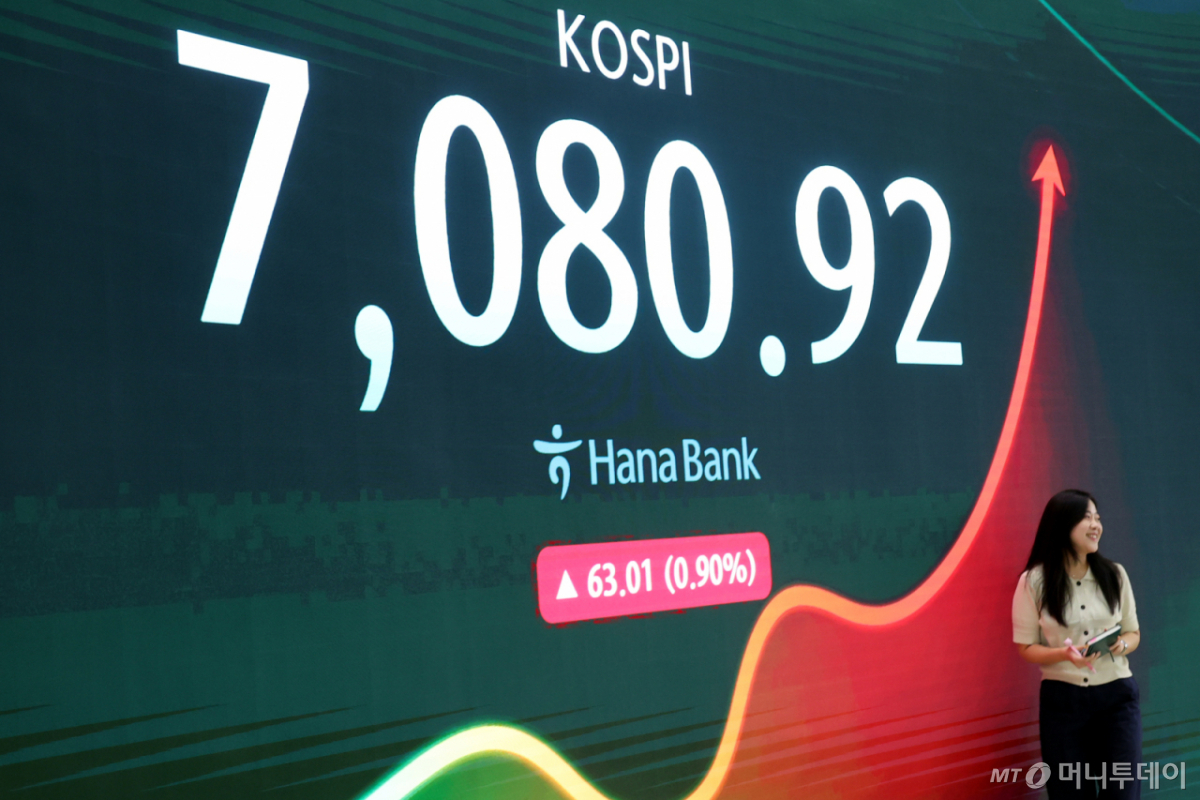
Thanks to a rebound in AI semiconductor stocks, KOSPI recovered the 7000th-point level last week. Despite an increase in the U.S. base rate, the domestic market showed signs of recovering investor sentiment with steady upward movement. Attention is focused on whether upcoming events this week, such as U.S. inflation data and Micron's earnings report, will provide additional momentum for further gains.
According to Korea Exchange data on the 27th, KOSPI closed regular trading last week (the 21st–23) at 7080.92, marking four consecutive days of gains. Last week, KOSPI rose a total of 186.69 points (2.71%) based on the closing price of regular trading, settling firmly above the 7000th-point level.
Last week, institutional investors were the only buyers, purchasing stocks worth 1.7129 trillion won net, while retail and foreign investors sold off stocks worth 6.2021 trillion won and 419.1 billion won, respectively. The securities industry attributes this to a cooling in international oil prices and U.S. Treasury yields, which sparked a rally in AI-themed stocks on the New York market, creating favorable conditions for the domestic market with its high exposure to the semiconductor sector.
Volatility in KOSPI also eased. The 'KOSPI 200 Volatility Index' closed at 42.98 on the 23rd, down 7.1 points from 50.08 on August 28, one month prior.
Short-term macroeconomic uncertainty stemming from U.S.-China tensions during the Chuseok holiday has also been temporarily resolved. On the 24th (local time), the two countries agreed at a summit to extend their trade truce for two months. However, Chinese President Xi Jinping and U.S. President Donald Trump held differing views on AI. Xi emphasized human control and responsible development, while Trump stressed maintaining the pace of AI development.
The domestic market this week faces several upcoming events. Various local indicators that could influence the U.S. Federal Open Market Committee (FOMC) meeting in October are drawing particular attention. Scheduled releases include the September U.S. Consumer Confidence Index and JOLTS (Job Openings and Labor Turnover Survey) on the 29th; the September ADP (Automatic Data Processing) private employment report and August PCE (Personal Consumption Expenditures) inflation index on the 30th; and the September U.S. Employment Report on the 2nd of next month.
On the 30th, Micron Technology's earnings will also be released. Micron is the world's third-largest memory semiconductor company. This earnings report is seen as a key indicator for forecasting industry conditions such as AI semiconductor supply and demand.
Additionally, on the 28th, the Bank of Japan (BOJ) monetary policy meeting minutes will be released; on the 1st, September South Korean export-import statistics; and on the 2nd, September South Korean consumer price index and September Eurozone consumer price index are scheduled for release in succession.
Lee Kyung-min, a researcher at Daishin Securities, stated, "Depending on the gap between the consensus estimate for August's U.S. PCE inflation data, we may see the probability of a 0.25 percentage point base rate hike at the October FOMC meeting and fluctuations in bond yields." He added, "Micron's earnings could serve as a new rally trigger if they exceed the consensus estimate for next quarter's guidance, which is needed given the current surprise requirement, thereby confirming the lower bound of performance expectations for Korean semiconductors."
Lee Jae-man, a researcher at Hana Securities, noted, "In the domestic market, a decline in WTI (West Texas Intermediate) crude oil prices could be linked to net foreign buying." He further explained, "Domestic sectors with a high correlation coefficient (0.9 or above) between U.S. hyperscaler CAPEX (capital expenditure) and revenue include IT hardware, power equipment, and semiconductors."

 in STOCK
